Dara on Arcadia
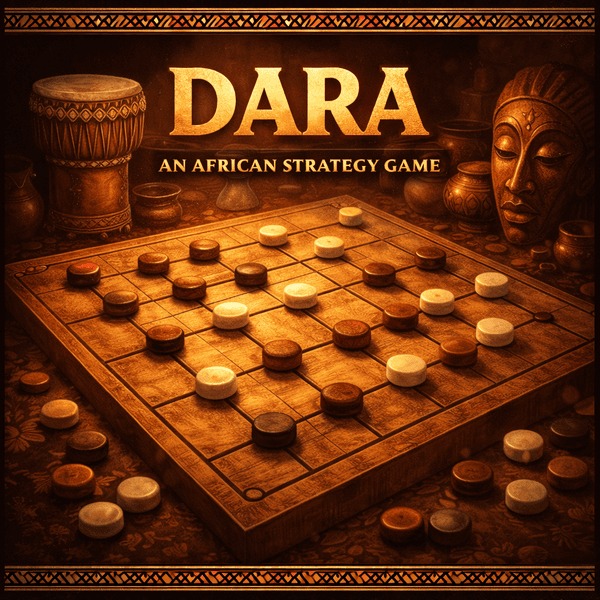
Dara is a traditional strategy board game from the Dakarkari people of Nigeria — a two-phase chess-like game played on a 5×6 grid. First you drop 12 pieces each, then you slide them to form three-in-a-row and capture your opponent. Reduce the other player below three pieces to win.
How to Play
Phase 1 — Drop (24 placements total): 1. Players alternate placing one piece per turn. 2. Each player places 12 pieces on the 5×6 board. 3. You may not form 3-in-a-row during this phase — invalid moves are blocked.
Phase 2 — Move: 1. Slide one of your pieces to an adjacent empty square (up/down/left/right — no diagonals). 2. Form exactly 3 of your pieces in a row to capture an opponent piece. 3. 4-in-a-row does NOT count — it must be exactly 3. 4. Pieces already in a 3-in-a-row are protected and cannot be captured (unless all opponent pieces are protected). 5. First to reduce the opponent below 3 pieces OR trap them without legal moves wins.
Core Rules
- 5×6 board, 30 squares
- 12 pieces each, 24 total in play
- Drop phase forbids 3-in-a-row
- Move phase captures only on exactly 3
- Orthogonal moves only (no diagonals)
- No jumping
- Protected pieces (already in 3-in-a-row) are immune to capture
Strategy
- Drop phase is half the game. Set up partial lines (2-in-a-row with open ends) that you can complete in the move phase.
- Centre is king — central cells have more neighbours and line-forming potential.
- Build multiple threats — if you can threaten two 3-in-a-rows at once, the opponent can only block one.
- Don't over-extend. Once a line becomes 4+, it's wasted material that can't be used to capture.
- Protect high-value pieces by keeping them in 3-in-a-row formations.
Practical Tips
- The AI is aggressive — it rewards forming lines at 100 points per 3-in-a-row and blocks your threats.
- Pulse indicators show valid move targets during the move phase.
- Red pulse marks capturable opponent pieces after you form 3-in-a-row.
- Gold glow marks your own 3-in-a-row — those pieces are now protected.
FAQ
Where does Dara come from?
Dara is traditional to the Dakarkari people of northern Nigeria. Similar games are played across West Africa under different names.
Why doesn't 4-in-a-row count?
Classic Dara rules reward exactly 3-in-a-row for captures. A line of 4+ is wasted material — it doesn't trigger a capture. This is a core strategic constraint of the game.
Can I capture any opponent piece?
Only unprotected ones. A piece that is already part of a 3-in-a-row is protected. Exception: if ALL opponent pieces are in 3-in-a-rows, all become capturable.
How do I win?
Reduce your opponent below 3 pieces, OR trap them so they have no legal moves.
Is there a time limit?
No — Dara is turn-based with no clock. Take your time, especially in the drop phase where your setup decides the game.
Related Games




Ready to play Dara?
Launch the free demo, learn the flow, and practice your tactics.