Pente on Arcadia
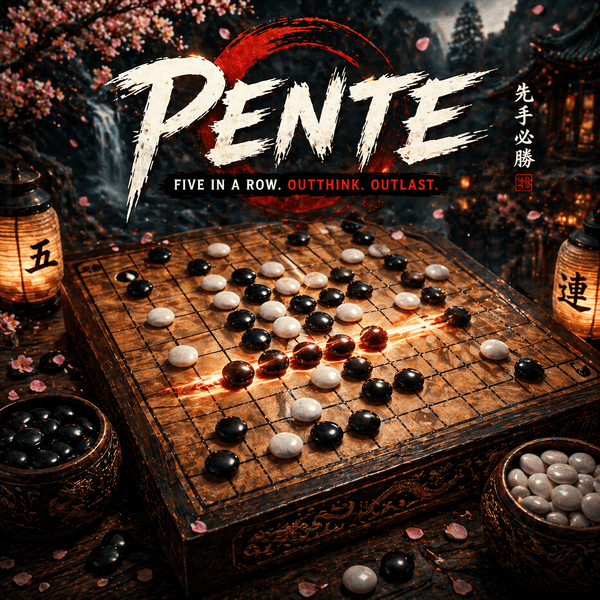
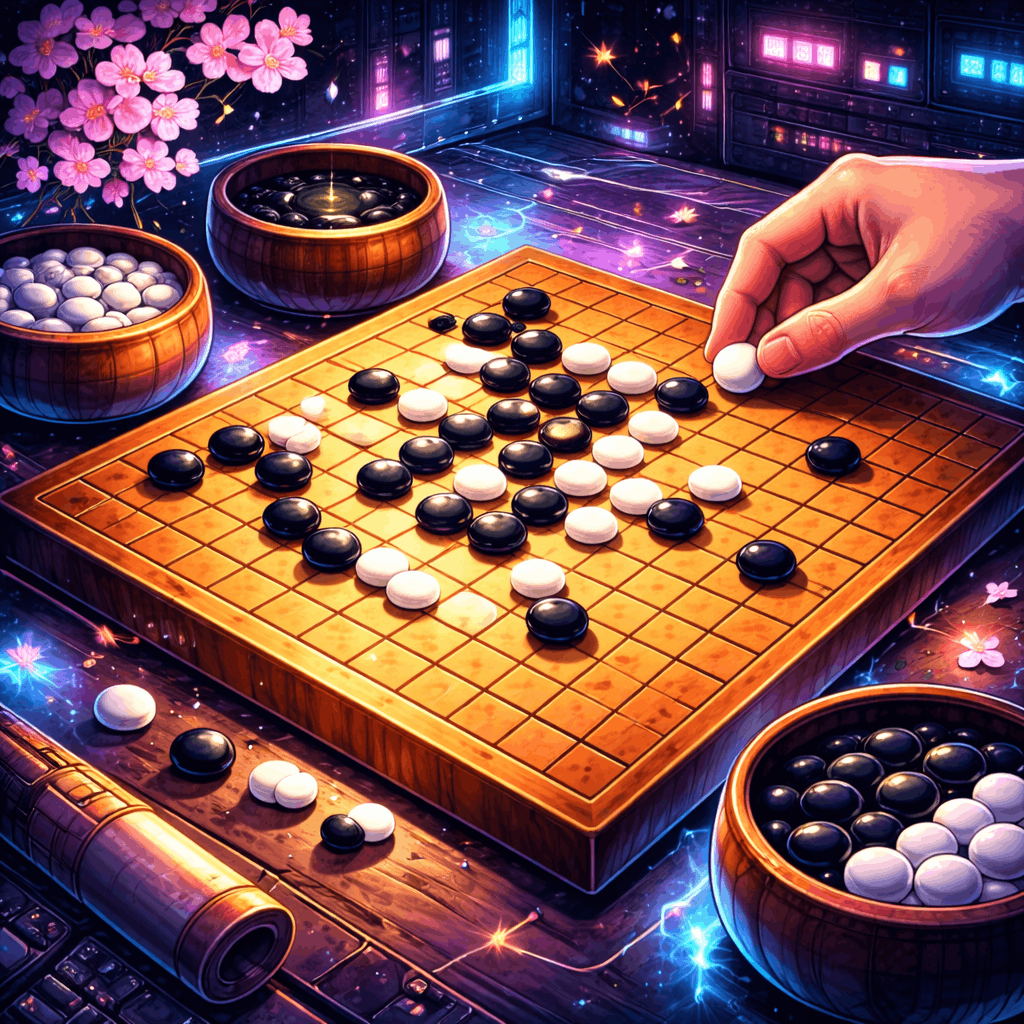
Pente is a modern abstract strategy game invented in 1977 by Gary Gabrel. It plays on a Go-style 19×19 intersection board but adds a sharp twist to five-in-a-row: flanking captures. Place stones on the grid and race to either connect five-in-a-row OR capture five pairs of your opponent — whichever comes first.
How to Play
- Center start — the very first stone of the game must be placed on the centre point of the board.
- Alternate turns — players take turns placing one stone on any empty intersection.
- Capture by flanking — if you place a stone so that exactly two opponent stones are sandwiched between two of yours along a straight line, those two stones are captured and removed.
- Win condition A — connect five (or more) stones in an unbroken row horizontally, vertically, or diagonally.
- Win condition B — capture five pairs (ten stones total) of your opponent's stones.
- Self-flanking is safe — you cannot be captured by voluntarily moving into a flanked position; captures trigger only when the capturing stone is actively placed.
Core Rules
- 19×19 intersection board, like Go
- The first stone must be placed on the centre point
- Stones never move once placed (until captured)
- Captures require exactly 2 opponent stones flanked by 2 of yours — not 1, not 3
- Captures can chain in different directions from a single placement
- 5+ in a row wins immediately
- 5 captured pairs wins immediately
- No suicide rule, no ko rule (this is not Go)
Strategy
- Pairs are vulnerable. Two adjacent stones with both flanks open are a free capture for your opponent. Avoid creating them unless forced.
- Open threes are deadly. Three in a row with both ends open guarantees a four-in-a-row next turn — opponents must block immediately, giving you tempo.
- Captures vs. lines. Sometimes a quick capture is worth more than extending a row — five pairs is its own win condition.
- Don't overextend. A line of four is strong but its endpoints are obvious targets. Combine threats so the opponent can't block both.
- Watch for double threats. A move that creates two open threes simultaneously is usually winning.
Practical Tips
- The first move is fixed — only the centre point is legal at move 1, for both player and AI.
- Hover ghosts show you exactly where your stone will land before you commit.
- The pip indicators at the top of the screen track captured pairs (5 to win) for each side.
- The gold dot on the most recent stone marks the last move — useful when you lose track in a busy position.
- The AI prioritises immediate wins, blocking immediate threats, then heuristic line strength + capture potential.
FAQ
How is Pente different from Gomoku or Go?
Pente shares the 19×19 grid with Go and the five-in-a-row goal with Gomoku, but adds sandwich captures: flank exactly two opponent stones to remove them. This single rule transforms the strategic landscape — pairs become liabilities and capture-only wins become a real possibility.
Why must the first move be on the centre?
It's a balancing rule from the original 1977 design. The centre is the most powerful starting point, so requiring it removes opening-theory complexity. After move 1, both players are free to play anywhere empty.
Can I capture three or more stones in a single direction?
No — captures require exactly two opponent stones between yours. Three or more flanked stones are not captured. This is a deliberate constraint that makes pair management central to the game.
How do I avoid being captured?
Never let two of your stones sit adjacent with both flanks open. If you must form a pair, ensure at least one flank is blocked (by your own stone, an opponent stone, or the board edge).
Is there a draw in Pente?
Theoretically possible if the board fills up with no five-in-a-row and neither side has captured five pairs, but extremely rare in practice. With 361 intersections and active capture mechanics, games almost always resolve well before the board is full.
Related Games

Ready to play Pente?
Launch the free demo, learn the flow, and practice your tactics.