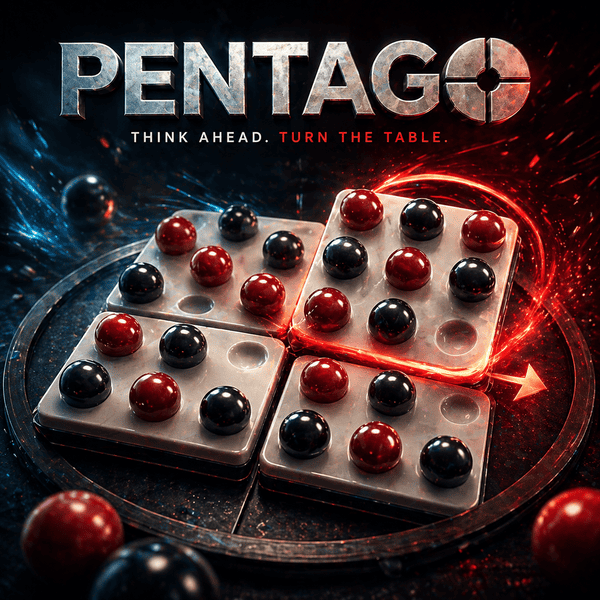
Pentago on Arcadia
Pentago is a modern abstract strategy game invented in Sweden in 2005 — five-in-a-row meets a rotating board. Two players take turns on a 6×6 grid divided into four independent 3×3 quadrants. Every turn has two parts: place a marble, then twist any one quadrant 90°. The rotation is your weapon and your risk — it can complete a line of five or scatter your opponent's near-victory.
How to Play
- Place one marble of your color on any empty square of the 6×6 board.
- Rotate any one of the four 3×3 quadrants 90° — clockwise or counterclockwise. You must rotate, even if it hurts you.
- The board state is only judged after the rotation, so the spin can make or break the game.
- First to align five marbles in a row — horizontal, vertical, or diagonal — wins.
- If a single rotation produces five-in-a-row for both sides at once, the game is a draw. A full board with no line is also a draw.
Core Rules
- 6×6 board, four 3×3 quadrants that rotate independently
- 36 marbles total in play (18 per side)
- Each turn = 1 placement + 1 mandatory rotation
- Win check happens after rotation, not after placement
- Five-in-a-row in any direction (horizontal, vertical, diagonal) wins
- Simultaneous five-in-a-row for both players is a draw
- Full board with no five-in-a-row is a draw
Strategy
- Think two ahead — placement and rotation are one unit. Always evaluate them together.
- Watch all four quadrants. A threat that looks safe can become a winning line after a single twist.
- Center cells (rows 2–3, cols 2–3) are powerful — they participate in the most lines and are stable across rotations.
- Don't rotate into a loss. A bad rotation can hand your opponent five-in-a-row. When forced, prefer rotations that scatter rather than build.
- Build double threats. Setting up two potential lines that share a rotation is the classic Pentago fork — your opponent can only block one.
- Diagonal threats are sneakiest — they cross multiple quadrants and shift dramatically with each spin.
Practical Tips
- The AI weights immediate wins and blocks at top priority — it will punish careless rotations.
- Gold-bordered quadrants during your rotate phase show what you can spin. Tap one of the two arrow buttons attached to that corner.
- The last placed marble has a brief animation — useful for tracking the AI's move.
- A gold glow on five marbles signals the winning line at game end.
FAQ
When was Pentago invented?
Pentago is a modern abstract strategy game designed by Tomas Flodén and published by Mindtwister in Sweden in 2005. It has since won numerous game-design awards.
Do I have to rotate every turn?
Yes — rotation is mandatory. You cannot pass on the rotation, even if every available rotation hurts your position. That tension is what makes Pentago interesting.
What happens if I make five in a row by placing, before rotating?
You still must rotate. The win is only awarded after the rotation. If your rotation breaks the line you just made, the line is no longer a win.
What if a rotation makes five-in-a-row for both sides at once?
The game is a draw. Pentago does not give priority to the player who rotated — simultaneous lines split the game.
Is Pentago solved?
Yes — Pentago was weakly solved in 2014 by computer analysis: with perfect play, the first player (Crimson) wins. In casual human play it remains highly competitive and tense.


Ready to play Pentago?
Launch the free demo, learn the flow, and practice your tactics.