Fox and Hounds - Rules, History & Strategy Guide
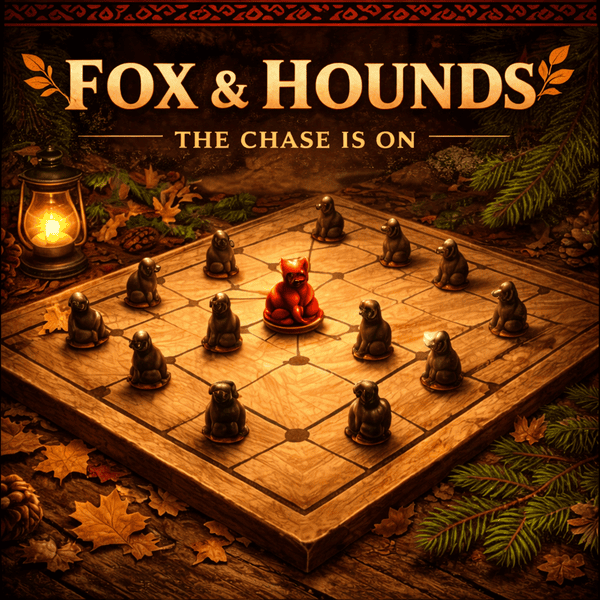
Fox and Hounds is an asymmetric two-player chase game on the dark squares of a chessboard. One player moves a lone fox diagonally in any direction; the other advances four hounds that can only move forward. The fox tries to slip past; the hounds try to trap it. Games take five to ten minutes.
Reviewed & updated
History & Origins
Fox and Hounds (also called Fox and Geese) has been played in northern Europe for at least 300 years, with references in 18th-century English game collections. Versions appear under names like "The Devil and the Tailors" and "Wolf and Sheep" across the continent.
Despite its simplicity, Fox and Hounds is a solved game: with optimal play, the Hounds always win. Studying it teaches the core ideas behind asymmetric pursuit games and zugzwang.
How to Play
One player controls a single Fox starting on the back row. The other controls four Hounds starting on the opposite back row. Pieces move one diagonal square per turn on dark squares only.
- Hounds move first. Each turn, move one Hound diagonally forward by one square (toward the Fox).
- On the Fox's turn, move the Fox diagonally one square — forward OR backward.
- No captures, no jumps. Pieces cannot share a square.
- The Fox wins by reaching the back rank where the Hounds started, OR by escaping past the Hounds line so they cannot catch it.
- The Hounds win by trapping the Fox so it has no legal move.
Strategy Tips
Despite the Fox's diagonal-backward freedom, optimal Hound play wins every time — but only if the Hounds advance as a coordinated wall.
- Hounds: never break the line. Advance the rear Hound first to keep the formation tight; a gap is what the Fox needs to slip through.
- Fox: probe each side aggressively to force the Hounds to commit, then pivot to the weaker flank.
- Hounds: when the Fox retreats, advance — never let it gain tempo without paying for it.
- Both sides: count squares between the Fox and the back rank constantly. The Fox needs to maintain enough breathing room to maneuver.
Variations
Some variants use five Hounds (easier for Hounds), or allow the Fox to capture by jumping (closer to checkers). The "Wolf and Goats" variant uses 12 sheep on a smaller board with similar dynamics.
Play Fox and Hounds on Arcadia
Play Fox and Hounds on Arcadia to feel the tension of an asymmetric game where one good move per side decides the whole match.
Quick Answers
Can the Fox win at Fox and Hounds with perfect play?
No. The game is solved — with optimal play, the four Hounds always win. The Fox wins only when the Hounds make a positional error and break formation.
Why can the Fox move backward?
The asymmetry is the whole point. The Fox's freedom to retreat is what gives it any chance against four pieces; Hounds trade mobility for numerical advantage.
Can I play Fox and Hounds online for free?
Yes. Arcadia offers free Fox and Hounds with AI that plays both sides correctly — try the Fox first to see how hard escape really is.
What board do you need for Fox and Hounds?
A standard 8×8 chessboard or draughts board works: all five pieces live on the dark squares only, so the game really happens on a 32-square diagonal grid. The four hounds start on one back rank and the fox starts on the opposite side.
Do the hounds capture the fox in Fox and Hounds?
No — there are no captures or jumps at all. The hounds win by immobilising the fox: surrounding it so that it has no legal diagonal move left. That makes the game a pure blockade race rather than a fight.
Is Fox and Hounds the same as Fox and Geese?
The names are often used interchangeably, but the traditional Fox and Geese is a different game played on a cross-shaped board where the fox captures geese by jumping over them. The chessboard version described here has no captures and is also known as Wolf and Sheep or The Devil and the Tailors.
Who moves first in Fox and Hounds?
The hounds move first, advancing one hound diagonally forward per turn. The opening matters because the game is essentially a battle of tempo: the hound wall only holds if it advances without ever wasting a move, and the first move sets that rhythm.
How does the fox actually win a game?
The fox wins by breaking through — either slipping past the hounds so they can no longer trap it or reaching the rank where they started. In practice that means probing one flank to draw hounds forward, then doubling back through the gap they leave. Against precise hound play no gap ever appears, which is why the fox is the harder side to master.
What is zugzwang in Fox and Hounds?
Zugzwang means being forced to move when every move worsens your position, and it decides most Fox and Hounds games. Because the hounds can never retreat, a single wasted advance can leave one hound stranded; the fox, which can move backward, uses waiting moves to hand the awkward turn back. Learning to count tempo here transfers directly to checkers endgames.
How long does a game of Fox and Hounds take?
Games are short — typically five to ten minutes, since the board is small and each side moves one piece one square per turn. The result usually crystallises in the midgame, the moment the hound line either holds or breaks.
Is Fox and Hounds a good game for beginners and kids?
Yes — the rules fit in a sentence, yet the game quietly teaches diagonal movement, formation play, and tempo, which are foundations for checkers and chess. Taking the fox against Arcadia’s free browser AI is a quick way to appreciate how disciplined the hounds must stay, with no download or account needed.

MAIN MENU
PvP Games
 Battleship
 Crazy Eights
 Dots & Boxes Blitz
 Gomoku
 Ludo
Ludo Quoridor
 Snakes & Ladders
 Yahtzee
Free Games
 Alquerque
 Backgammon
 Bagh-Chal
 Balut
Balut Battle for TokyoBattleship
 Bingo
Bingo Brick Breaker
 Bridge
 Bunco
Bunco Checkers
 Chess
Chess ChompCrazy Eights
 Cribbage
 Dara
Dara Derby Dash
 DominoesDots & Boxes Blitz
 Durak
Durak Emberdeep
 Fanorona
 Farkle
 Fox and GeeseFox and Hounds
 Generala
 Gin Rummy
 Go / WeiqiGomoku
 Hazard
 Hex
Hex Higher or Lower
 Hnefatafl
 Hounds and Jackals
 Indian Rummy
 Jungle
 Ludus Latrunculorum
 Liar's DiceLudo
 Mahjong Solitaire
 Mancala
 Minesweeper
 Nim
Nim Nine Men's Morris
 Onitama
 Patolli
 Peg Solitaire
 Pentago
 Pente
Pente Pig
Pig PylosQuoridor
 Reversi
 Royal Game of Ur
 Scratch Cards
 Seega
Seega Senet
Senet Shax
Shax Ship, Captain, Crew
 Shut the Box
 Sixteen Soldiers
 SnakeSnakes & Ladders
 Klondike Solitaire
 Space Blaster
 Spades
 Sugar Pop
 Sungka
 Tangram
 Tile Rummy
 Tower
Tower Truco
Truco War
War Word Spy
 XII ScriptaYahtzee
NEED HELP?