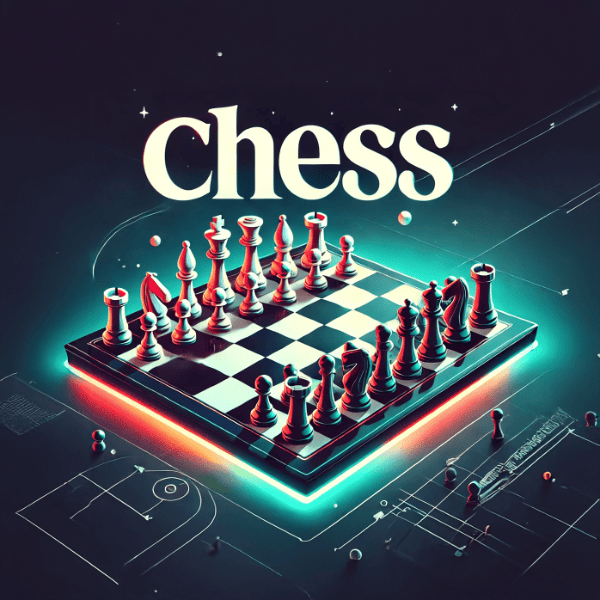
Chess - Rules, History & Strategy Guide
Chess is a two-player strategy game played on an 8×8 board with sixteen pieces per side. Players alternate moves, each piece moving in its own way, with the goal of checkmating the enemy king — attacking it so it cannot escape. Casual games run ten to thirty minutes; classical games last hours.
Reviewed & updated
History & Origins
Chess evolved from earlier strategy games such as chaturanga and shatranj before becoming the modern royal game recognized across the world. Over centuries it grew into both a cultural symbol and a competitive discipline, with huge opening theory and legendary championship rivalries.
Even with that depth, the appeal is simple: every piece moves differently, every move matters, and every position contains a story about attack, defense, and time.
How to Play
The objective of chess is to checkmate the enemy king, meaning the king is under attack and has no legal escape.
- Set up the pieces in the standard starting position with queens on their own color.
- White moves first, then players alternate one move at a time.
- Use each piece according to its movement rules while respecting checks on your king.
- Special rules include castling, en passant, and pawn promotion.
- You win by checkmate, though games can also end in resignation, stalemate, or other drawn results.
Strategy Tips
Most early improvement in chess comes from respecting simple principles before chasing flashy tactics.
- Fight for the center so your pieces gain more activity.
- Develop minor pieces early and avoid wasting tempo with repeated queen moves.
- Castle when the position allows so your king is safer and your rook joins the game.
- Before every move, ask what your opponent threatens if you do nothing.
Variations
Rapid, blitz, bullet, Chess960, and puzzle formats all change the experience. Arcadia players often benefit from standard time controls first because they make calculation and board awareness easier to build.
Play Chess on Arcadia
Play Chess on Arcadia to put these rules and ideas into practice right away.
Quick Answers
What is checkmate?
Checkmate is a position where the king is in check and there is no legal move to escape the attack.
Should beginners memorize opening lines?
Not deeply at first. Beginners improve faster by learning opening principles, tactics, and endgame basics before memorizing long theory.
Why is castling important?
Castling usually makes the king safer and helps activate a rook, which improves coordination for the middlegame.
How long does a game of chess take?
A typical game runs around 40 moves and, at casual pace, ten to thirty minutes. Timed formats set the range explicitly: bullet games finish inside a few minutes, blitz in roughly ten, rapid within the hour, and classical tournament games can last four hours or more.
What is stalemate in chess?
Stalemate occurs when the player to move has no legal move and their king is not in check — the game is immediately drawn. It differs from checkmate precisely because the king is not attacked, and rescuing a lost position by engineering stalemate is a classic defensive resource.
Is chess a game of luck or skill?
Chess is pure skill: both players see the whole board, there are no dice or hidden cards, and the same position always offers the same possibilities. That is why rating systems such as Elo predict results so reliably — a 200-point rating gap corresponds to the stronger player scoring roughly 76% of the points.
How many possible chess games are there?
The game-tree estimate known as the Shannon number puts the count of possible chess games at around 10^120, proposed by Claude Shannon in 1950. Distinct legal positions are far fewer but still astronomical — computed in 2021 to be roughly 4.8 × 10^44 — which is why chess remains unsolved.
What is en passant in chess?
En passant lets a pawn capture an enemy pawn that has just advanced two squares past it, taking it as though it had moved only one square. The right exists only on the move immediately following the two-square advance — wait a turn and it is gone for good.
Does White have an advantage in chess?
A small but persistent one, thanks to moving first. In large databases of master games White scores roughly 54 to 56% of the available points, counting draws as half. The edge matters at elite level but is dwarfed at club level by differences in playing strength.
How old is chess?
About 1,500 years. Chess descends from chaturanga, played in India by the 6th century AD, which travelled through Persia as shatranj into the medieval world. The modern rules arrived in Europe in the late 15th century, when the queen and bishop received their powerful modern moves and the game accelerated dramatically.
Can you play chess online for free?
Yes. Chess is free to play on Arcadia in your browser against an AI opponent, with no download or account required. Playing full games against the computer, then reviewing the moments where material changed hands, is one of the fastest practical ways to improve.
Related Games On Arcadia
Related Guides

MAIN MENU
PvP Games
 Battleship
 Crazy Eights
 Dots & Boxes Blitz
 Gomoku
 Ludo
Ludo Quoridor
 Snakes & Ladders
 Yahtzee
Free Games
 Alquerque
 Backgammon
 Bagh-Chal
 Balut
Balut Battle for TokyoBattleship
 Bingo
Bingo Brick Breaker
 Bridge
 Bunco
Bunco Callbreak
 CheckersChess
 ChompCrazy Eights
 Cribbage
 Dara
Dara Derby Dash
 DominoesDots & Boxes Blitz
 Durak
Durak Emberdeep
 Euchre
 Fanorona
 Farkle
 Fox and Geese
 Fox and Hounds
 Generala
 Gin Rummy
 Go / WeiqiGomoku
 Hazard
 Hearts
 Hex
Hex Higher or Lower
 Hnefatafl
 Hounds and Jackals
 Indian Rummy
 Jungle
 Ludus Latrunculorum
 Liar's DiceLudo
 Mahjong Solitaire
 Mancala
 Minesweeper
 Nim
Nim Nine Men's Morris
 Onitama
 Patolli
 Peg Solitaire
 Pentago
 Pente
Pente Pig
Pig PylosQuoridor
 Reversi
 Royal Game of Ur
 Scratch Cards
 Seega
Seega Senet
Senet Shax
Shax Ship, Captain, Crew
 Shut the Box
 Sixteen Soldiers
 SnakeSnakes & Ladders
 Klondike Solitaire
 Space Blaster
 Spades
 Sugar Pop
 Sungka
 Tangram
 Tile Rummy
 Tower
Tower Truco
Truco War
War Word Spy
 XII ScriptaYahtzee
NEED HELP?