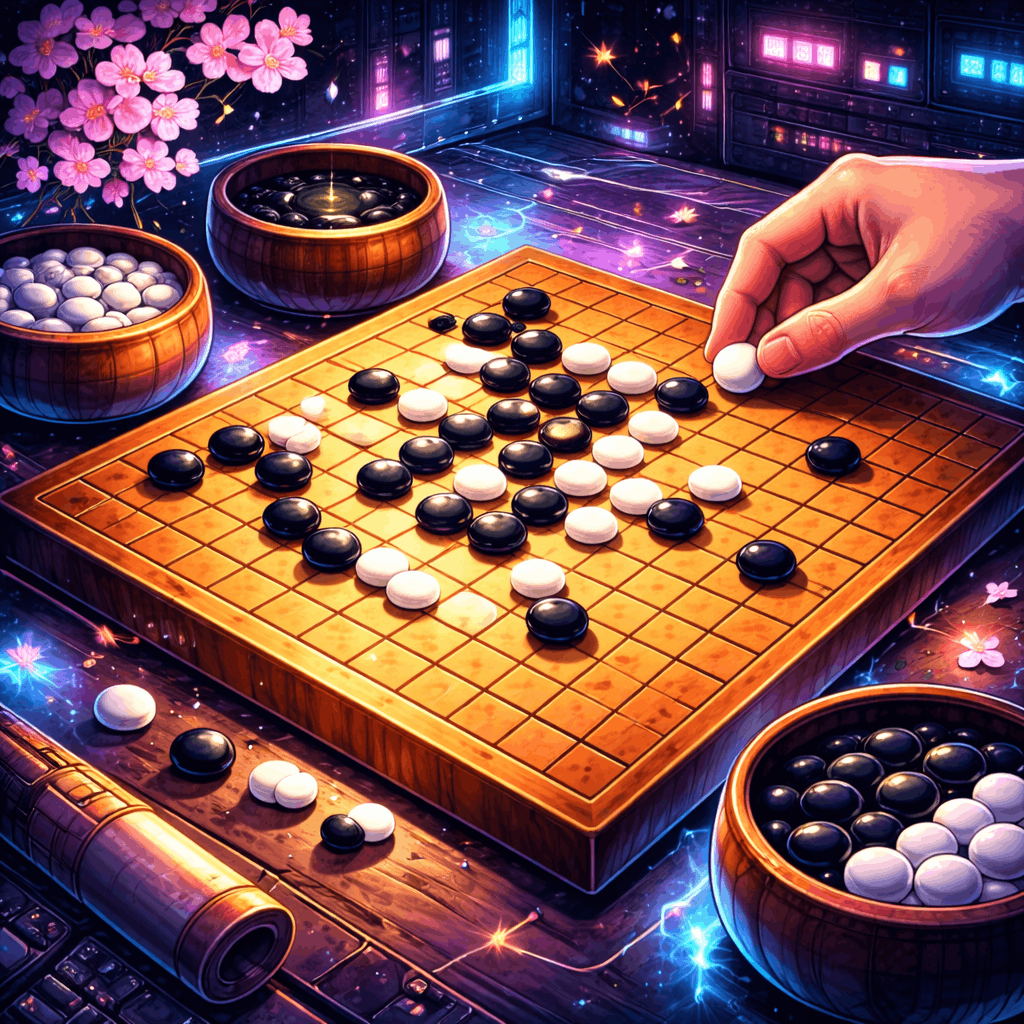
Go / Weiqi - Rules, History & Strategy Guide
Go is a two-player territory game from ancient China, played by placing black and white stones on the intersections of a grid, 19×19 at full size. You surround empty territory and capture enemy groups that run out of liberties, and the larger total wins. Casual games take roughly 20–90 minutes depending on board size.
Reviewed & updated
History & Origins
Go is one of the oldest continuously played board games in the world and is deeply tied to East Asian strategic culture. Its rules are famously small, but the strategic landscape they create is immense.
What keeps Go unique is how naturally local fights connect to global balance. Every stone can be both a tactical move and a statement about long-term territory.
How to Play
Players alternate placing stones on intersections to surround territory and capture opposing groups that run out of liberties.
- Place one stone on an empty intersection on your turn.
- Connected stones form groups that share liberties.
- If an opposing group loses all liberties, it is captured and removed.
- Players may pass when they believe the major fights are settled.
- Score is based on territory plus captures according to the rule set in use.
Strategy Tips
- Think in terms of influence and shape, not just immediate captures.
- Do not start too many weak groups at once.
- A solid connection is often better than a flashy cut that cannot be supported.
- Global balance matters: a profitable local move can still be wrong if another area is urgent.
Variations
Board size, handicap stones, and the differences between Japanese and Chinese scoring all affect the feel of the game. Smaller boards are excellent training tools because they make fight timing easier to grasp.
Play Go / Weiqi on Arcadia
Play Go / Weiqi on Arcadia to put these rules and ideas into practice right away.
Quick Answers
What is a liberty in Go?
A liberty is an empty adjacent point connected to a stone or group. Groups without liberties are captured.
Is Go harder than Chess?
They are difficult in different ways. Go has simpler rules but extremely deep positional judgment and large-scale planning.
Why do Go players talk about shape?
Shape describes how efficiently stones connect, defend themselves, and influence the board.
How long does a game of Go take?
A casual 19×19 game usually takes 45–90 minutes, while serious tournament games can run for several hours. On a 9×9 board a game takes about 10–15 minutes, which is why small boards are recommended for learning. Online games with clocks can be far faster still.
Is Go a game of luck or skill?
Go is pure skill: there are no dice and no hidden information, and both players see the whole board at all times. Player strength is measured on a ladder of kyu and dan grades, and even a single grade of difference is usually decisive over a handful of games.
What is komi in Go?
Komi is a fixed number of points added to White’s score to compensate for moving second. Modern Japanese rules typically use 6.5 points and Chinese rules 7.5; the half point also guarantees the game cannot end in a tie.
Has a computer ever beaten a professional Go player?
Yes. DeepMind’s AlphaGo beat the European champion Fan Hui 5–0 in October 2015, the first win by a program against a professional on a full board without handicap, and then defeated the world-class player Lee Sedol 4–1 in March 2016. Before those matches, the best programs were still several stones weaker than professionals.
What board size should a beginner start with?
Start on 9×9 to learn capturing and life-and-death, move to 13×13 for opening ideas, then graduate to the full 19×19 board with its 361 intersections. The full board is enormous: it allows roughly 2.1 × 10^170 legal positions, far more than the number of atoms in the observable universe.
How old is Go?
Go originated in China at least 2,500 years ago and is often described as the oldest board game still played in its original form. It is mentioned in the Analects of Confucius, and it spread to Korea and Japan well over a thousand years ago.
How do handicap stones work in Go?
The weaker player places two to nine black stones on the marked star points before White’s first move, roughly one stone for each grade of difference between the players. Handicaps let mismatched players contest a meaningful game, which is one reason Go clubs mix strengths so freely.
Can you play Go online for free?
Yes. Arcadia offers free Go in your browser against an AI opponent, with no download or account required. Playing against a computer is a low-pressure way to practise counting liberties and spotting weak groups before facing human opponents.

MAIN MENU
PvP Games
 Battleship
 Crazy Eights
 Dots & Boxes Blitz
 Gomoku
 Ludo
Ludo Quoridor
 Snakes & Ladders
 Yahtzee
Free Games
 Alquerque
 Backgammon
 Bagh-Chal
 Balut
Balut Battle for TokyoBattleship
 Bingo
Bingo Brick Breaker
 Bridge
 Bunco
Bunco Callbreak
 Checkers
 Chess
Chess ChompCrazy Eights
 Cribbage
 Dara
Dara Derby Dash
 DominoesDots & Boxes Blitz
 Durak
Durak Emberdeep
 Euchre
 Fanorona
 Farkle
 Fox and Geese
 Fox and Hounds
 Generala
 Gin RummyGo / WeiqiGomoku
 Hazard
 Hearts
 Hex
Hex Higher or Lower
 Hnefatafl
 Hounds and Jackals
 Indian Rummy
 Jungle
 Ludus Latrunculorum
 Liar's DiceLudo
 Mahjong Solitaire
 Mancala
 Minesweeper
 Nim
Nim Nine Men's Morris
 Onitama
 Patolli
 Peg Solitaire
 Pentago
 Pente
Pente Pig
Pig PylosQuoridor
 Reversi
 Royal Game of Ur
 Scratch Cards
 Seega
Seega Senet
Senet Shax
Shax Ship, Captain, Crew
 Shut the Box
 Sixteen Soldiers
 SnakeSnakes & Ladders
 Klondike Solitaire
 Space Blaster
 Spades
 Sugar Pop
 Sungka
 Tangram
 Tile Rummy
 Tower
Tower Truco
Truco War
War Word Spy
 XII ScriptaYahtzee
NEED HELP?