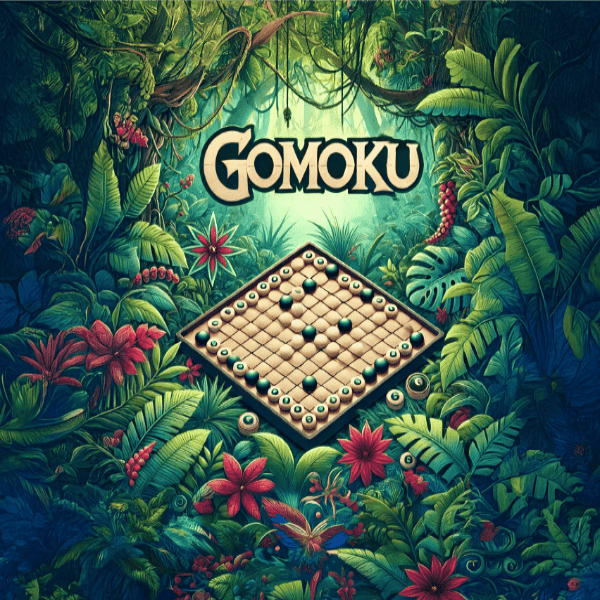
Gomoku - Rules, History & Strategy Guide
Gomoku is a two-player abstract strategy game in which players take turns placing stones on a grid, racing to make an unbroken line of five horizontally, vertically, or diagonally. There is no capturing and no luck — the whole game is threat and reply. Most games finish in five to fifteen minutes.
Reviewed & updated
History & Origins
Gomoku descends from old connection games and is especially associated with East Asian abstract strategy traditions. The objective looks simple, but threat sequencing gives it a sharp tactical identity.
That identity is why Gomoku is so replayable. Every move changes both your own lines and your opponent's urgent defensive duties.
How to Play
Players alternate placing stones on intersections, trying to become the first to make an unbroken line of five.
- Choose an open intersection and place one stone each turn.
- Build horizontal, vertical, or diagonal lines of five.
- Watch for open-ended threats that force a defensive reply.
- Block the opponent's dangerous lines before they become unstoppable.
- The first player to complete five in a row wins.
Strategy Tips
- Open-ended fours and double-threes often create forcing sequences.
- Do not chase a slow attack when the opponent already has a stronger threat.
- Central control usually offers more branching potential than edge play.
- Think one move ahead in terms of threat hierarchy: what forces, what threatens, and what merely hopes.
Variations
Some competitive rulesets add opening restrictions or ban certain black patterns to reduce first-player advantage. Those tournament refinements matter a lot at stronger levels.
Play Gomoku on Arcadia
Play Gomoku on Arcadia to put these rules and ideas into practice right away.
Quick Answers
How do you win Gomoku?
You win by creating an uninterrupted line of five stones horizontally, vertically, or diagonally.
Is defense important in Gomoku?
Absolutely. Many games are decided by whether a player recognizes and answers the opponent's forcing threat in time.
Why is the center strong in Gomoku?
The center gives your lines more room to branch in multiple directions, which makes future threats more flexible.
Is Gomoku a solved game?
Yes — in 1993 Victor Allis proved that the first player wins free-style Gomoku on a 15×15 board with perfect play. That result is why serious tournaments add opening restrictions or swap protocols rather than letting the first player simply cash in the built-in advantage.
What is the difference between Gomoku and Renju?
Renju is the balanced tournament version of Gomoku, played on a 15×15 board. It restricts Black, the first player, by forbidding double-threes, double-fours, and overlines, while White may use all of them; free-style Gomoku has no such restrictions.
Does six in a row win in Gomoku?
It depends on the rule set. In free-style Gomoku any line of five or more wins, while standard Gomoku and Renju require exactly five, so a line of six — called an overline — does not count. Check which rule is in force before relying on an overline to finish a game.
What does the word Gomoku mean?
Gomoku is Japanese for “five points”, short for gomoku narabe, “five points in a row”. The same game is known as wuziqi in China, omok in Korea, and simply Five in a Row across much of the West.
What is a double three in Gomoku?
A double three is a single move that creates two open-ended rows of three at once. Because each open three threatens to become an unstoppable open four, the defender can usually block only one of them, which makes double threes a classic winning device — and the reason Renju bans them for Black.
How long does a game of Gomoku take?
Most casual games are over in five to fifteen minutes, far faster than Go on the same board. Decisive attacks often land within the first 20–30 moves, so a single session usually fits several games.
Is Gomoku a game of luck or skill?
Gomoku is entirely skill: both players see everything and nothing is random. Games between mismatched players are extremely one-sided, because recognising threat sequences one move earlier than your opponent is usually enough to win outright.
Can you play Gomoku online for free?
Yes. Arcadia offers free Gomoku in your browser against an AI opponent, with no download or account required. Practising against a computer is a quick way to learn to spot open threes and forcing sequences before they become unstoppable.
Related Games On Arcadia
Related Guides

MAIN MENU
PvP Games
 Battleship
 Crazy Eights
 Dots & Boxes BlitzGomoku
 Ludo
Ludo Quoridor
 Snakes & Ladders
 Yahtzee
Free Games
 Alquerque
 Backgammon
 Bagh-Chal
 Balut
Balut Battle for TokyoBattleship
 Bingo
Bingo Brick Breaker
 Bridge
 Bunco
Bunco Callbreak
 Checkers
 Chess
Chess ChompCrazy Eights
 Cribbage
 Dara
Dara Derby Dash
 DominoesDots & Boxes Blitz
 Durak
Durak Emberdeep
 Euchre
 Fanorona
 Farkle
 Fox and Geese
 Fox and Hounds
 Generala
 Gin Rummy
 Go / WeiqiGomoku
 Hazard
 Hearts
 Hex
Hex Higher or Lower
 Hnefatafl
 Hounds and Jackals
 Indian Rummy
 Jungle
 Ludus Latrunculorum
 Liar's DiceLudo
 Mahjong Solitaire
 Mancala
 Minesweeper
 Nim
Nim Nine Men's Morris
 Onitama
 Patolli
 Peg Solitaire
 Pentago
 Pente
Pente Pig
Pig PylosQuoridor
 Reversi
 Royal Game of Ur
 Scratch Cards
 Seega
Seega Senet
Senet Shax
Shax Ship, Captain, Crew
 Shut the Box
 Sixteen Soldiers
 SnakeSnakes & Ladders
 Klondike Solitaire
 Space Blaster
 Spades
 Sugar Pop
 Sungka
 Tangram
 Tile Rummy
 Tower
Tower Truco
Truco War
War Word Spy
 XII ScriptaYahtzee
NEED HELP?