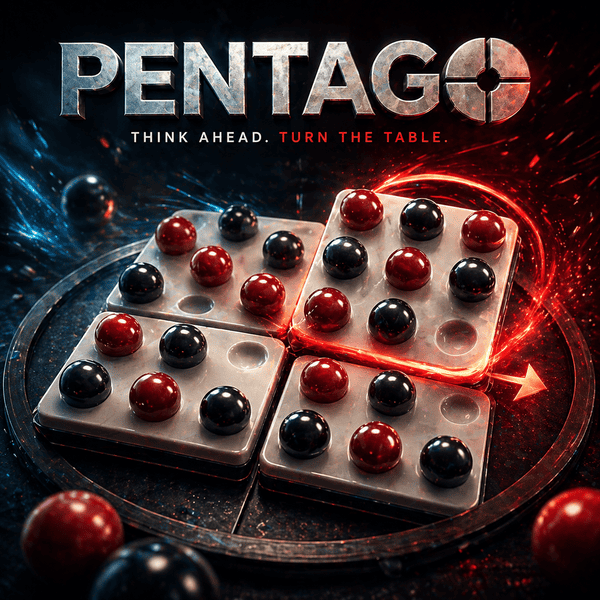
Pentago - Rules, History & Strategy Guide
Pentago is a two-player abstract strategy game on a 6×6 board split into four rotating 3×3 quadrants. Each turn you place a marble, then rotate any quadrant 90 degrees, aiming to line up five marbles in a row. Games are quick, usually finishing within 5 to 15 minutes.
Reviewed & updated
History & Origins
Pentago was designed by Tomas Flodén and published by the Swedish board game company Mindtwister in 2005. It won the Mensa Select award in 2006 and has since become a fixture of the modern abstract strategy genre, sitting alongside Hive, Quoridor, and GIPF as games that take a single elegant mechanic and build a deep tactical space around it.
The Pentago innovation is the forced quadrant rotation — every turn ends with a 90° spin of one 3×3 region of the board. Even your opponent's placements can be scrambled by your rotation, which means the board state never settles. The game was solved (it's a first-player win with perfect play) by Erik van Bekkum in 2014, but at human skill levels Pentago remains genuinely tactical.
How to Play
Pentago is played on a 6×6 board divided into four 3×3 quadrants, each of which can rotate independently. Players alternate placing marbles of their colour and rotating quadrants. First to get five marbles in a row wins.
- On your turn, place one marble of your colour on any empty square.
- Then rotate any one of the four quadrants 90° — clockwise or counterclockwise. You must rotate (no passes), even if it hurts you.
- After the rotation, check for five-in-a-row. If you have five of your colour in any horizontal, vertical, or diagonal line, you win.
- If both players make five-in-a-row from the same rotation, it is a draw.
- If the board fills (36 marbles) with no five-in-a-row, the game is a draw.
Strategy Tips
- The centre of each quadrant doesn't move when you rotate that quadrant — it's the only stable square. Centre squares are gold for permanent threats.
- Plan two moves ahead: every placement is followed by a rotation, so think about what the board looks like AFTER your rotation, not just after your placement.
- Forced double threats win the game. If you can set up two open four-in-a-row lines that no single rotation can block, the win is yours.
- Watch out for "rotation traps" — your opponent might place a marble in a location that becomes a five-in-a-row after the rotation you're about to make.
- The first player has a small inherent advantage. The opening 4-5-6 moves are critical; mistakes there are very hard to recover from.
Variations
Standard Pentago is 6×6 with four 3×3 quadrants. There are 8×8 "Pentago XL" variants with larger quadrants for longer games, and a 4-player team version where two pairs alternate on shared colours. Arcadia's implementation uses the standard 6×6 ruleset.
Play Pentago on Arcadia
Play Pentago on Arcadia to experience the modern abstract that made the Mensa Select hall of fame — every turn is a placement AND a rotation, every line is one spin from victory or chaos.
Quick Answers
Can I skip the rotation in Pentago?
No — the rotation is mandatory. Every turn has two parts: place a marble, then rotate a quadrant 90°. Even if you'd rather not rotate (because the rotation hurts your position), you must.
What happens if both players get five-in-a-row from the same rotation?
It's a draw. Pentago's "simultaneous win" rule treats both players reaching five at the same instant as a tie, even though only one player triggered the rotation.
Is Pentago a solved game?
Yes — Erik van Bekkum solved Pentago in 2014, proving it's a first-player win with perfect play. But the game tree is far too large for any human to memorise, so at human skill levels it remains genuinely tactical and competitive.
Why are the centre squares so important?
When you rotate a quadrant, the centre square of that quadrant doesn't move — only the eight outer squares cycle around it. So a marble on a quadrant centre is permanent for that quadrant, making it the most valuable real estate on the board.
Can I play Pentago online for free?
Yes. Arcadia offers free Pentago against a heuristic AI that scores all 8 possible rotations per candidate placement — no download or account required.
Who invented Pentago?
Pentago was designed by Tomas Flodén and published in 2005 by the Swedish company Mindtwister. It won the Mensa Select award in 2006, joining games like Quoridor on the shortlist of modern abstracts honoured for building real depth from a single clean mechanic.
Is Pentago just tic-tac-toe with extra steps?
No — the rotation changes everything. A tic-tac-toe player only ever faces a few hundred essentially different positions, while computer analysis of Pentago has counted roughly three quadrillion (3 × 10¹⁵) legal positions. Five-in-a-row on a twisting 6×6 board is also simply a harder pattern to see than three-in-a-row on a static grid.
Can you rotate the same quadrant you just placed a marble in?
Yes — you may rotate any of the four quadrants, including the one you just played in, in either direction. That gives eight possible rotations after every placement, and placing a marble into a quadrant specifically so the spin carries it to the right square is a core Pentago tactic.
Does it matter which way you rotate a quadrant in Pentago?
Yes: clockwise and anticlockwise turns produce different boards, since a 90° rotation is not symmetric. The one exception is a quadrant whose contents do not change when turned — an empty quadrant, for example — and rotating one is a recognised way to satisfy the mandatory rotation without disturbing your position.
What happens if the Pentago board fills up with no five-in-a-row?
The game is a draw once all 36 squares are filled without a line of five. Full-board draws are uncommon in practice, because 18 marbles per colour on a 6×6 board leave few ways to avoid a five while the rotations keep reshuffling the quadrants.
How long does a game of Pentago take?
Most games run 5 to 15 minutes, and a single tactical miss can end one inside ten moves. The pace makes it ideal for best-of-three sessions — on Arcadia you can play free in the browser against the AI, with no download, and get through several games in a lunch break.
How do you set up a double threat in Pentago?
Build two separate lines of four that no single rotation can block or break at the same time — usually anchored on quadrant-centre squares, which never move. Because your opponent gets exactly one placement and one rotation to respond, two genuinely independent winning threats cannot both be answered.
Can more than two people play Pentago?
The standard game is strictly two players, but a team variant lets four people play as two pairs sharing colours, and oversized “Pentago XL” boards support longer games. The two-player 6×6 version remains the definitive form and the one used for competitive play.

MAIN MENU
PvP Games
 Battleship
 Crazy Eights
 Dots & Boxes Blitz
 Gomoku
 Ludo
Ludo Quoridor
 Snakes & Ladders
 Yahtzee
Free Games
 Alquerque
 Backgammon
 Bagh-Chal
 Balut
Balut Battle for TokyoBattleship
 Bingo
Bingo Brick Breaker
 Bridge
 Bunco
Bunco Callbreak
 Checkers
 Chess
Chess ChompCrazy Eights
 Cribbage
 Dara
Dara Derby Dash
 DominoesDots & Boxes Blitz
 Durak
Durak Emberdeep
 Euchre
 Fanorona
 Farkle
 Fox and Geese
 Fox and Hounds
 Generala
 Gin Rummy
 Go / WeiqiGomoku
 Hazard
 Hearts
 Hex
Hex Higher or Lower
 Hnefatafl
 Hounds and Jackals
 Indian Rummy
 Jungle
 Ludus Latrunculorum
 Liar's DiceLudo
 Mahjong Solitaire
 Mancala
 Minesweeper
 Nim
Nim Nine Men's Morris
 Onitama
 Patolli
 Peg SolitairePentago
 Pente
Pente Pig
Pig PylosQuoridor
 Reversi
 Royal Game of Ur
 Scratch Cards
 Seega
Seega Senet
Senet Shax
Shax Ship, Captain, Crew
 Shut the Box
 Sixteen Soldiers
 SnakeSnakes & Ladders
 Klondike Solitaire
 Space Blaster
 Spades
 Sugar Pop
 Sungka
 Tangram
 Tile Rummy
 Tower
Tower Truco
Truco War
War Word Spy
 XII ScriptaYahtzee
NEED HELP?