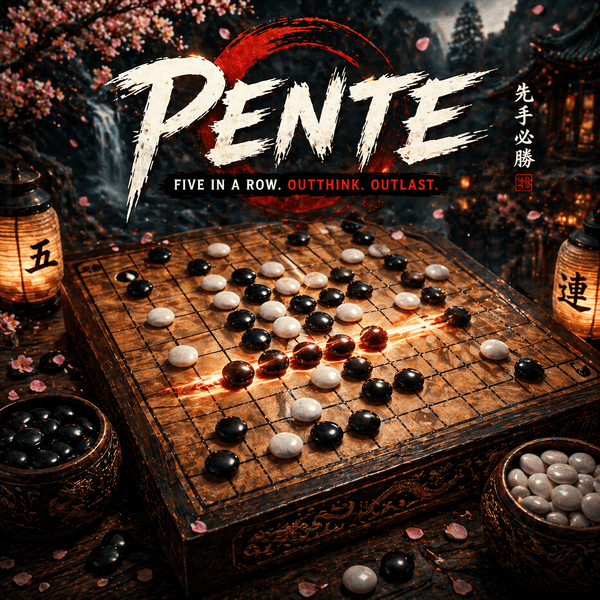
Pente - Rules, History & Strategy Guide
Pente is a two-player abstract strategy game from 1977, played on a 19×19 Go board. Players alternate placing stones, trying to make five in a row or capture five pairs by flanking enemy stones — two ways to win in the same game. A match usually lasts 10 to 30 minutes.
Reviewed & updated
History & Origins
Pente was designed by Gary Gabrel in 1977 in Stillwater, Oklahoma, where he was running a hobby shop. He took the ancient Japanese game of Go-Moku (five-in-a-row) and added a single rule — the pair-capture mechanic — that turned a relatively simple alignment game into a deep strategy contest. Pente was published commercially by Parker Brothers in 1982 and became a cultural fixture of 1980s American game shelves.
The capture rule changes everything. Pure Gomoku has a known first-player advantage that's difficult to balance; Pente's capture mechanic introduces a parallel win condition (capture five pairs) and gives the second player real defensive tools. The game was solved as a first-player win in 1995, but unlike chess or checkers, the proof requires "swap" rules that human players rarely use — at competitive human level, Pente is still considered fairly balanced.
How to Play
Pente is played on the intersections of a 19×19 board (the same as Go). Players alternate placing stones; the first stone must go on the centre point. Win by either getting five-in-a-row OR capturing five pairs of your opponent's stones.
- The first move must be played on the centre intersection (the "tengen" or star point in Go terminology).
- After that, players alternate placing one stone per turn on any empty intersection.
- After every placement, check all 8 directions: if your new stone has flanked exactly two of your opponent's stones (an unbroken pair, with your stone on the far side), you capture both — they're removed from the board.
- You only capture when you place between an existing stone of yours and an enemy pair — placing a stone INTO an existing flanked position doesn't trigger a capture.
- Win by getting five of your stones in an unbroken row (horizontal, vertical, or diagonal) OR by capturing five pairs (10 enemy stones total).
Strategy Tips
- Don't leave your stones in pairs along open lines — your opponent's next move can capture them. Either group three in a row (uncapturable) or keep them separated.
- The capture rule lets you "tempo" — sometimes the right move isn't to extend your line, but to threaten a capture that forces your opponent to defend.
- Watch for "double threats" where a single placement both extends a four-in-a-row AND threatens a capture. These are the killing blows in Pente.
- The first move on the centre is mandatory; modern competitive Pente uses "Pro Pente" or "swap" rules to balance the first-player advantage. Arcadia uses the classic centre-mandatory variant.
- Keep track of your opponent's pair-captures count — at 4 pairs captured, the next pair captured wins the game even without a five-in-a-row. Don't let yourself slide into capture-loss territory.
Variations
Pente has several modern competitive variants. "Keryo Pente" allows three-stone captures as well as pairs. "Pro Pente" and "Tournament Pente" use opening swap rules to balance the first-player advantage. Some house variants count single stones for capture, dramatically speeding up the game. Arcadia uses the classic 1977 ruleset with pair-capture and centre-mandatory opening.
Play Pente on Arcadia
Play Pente on Arcadia to experience the 1977 design that made Gomoku tactical — five stones to win, or five pairs captured, and every placement is offence and defence at once.
Quick Answers
How is Pente different from Gomoku?
Gomoku is pure five-in-a-row; Pente adds the pair-capture rule and a second win condition (capture five pairs). The capture rule fundamentally changes positional play — leaving stones in twos becomes dangerous, and tempo shifts from pure offence to mixed offence-defence.
How does the pair-capture mechanic work?
When you place a stone such that two of your opponent's stones are flanked between your new stone and an existing stone of yours (in an unbroken line), you capture both. The captured stones are removed and added to your pair count. Five pair captures = win.
Why must the first move be on the centre?
It's a balancing rule. Without restrictions, the first player's ideal opening is too strong. Forcing the centre placement (and many tournaments use additional restrictions on moves 2 and 3) keeps the opening tactical instead of giving away an immediate winning line.
What size board does Pente use?
A 19×19 board (the same as Go), playing on intersections. Some informal/family games use a smaller 13×13 or 15×15 board to speed things up, but tournament Pente is always 19×19.
Can I play Pente online for free?
Yes. Arcadia offers free Pente on a 19×19 board against a heuristic AI that understands captures, line-strength scoring, and threat priority — no download or account required.
What does the name Pente mean?
Pente is simply the Greek word for five — the number at the heart of both win conditions: five stones in a row, or five captured pairs. Designer Gary Gabrel chose the classical name for the game he created in 1977 as a capture-driven evolution of Japanese Gomoku.
Can you capture three stones at once in Pente?
Not in standard Pente — captures remove exactly two stones, and a line of three or more is actually immune to flanking capture. That is why extending a vulnerable pair into a three is a standard defensive move. The Keryo-Pente variant changes this, allowing captures of pairs and triples alike.
Can you safely move into a capture position in Pente?
Yes. Captures only trigger on the closing move — the placement that completes the flank. If you voluntarily place a stone into a gap where you would be flanked, nothing happens, and this safe entry is a real tactic for grabbing key intersections your opponent thought were poisoned.
Is Pente a solved game?
Yes — Pente was proven a first-player win in 1995. The proof depends on the first player exploiting the unrestricted opening, which is why serious play uses balancing rules such as Pro Pente or swap openings. At casual and club level the result changes nothing: humans cannot play the perfect line.
Is Pente luck or skill?
Pente is pure skill — no dice, no hidden information, and no randomness of any kind. Every game is decided by pattern recognition and threat management: spotting open threes, timing captures for tempo, and counting pair totals. Losses are always traceable to a specific missed threat.
How long does a game of Pente take?
Typical games last 10 to 30 minutes — much faster than Go despite sharing the same 19×19 board, because threats escalate quickly and a single missed tria can end the game. On Arcadia you can play free against an AI in the browser, so a quick game is always available.
What are a tria and a tessera in Pente?
A tria is an open three — three stones in a row with both ends empty — and a tessera is four in a row. A tria must usually be answered immediately, since left alone it becomes a tessera, and a tessera open at both ends is unstoppable: it makes five on either end next turn.
Do six or more stones in a row win at Pente?
Yes — Pente counts any unbroken run of five or more as a win, so an overline of six is just as good as five. This differs from Renju-style Gomoku rules, where an overline can be forbidden for the first player. In Pente the only concern is reaching five before your opponent does — or before you lose ten stones to captures.
Related Games On Arcadia
Related Guides

MAIN MENU
PvP Games
 Battleship
 Crazy Eights
 Dots & Boxes Blitz
 Gomoku
 Ludo
Ludo Quoridor
 Snakes & Ladders
 Yahtzee
Free Games
 Alquerque
 Backgammon
 Bagh-Chal
 Balut
Balut Battle for TokyoBattleship
 Bingo
Bingo Brick Breaker
 Bridge
 Bunco
Bunco Callbreak
 Checkers
 Chess
Chess ChompCrazy Eights
 Cribbage
 Dara
Dara Derby Dash
 DominoesDots & Boxes Blitz
 Durak
Durak Emberdeep
 Euchre
 Fanorona
 Farkle
 Fox and Geese
 Fox and Hounds
 Generala
 Gin Rummy
 Go / WeiqiGomoku
 Hazard
 Hearts
 Hex
Hex Higher or Lower
 Hnefatafl
 Hounds and Jackals
 Indian Rummy
 Jungle
 Ludus Latrunculorum
 Liar's DiceLudo
 Mahjong Solitaire
 Mancala
 Minesweeper
 Nim
Nim Nine Men's Morris
 Onitama
 Patolli
 Peg Solitaire
 PentagoPente
 Pig
Pig PylosQuoridor
 Reversi
 Royal Game of Ur
 Scratch Cards
 Seega
Seega Senet
Senet Shax
Shax Ship, Captain, Crew
 Shut the Box
 Sixteen Soldiers
 SnakeSnakes & Ladders
 Klondike Solitaire
 Space Blaster
 Spades
 Sugar Pop
 Sungka
 Tangram
 Tile Rummy
 Tower
Tower Truco
Truco War
War Word Spy
 XII ScriptaYahtzee
NEED HELP?