Patolli on Arcadia
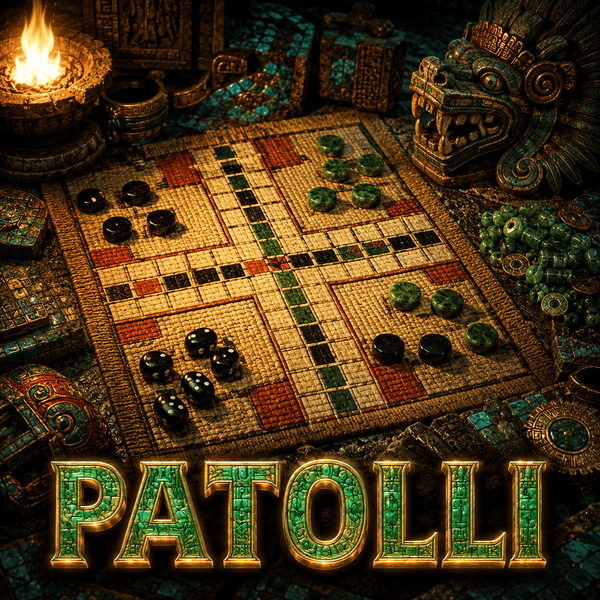
Patolli is one of the oldest games of the Americas, played by the Aztecs and recorded in detail by the Spanish friar Sahagún, who watched games in the courts of Tenochtitlan. Players tossed marked beans, raced markers around a cross-shaped mat, and wagered real treasure on the outcome; the game was tied to Macuilxochitl, the god of games, and stakes could run to cloaks, feathers, and worse.
Arcadia's version keeps the gambling heart with a safe twist: you and the AI Xolotl each stake six jade treasures. Run all six markers around the cross, or bankrupt your opponent.
How to Play
- Toss five marked beans: marks up count 1-4, all five marks count 10, all blank counts 20.
- A toss of exactly 1 enters a new marker on your start square (your first marker may enter on any toss).
- Race your markers clockwise around the 52-square cross.
- Land exactly on an enemy marker to capture it and take a treasure; land on a red triangle square and you pay one.
- Bring all six markers around the full circuit, or take Xolotl's last treasure, to win.
Core Rules
- Both players race the same circuit from opposite corners of the center.
- Your own markers block each other: two markers can never share a square.
- Captures send the enemy marker back to its reserve and transfer one treasure.
- The gold squares at the four arm ends grant an extra toss.
- The red triangle squares cost one treasure when landed on.
- Markers complete the circuit on reaching or passing their start; no exact toss needed.
- Running out of treasures loses the game immediately.
Strategy: Jade Management & the Center
- Treat treasures as a second health bar: a capture is a 2-point swing, so threaten captures even when you do not take them.
- The four turquoise center squares are shared ground where both circuits cross: pass through late in a toss chain, not as a landing spot.
- Bank extra tosses: the arm-end squares are safe AND give another toss, making them the best parking spots on the board.
- Do not hoard the reserve. A toss of 1 spent entering is rarely wasted; markers at home score nothing.
- Near the end, count Xolotl's treasures. If he is down to one or two, hunting captures beats racing.
Practical Tips
- Gold ↻ squares grant another toss; red ▲ squares cost a treasure.
- The diamond gems under each name show the treasure count: when a gem goes dark, it has been lost.
- A blank toss of five beans is the big one: 20 squares, nearly half the circuit.
- Watch which squares Xolotl can reach with 1-4: those are the spots your lone markers should avoid.
FAQ
How does scoring work with the beans?
Five beans are tossed. The number of marked faces up scores 1 to 4; all five marked scores 10; all blank scores 20. Historical players drilled holes in the beans for the marks.
What are the treasures for?
They are the stake. Captures and penalty squares transfer treasures between players, and losing your last treasure loses the game, even if your markers lead the race.
Did the Aztecs really gamble on Patolli?
Heavily. Sahagún and other chroniclers describe wagers of cloaks, precious feathers, and even personal freedom. The Spanish banned the game partly for that reason, which is why complete original rules are lost.
Are these the original rules?
The exact original rules did not survive the Spanish conquest, so Arcadia uses a standard modern reconstruction: the cross board, bean scoring, captures, and treasure wagering are all documented; the special-square details follow common modern practice.
Can I play Patolli online for free?
Yes. Arcadia offers free Patolli in your browser against an AI opponent — no download or account required.
Related Games


Ready to play Patolli?
Launch the free demo, learn the flow, and practice your tactics.