Patolli - Rules, History & Strategy Guide
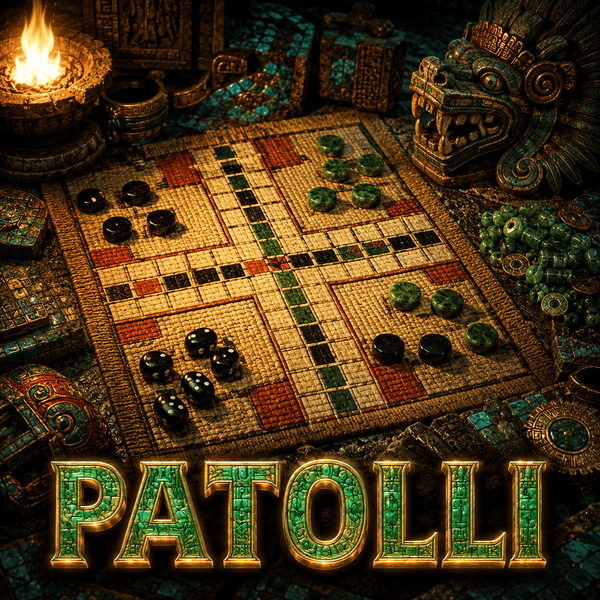
Patolli is an ancient Aztec race-and-gambling board game for two players, reconstructed from 16th-century Spanish accounts. Players toss five marked beans to move six markers around a 52-square cross, capturing rivals and wagering treasures on every hazard. A full match typically runs 20 to 40 minutes.
Reviewed & updated
History & Origins
Patolli is among the oldest games of the Americas: versions of its cross-shaped mat appear in Teotihuacan and Maya contexts centuries before the Aztecs made it their signature gambling game. The friar Bernardino de Sahagún described matches in detail, from the five marked beans used as dice to the mats painted with a cross of fifty-two squares, a number that mirrored the fifty-two-year Mesoamerican calendar round. The game belonged to Macuilxochitl, the god of games and music, and players invoked him with every toss.
The stakes were the point: chroniclers record wagers of cloaks, precious stones, feathers, fields, and in extreme cases personal freedom. That gambling culture is also why the game nearly vanished, as Spanish authorities burned mats and banned play, leaving the exact rules to be reconstructed by historians from Sahagún’s descriptions and surviving imagery.
How to Play
Patolli is a race with a wager attached: six markers around a 52-square cross, with jade treasures changing hands on captures and penalty squares. Win the race, or take everything your opponent staked.
- Toss five marked beans: marks up score 1 to 4, all five marks score 10, all blank scores 20.
- Enter a new marker on your start square with a toss of exactly 1 (your first marker may enter on any toss).
- Move one marker the full toss value clockwise around the cross; your own markers block each other.
- Land exactly on an enemy marker to capture it and take one treasure; land on a penalty square and pay one treasure.
- Bring all six markers around the circuit, or take your opponent’s last treasure, to win.
Strategy Tips
- Play the treasures, not just the race: a capture is a two-treasure swing, and bankrupting your opponent ends the game on the spot.
- Respect the shared center squares where both circuits cross: pass through them, do not park on them.
- The arm-end squares grant an extra toss and make the safest stopping points; route your markers to land there exactly.
- Enter markers steadily. Tosses of 1 feel small, but a full reserve late in the game turns big tosses into dead tosses.
- When your opponent is down to one or two treasures, switch from racing to hunting: threaten captures on every toss.
Variations
Reconstructions differ on entry rules, the exact effect of the marked squares, and whether the big tosses score 10 and 20 or grant extra turns; the cross board, bean dice, and treasure wagering are constant. Related cross-and-circle games run through the whole region and beyond, from the Maya bul to Indian pachisi, which shares the entering, racing, and capturing skeleton on a different board.
Play Patolli on Arcadia
Play Patolli on Arcadia to toss the beans, race the sacred cross, and win the jade before Xolotl takes yours.
Quick Answers
How do the bean dice work?
Five beans with a marked face are tossed together. The count of marks facing up scores 1 to 4; all five marks score 10; all blank scores 20. The beans were traditionally drilled with a hole for the mark.
Why is the board 52 squares?
The number matched the 52-year Mesoamerican calendar round, the great cycle shared by the Aztec ritual and solar calendars. Patolli carried religious weight: it belonged to Macuilxochitl, god of games.
What did the Aztecs wager on Patolli?
Chroniclers record cloaks, precious feathers, jade, fields, and occasionally personal freedom. The gambling is why Spanish authorities banned the game and destroyed the painted mats.
Are the original rules known?
Not completely. The Spanish suppression means modern Patolli is a reconstruction from Sahagún’s descriptions: board, beans, captures, and wagering are documented, while special-square details follow modern convention.
Can I play Patolli online for free?
Yes. Arcadia offers free Patolli in your browser against an AI opponent, jade treasures included — no download or account required.
How old is Patolli?
Patolli-style cross diagrams appear scratched into floors and plazas at Teotihuacan, a city that flourished in the first millennium AD, and at Maya sites of the same era — several centuries before the Aztecs. By the time Spanish chroniclers described it in the 1500s, the game was already ancient.
What does the word patolli mean?
Patolli is a Nahuatl word generally translated as beans — the fat marked beans that served as dice gave the game its name. Nahuatl was the language of the Aztecs, and Spanish sources kept the native name even while condemning the game itself.
Is Patolli related to the Indian game Pachisi?
They look strikingly similar — both are cross-shaped race games using lot-based dice — and in 1879 the anthropologist E. B. Tylor famously argued that Patolli proved ancient contact between Asia and Mexico. Modern scholars reject that theory and treat the two as independent inventions of the same natural idea.
How many pieces does each player have in Patolli?
In the reconstruction played today, each player races six markers around the 52-square cross. Only a toss of exactly 1 lets a new marker enter after the first, so managing your reserve is a real part of the game — a hand full of unentered markers can turn big tosses into wasted ones.
Is Patolli luck or skill?
The bean toss is pure chance, but choosing which marker to move, when to enter reserves, and when to switch from racing to hunting captures is genuine skill — much like backgammon. The stakes sharpen the judgement: a reckless capture chase can cost real treasure when a penalty square interrupts it.
How long does a game of Patolli take?
A full match of the modern reconstruction usually runs 20 to 40 minutes, though a capture-heavy game can end abruptly when one player loses their last treasure. On Arcadia you can play Patolli free in the browser against an AI, so it is easy to try a few matches back to back.
What are the penalty squares in Patolli?
Certain marked squares on the cross cost a treasure when a marker lands on them, paid straight to your opponent. The squares at the ends of the arms are the opposite: landing there exactly grants an extra toss, making them the safest places to pause a marker mid-circuit.
What equipment did the Aztecs use to play Patolli?
A painted mat bearing the 52-square cross, five large bean dice marked on one face, coloured stones as markers, and a stock of stakes — jade, cloaks or precious feathers. Chroniclers describe devoted players carrying their rolled mats and beans with them, ready for a game anywhere.
Related Games On Arcadia
Related Guides

MAIN MENU
PvP Games
 Battleship
 Crazy Eights
 Dots & Boxes Blitz
 Gomoku
 Ludo
Ludo Quoridor
 Snakes & Ladders
 Yahtzee
Free Games
 Alquerque
 Backgammon
 Bagh-Chal
 Balut
Balut Battle for TokyoBattleship
 Bingo
Bingo Brick Breaker
 Bridge
 Bunco
Bunco Callbreak
 Checkers
 Chess
Chess ChompCrazy Eights
 Cribbage
 Dara
Dara Derby Dash
 DominoesDots & Boxes Blitz
 Durak
Durak Emberdeep
 Euchre
 Fanorona
 Farkle
 Fox and Geese
 Fox and Hounds
 Generala
 Gin Rummy
 Go / WeiqiGomoku
 Hazard
 Hearts
 Hex
Hex Higher or Lower
 Hnefatafl
 Hounds and Jackals
 Indian Rummy
 Jungle
 Ludus Latrunculorum
 Liar's DiceLudo
 Mahjong Solitaire
 Mancala
 Minesweeper
 Nim
Nim Nine Men's Morris
 OnitamaPatolli
 Peg Solitaire
 Pentago
 Pente
Pente Pig
Pig PylosQuoridor
 Reversi
 Royal Game of Ur
 Scratch Cards
 Seega
Seega Senet
Senet Shax
Shax Ship, Captain, Crew
 Shut the Box
 Sixteen Soldiers
 SnakeSnakes & Ladders
 Klondike Solitaire
 Space Blaster
 Spades
 Sugar Pop
 Sungka
 Tangram
 Tile Rummy
 Tower
Tower Truco
Truco War
War Word Spy
 XII ScriptaYahtzee
NEED HELP?