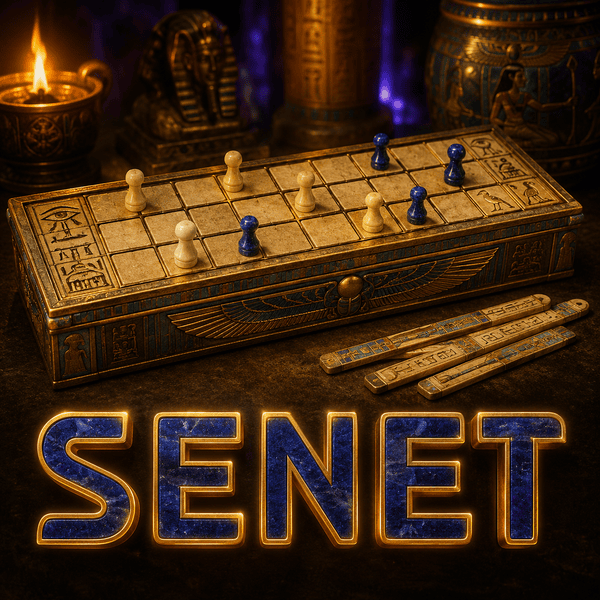
Senet - Rules, History & Strategy Guide
Senet is a two-player race game from ancient Egypt, dating back more than 5,000 years. Players throw four casting sticks and race five pawns along a winding 30-square track, swapping with lone enemy pawns and navigating special squares near the end. A typical game takes 15 to 30 minutes.
Reviewed & updated
History & Origins
Senet — “the game of passing” — was played in Egypt more than 5,000 years ago, making it one of the oldest known board games in the world. Boards and pieces have been recovered from tombs across the dynasties, most famously among the treasures of Tutankhamun, and the game appears painted on tomb walls as a pastime of the living and the dead alike.
Over the centuries Senet took on a spiritual dimension: the winding 30-square track came to represent the soul’s journey through the underworld, with the final squares standing for judgment and rebirth. That fusion of a genuine race game with Egyptian belief is why Senet endures as both a playable contest and a window into the ancient world.
How to Play
You race five pawns against an AI along a boustrophedon path of 30 squares, throwing four casting sticks instead of dice.
- Throw the sticks: count the light faces up for a move of 1 to 4, or 5 when all land dark.
- Move one pawn forward along the winding path; a throw of 1, 4, or 5 earns another throw, while 2 or 3 ends your turn.
- Land on a lone enemy pawn to swap places with it, but a pawn beside a friend is protected and three in a row form an impassable wall.
- Square 26 (House of Beauty) is a mandatory stop and square 27 (House of Waters) washes a pawn back to square 15.
- Bear pawns off from squares 28, 29, and 30 with an exact 3, 2, or 1 — clear all five to win.
Strategy Tips
- Keep pawns paired so they cannot be swapped off their squares.
- Build a three-pawn wall to block the AI from passing a key stretch of the path.
- Respect the House of Waters on square 27 — landing there is a major setback, so time your throws to skip it.
- Do not push a single runner far ahead unguarded; a lone pawn is an easy swap target.
- Use the extra-throw rolls of 1, 4, and 5 to reposition safely and chain your progress.
Variations
Because no complete rulebook survived from antiquity, modern Senet rests on reconstructions by scholars such as Timothy Kendall and R. C. Bell, and rule sets differ on stick values, the special squares, and bearing off. Related ancient race games include the Egyptian Game of Twenty Squares and the Mesopotamian Royal Game of Ur, which share the throw-and-move lineage.
Play Senet on Arcadia
Play Senet on Arcadia to throw the sticks, wall off Anubis, and race all five pawns into the afterlife in humanity’s oldest board game.
Quick Answers
How old is Senet?
Senet dates back more than 5,000 years to predynastic and dynastic Egypt, making it one of the oldest board games known. Boards have been found in tombs including that of Tutankhamun.
How do you move in Senet?
You throw four casting sticks instead of dice; the number of light faces up (1 to 4, or 5 for all dark) is your move. A throw of 1, 4, or 5 grants another throw, while 2 or 3 ends your turn.
What are the special squares in Senet?
Square 26 (House of Beauty) is a mandatory stop, square 27 (House of Waters) sends a pawn back to 15, and squares 28, 29, and 30 bear a pawn off with an exact 3, 2, or 1.
How do captures work in Senet?
Land on a lone enemy pawn to swap places with it. A pawn next to a friendly pawn is protected, and three friendly pawns in a row form a wall the enemy cannot pass.
Can I play Senet online for free?
Yes. Arcadia offers free Senet against an AI opponent, with casting sticks, special squares, and bear-off rules — no download or account required.
How do you win Senet?
You win by bearing all five of your pawns off the end of the 30-square track before your opponent. Because the last squares demand exact throws, games are often decided by how cleanly you manage the final stretch rather than by who led early.
Is Senet a game of luck or skill?
Both. The casting sticks supply the luck, but choosing which pawn to move — when to pair pawns for protection, when to build a blocking wall, when to risk the House of Waters — is genuine skill. A few rounds against Arcadia’s free browser AI make the skill layer obvious, and there is nothing to download.
What does the name Senet mean?
Senet comes from the ancient Egyptian for “passing”, and the game is often translated as “the game of passing”. The name fits both the literal mechanics — pawns passing along and off the board — and the later religious reading of the board as the soul’s passage through the underworld.
Why was Senet buried in Egyptian tombs?
Because the game acquired religious meaning: the 30-square journey came to represent the soul’s passage through the underworld towards rebirth. Boards were placed in tombs as equipment for the afterlife, and Chapter 17 of the Book of the Dead even shows the deceased playing Senet against an unseen opponent.
Did Tutankhamun play Senet?
Almost certainly. Several complete game boxes were found among the treasures of his tomb, including a fine ebony-and-ivory set, and tomb art across the dynasties shows royalty at the Senet board. Queen Nefertari is famously depicted playing Senet in the paintings of her own tomb.
Are modern Senet rules the original ancient rules?
No complete ancient rulebook survives, so every modern version is a scholarly reconstruction. The most widely played rule sets draw on work by researchers such as Timothy Kendall and R. C. Bell, who combined tomb paintings, board markings and game texts into playable rules. Details such as stick values and the special squares still differ between reconstructions.
How many squares and pawns does Senet use?
The board has 30 squares arranged in three rows of ten, travelled in a boustrophedon — an S-shaped path that snakes back and forth. Arcadia’s version gives each player five pawns, following common reconstructions, though ancient sets varied in piece count.
How long does a game of Senet take?
Usually 15 to 30 minutes. Swaps and the House of Waters can drag a close game out, since a pawn washed back to square 15 must renegotiate the most dangerous stretch of the board.
Related Games On Arcadia
Related Guides

MAIN MENU
PvP Games
 Battleship
 Crazy Eights
 Dots & Boxes Blitz
 Gomoku
 Ludo
Ludo Quoridor
 Snakes & Ladders
 Yahtzee
Free Games
 Alquerque
 Backgammon
 Bagh-Chal
 Balut
Balut Battle for TokyoBattleship
 Bingo
Bingo Brick Breaker
 Bridge
 Bunco
Bunco Callbreak
 Checkers
 Chess
Chess ChompCrazy Eights
 Cribbage
 Dara
Dara Derby Dash
 DominoesDots & Boxes Blitz
 Durak
Durak Emberdeep
 Euchre
 Fanorona
 Farkle
 Fox and Geese
 Fox and Hounds
 Generala
 Gin Rummy
 Go / WeiqiGomoku
 Hazard
 Hearts
 Hex
Hex Higher or Lower
 Hnefatafl
 Hounds and Jackals
 Indian Rummy
 Jungle
 Ludus Latrunculorum
 Liar's DiceLudo
 Mahjong Solitaire
 Mancala
 Minesweeper
 Nim
Nim Nine Men's Morris
 Onitama
 Patolli
 Peg Solitaire
 Pentago
 Pente
Pente Pig
Pig PylosQuoridor
 Reversi
 Royal Game of Ur
 Scratch Cards
 SeegaSenet
 Shax
Shax Ship, Captain, Crew
 Shut the Box
 Sixteen Soldiers
 SnakeSnakes & Ladders
 Klondike Solitaire
 Space Blaster
 Spades
 Sugar Pop
 Sungka
 Tangram
 Tile Rummy
 Tower
Tower Truco
Truco War
War Word Spy
 XII ScriptaYahtzee
NEED HELP?