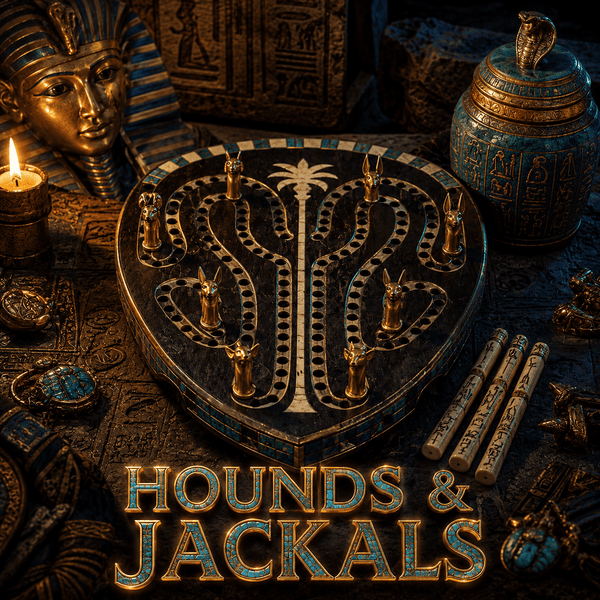
Hounds and Jackals - Rules, History & Strategy Guide
Hounds and Jackals is an ancient Egyptian race game for two players, dating to about 2000 BC. Each player throws casting sticks to run five pegs down a private 29-hole track, using carved shortcuts and lucky holes along the way. Played today with reconstructed rules, a game takes around ten to twenty minutes.
Reviewed & updated
History & Origins
Hounds and Jackals appeared in Egypt around 2000 BC, during the Middle Kingdom, and its nickname, the game of 58 holes, comes from the two private 29-hole tracks drilled into its boards. The most famous set was excavated by Howard Carter at Thebes: a palm-tree shaped board with five ivory pegs carved as hound heads and five as jackal heads, now one of the treasures of the Metropolitan Museum of Art in New York.
The game travelled far beyond the Nile. Boards have been found across Mesopotamia, the Levant, and Anatolia, carved into palace floors and scratched onto bricks, and it stayed in play for roughly a millennium before fading. Modern players use a straightforward reconstruction: the tracks, links between holes, and marked lucky holes are all visible on the surviving boards, and casting sticks stand in for the knucklebones some sets used.
How to Play
Hounds and Jackals is a pure race: each player runs five pegs down a private 29-hole track, and the first to bring all five home wins. There is no capturing; shortcuts and extra throws decide the race.
- Throw four casting sticks: the light faces up count 1 to 4, and all dark faces count 5.
- Enter a peg on the hole matching your throw, or advance one peg already on your track by the full value.
- Land exactly on a linked hole to slide forward along the carved path (hole 6 leads to 20, hole 8 to 10).
- Throws of 1, 4 and 5 grant another throw, as does landing exactly on a starred nefer hole (15 or 25).
- A peg leaves the board only on an exact throw past hole 29; the first player to run all five pegs off wins.
Strategy Tips
- Treat the 6-to-20 link as the main prize of the opening: fourteen free holes for landing exactly on hole 6.
- Keep your pegs spaced. Your own pegs block exact landings, and a clustered team wastes its best throws.
- Chain bonuses deliberately: a throw of 1, 4 or 5 that also lands on a nefer hole gives back-to-back extra throws.
- Stagger the endgame: park pegs 1 to 5 holes from the exit at different distances so any throw bears one off.
- Enter pegs early. A peg still in the kennel late in the game turns big throws into dead throws.
Variations
Surviving boards differ in their links: some connect different hole pairs or mark different lucky holes, and archaeologists suspect regional house rules. Some sets used knucklebones (astragali) instead of casting sticks, giving slightly different odds. Arcadia follows the most common reconstruction based on the Met board: links at 6-20 and 8-10, nefer holes at 15 and 25, and stick throws matching Senet for familiarity.
Play Hounds and Jackals on Arcadia
Play Hounds and Jackals on Arcadia to throw the sticks, ride the carved shortcuts, and race all five hounds home before the Jackal.
Quick Answers
Why is it called the game of 58 holes?
Each player has a private track of 29 holes, 58 across the whole board. The name Hounds and Jackals comes from the carved peg heads on the famous Met Museum set.
Is there any capturing in Hounds and Jackals?
No. The two tracks are completely separate, so pegs never interact. The game is a race decided by shortcuts, extra throws, and exact exit rolls.
How do the shortcuts work?
The boards have lines carved between hole pairs. Landing exactly on the start of a link slides your peg to its end: hole 6 leads to hole 20 and hole 8 to hole 10. Passing over a link hole does nothing.
How old is Hounds and Jackals?
About 4,000 years. It appeared in Middle Kingdom Egypt around 2000 BC, spread across the ancient Near East, and remained popular for roughly a thousand years.
Can I play Hounds and Jackals online for free?
Yes. Arcadia offers free Hounds and Jackals in your browser against an AI opponent, with the links and nefer holes of the original boards — no download or account required.
Are the original rules of Hounds and Jackals known?
No. No ancient rule text survives, so modern play is a scholarly reconstruction: the tracks, the carved links between holes, and the marked lucky holes are read directly from surviving boards, while movement and throw values are borrowed from better-understood Egyptian race games. Different museums and authors reconstruct minor details differently.
Where can you see the famous Hounds and Jackals set?
The best-known set is in the Metropolitan Museum of Art in New York: a palm-tree shaped board with hound-headed and jackal-headed ivory pegs, excavated by Howard Carter at Thebes in 1910 and dated to about 1800 BC. Other boards and fragments survive in collections across Egypt, Europe, and North America.
What does the nefer hole mean?
The starred holes are marked with the hieroglyph nefer, which means “good” or “beautiful” in ancient Egyptian. Landing exactly on one is good fortune made literal: in the usual reconstruction it grants the player another throw.
Did ancient Egyptians use dice for Hounds and Jackals?
Not cube dice. Players generated throws with casting sticks — flat sticks read by how many light faces landed up — or with astragali, the knucklebones of sheep and goats. Cubic dice existed in the ancient world, but sticks and bones were the standard randomisers for Egyptian board games.
Is Hounds and Jackals luck or skill?
The throws are pure luck, but the choices matter: which peg to advance, whether to aim a peg at the 6-to-20 shortcut, and how to space pegs for the exact-throw endgame. It plays like an ancestor of backgammon — a luck-driven race in which good peg management still wins noticeably more often over a series of games.
Is Hounds and Jackals related to Senet or the Royal Game of Ur?
They are cousins rather than versions of each other. Senet uses a 30-square track and the Royal Game of Ur a 20-square course with shared squares and capturing, while Hounds and Jackals runs two fully private 29-hole tracks with no interaction. Some scholars place the 58-holes family among the distant ancestors of backgammon-style race games.
What happens if you cannot use your throw in Hounds and Jackals?
In the common reconstruction the throw is simply forfeited and play passes on, since pegs may not land on occupied holes and must leave the board on exact throws. Nobody knows how the original players handled it — it is one of the details modern rules have to fill in.
How long does a game of Hounds and Jackals take?
Around 10–20 minutes for a two-player race, though chains of extra throws can swing a game quickly. Arcadia’s free browser version against an AI opponent follows the Met board reconstruction, so a full five-peg race fits comfortably into a break.
Related Games On Arcadia
Related Guides

MAIN MENU
PvP Games
 Battleship
 Crazy Eights
 Dots & Boxes Blitz
 Gomoku
 Ludo
Ludo Quoridor
 Snakes & Ladders
 Yahtzee
Free Games
 Alquerque
 Backgammon
 Bagh-Chal
 Balut
Balut Battle for TokyoBattleship
 Bingo
Bingo Brick Breaker
 Bridge
 Bunco
Bunco Callbreak
 Checkers
 Chess
Chess ChompCrazy Eights
 Cribbage
 Dara
Dara Derby Dash
 DominoesDots & Boxes Blitz
 Durak
Durak Emberdeep
 Euchre
 Fanorona
 Farkle
 Fox and Geese
 Fox and Hounds
 Generala
 Gin Rummy
 Go / WeiqiGomoku
 Hazard
 Hearts
 Hex
Hex Higher or Lower
 HnefataflHounds and Jackals
 Indian Rummy
 Jungle
 Ludus Latrunculorum
 Liar's DiceLudo
 Mahjong Solitaire
 Mancala
 Minesweeper
 Nim
Nim Nine Men's Morris
 Onitama
 Patolli
 Peg Solitaire
 Pentago
 Pente
Pente Pig
Pig PylosQuoridor
 Reversi
 Royal Game of Ur
 Scratch Cards
 Seega
Seega Senet
Senet Shax
Shax Ship, Captain, Crew
 Shut the Box
 Sixteen Soldiers
 SnakeSnakes & Ladders
 Klondike Solitaire
 Space Blaster
 Spades
 Sugar Pop
 Sungka
 Tangram
 Tile Rummy
 Tower
Tower Truco
Truco War
War Word Spy
 XII ScriptaYahtzee
NEED HELP?