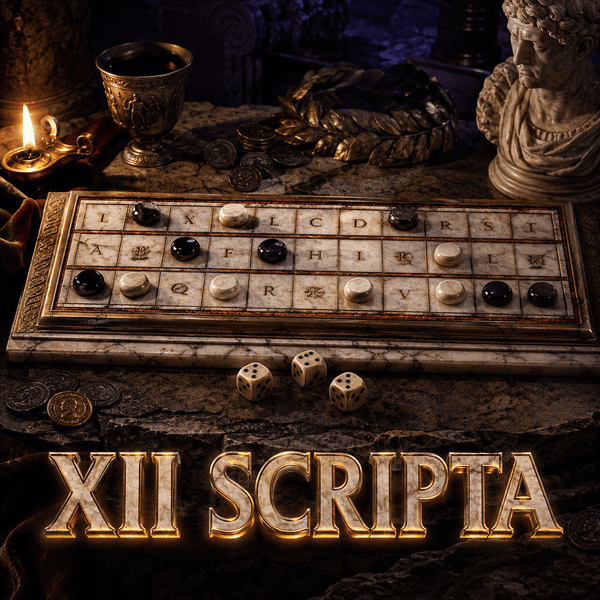
XII Scripta - Rules, History & Strategy Guide
XII Scripta is the Roman ancestor of backgammon: a two-player race game on three rows of twelve squares. Each turn you roll three dice and move your fifteen men along the shared track, hitting lone enemies and building blocking points. The first player to bear off all fifteen wins, in roughly 20 to 30 minutes.
Reviewed & updated
History & Origins
XII Scripta, in full ludus duodecim scriptorum or "the game of twelve markings", was the tables game of the Roman Empire. Boards survive scratched into the marble of the Forum Romanum, into bathhouse benches and barracks floors from Britain to Syria, and the poet Ovid dispensed advice about playing it charmingly in his Ars Amatoria. Players raced fifteen men over three rows of twelve squares, driven by three six-sided dice.
Around the first century the game shed a row and continued as tabula, which travelled through Byzantium into medieval Europe and evolved into the backgammon family played today. The complete Roman rules never survived, so modern players use a scholarly reconstruction: the board, dice counts, and racing character are historical, and the hit-and-block mechanics mirror its descendant tabula.
How to Play
XII Scripta is a race: both players move fifteen men in the same direction along one winding 36-square track, and the first to bear all fifteen off the end wins.
- Both players start with fifteen men off the board; roll three dice each turn.
- While any of your men wait off the board, they must enter first: a die brings one man in on squares 1 to 6, matching its value.
- Spend each die by moving one man its full value; several dice may move the same man in sequence.
- Landing on a square with exactly one enemy man sends him back off the board; a square with two or more enemy men is blocked.
- When all fifteen of your men occupy the final six squares, dice bear them off; the first player to bear off all fifteen wins.
Strategy Tips
- Make points: two men on a square are safe and block the Legate at the same time. Points on squares 1-6 also trap entering enemies off the board.
- Count blot danger by dice reach: a lone man within 1-6 of an enemy can be struck by any of three dice, so cover him or push him out of range.
- Prefer hits on enemies deep into the track: a man struck on the third row loses almost the whole race.
- Use the three dice flexibly: two dice can leapfrog one man through a dangerous zone that a single die would strand him in.
- Near the end, race pure: once no contact is possible, stop covering and spend every pip on the fastest bear-off.
Variations
The main historical variant is tabula, the two-row successor that dropped the entry row and is functionally early backgammon; some reconstructions of XII Scripta borrow its rule that men may only bear off exactly. Museum boards also differ in decoration: many surviving tracks are laid out as thirty-six letters spelling six-word mottoes, so any six-by-six word grid you see carved on a Roman step is probably a game board.
Play XII Scripta on Arcadia
Play XII Scripta on Arcadia to roll three dice like a Roman, wall the twelve lines, and bear off fifteen men before the Legate does.
Quick Answers
What does XII Scripta mean?
It is short for ludus duodecim scriptorum, Latin for "the game of twelve markings", after the three rows of twelve squares on the board. Romans played it everywhere: surviving boards are carved into forum steps and bathhouse benches.
Is XII Scripta the ancestor of backgammon?
Yes. XII Scripta evolved into the two-row game tabula around the first century, and tabula carried the racing, hitting, and bearing-off mechanics into the medieval backgammon family.
How many dice does XII Scripta use?
Three six-sided dice per turn, one more than backgammon. Each die moves one man its full value, and several dice may be spent on the same man in sequence.
Are the original rules known?
No complete Roman rulebook survives. Modern play uses a reconstruction by game historians: the board, three dice, and fifteen men are historical, while hits, blocks, and bear-off follow the game’s documented descendant tabula.
Can I play XII Scripta online for free?
Yes. Arcadia offers free XII Scripta in your browser against an AI opponent, with the full three-dice reconstruction — no download or account required.
How many pieces does each player have in XII Scripta?
Fifteen men each — the same count backgammon still uses — racing along a single track of 36 squares arranged as three rows of twelve. Both players move in the same direction rather than in opposite loops. All thirty men start off the board and must enter on the first six squares.
What happens if you land on an opponent’s piece in XII Scripta?
Landing on a square holding exactly one enemy man hits him: he is lifted off the board and must re-enter on squares 1 to 6. A square holding two or more enemy men is a wall you cannot land on at all. Late hits are devastating, because a man struck on the third row loses almost the whole race.
Can you move other men while some are waiting to enter?
No — under the standard reconstruction, while any of your men sit off the board, whether not yet entered or freshly hit, your dice must bring them in first. Enemy points on squares 1 to 6 can therefore trap you off the board for whole turns. Keeping entry squares open is a real tactical concern.
How is XII Scripta different from tabula?
Tabula kept the fifteen men and three dice but cut the board from three rows of twelve squares to two, producing the 24-point layout backgammon inherited. Losing the dedicated entry row made games shorter and more tactical. If you can play one, you can learn the other in minutes.
Why do some Roman game boards have words instead of squares?
Many surviving XII Scripta boards mark their 36 playing spaces with 36 letters spelling six six-letter words, usually a motto or joke. A famous example from Timgad in Roman North Africa reads, in translation, “to hunt, to bathe, to play, to laugh — that is to live”. Any six-word letter grid carved into a Roman pavement is probably one of these boards.
Did any famous Romans play XII Scripta?
Ovid offers flirting advice about the game in his Ars Amatoria, written around 2 AD. The emperor Claudius was such a devoted tables player that Suetonius records he wrote a book on dice play and had a board fitted to his carriage. Boards scratched into the steps of the Forum Romanum show ordinary Romans played wherever they could sit.
Is XII Scripta luck or skill?
The three dice inject plenty of luck, but the skills that separate backgammon players apply here too: building points, timing hits, limiting blot exposure and knowing when to break contact and race. Over a match, the stronger positional player wins clearly more often. Arcadia’s free version is a low-stakes place to build those instincts against the AI.
How long does a game of XII Scripta take?
Around 20 to 30 minutes for a typical game — slightly longer than backgammon, because the track is 36 squares rather than 24 and all fifteen men start off the board. Three dice per turn keep the race moving briskly. Digital play trims setup and dice handling to almost nothing.
Related Games On Arcadia
Related Guides

MAIN MENU
PvP Games
 Battleship
 Crazy Eights
 Dots & Boxes Blitz
 Gomoku
 Ludo
Ludo Quoridor
 Snakes & Ladders
 Yahtzee
Free Games
 Alquerque
 Backgammon
 Bagh-Chal
 Balut
Balut Battle for TokyoBattleship
 Bingo
Bingo Brick Breaker
 Bridge
 Bunco
Bunco Callbreak
 Checkers
 Chess
Chess ChompCrazy Eights
 Cribbage
 Dara
Dara Derby Dash
 DominoesDots & Boxes Blitz
 Durak
Durak Emberdeep
 Euchre
 Fanorona
 Farkle
 Fox and Geese
 Fox and Hounds
 Generala
 Gin Rummy
 Go / WeiqiGomoku
 Hazard
 Hearts
 Hex
Hex Higher or Lower
 Hnefatafl
 Hounds and Jackals
 Indian Rummy
 Jungle
 Ludus Latrunculorum
 Liar's DiceLudo
 Mahjong Solitaire
 Mancala
 Minesweeper
 Nim
Nim Nine Men's Morris
 Onitama
 Patolli
 Peg Solitaire
 Pentago
 Pente
Pente Pig
Pig PylosQuoridor
 Reversi
 Royal Game of Ur
 Scratch Cards
 Seega
Seega Senet
Senet Shax
Shax Ship, Captain, Crew
 Shut the Box
 Sixteen Soldiers
 SnakeSnakes & Ladders
 Klondike Solitaire
 Space Blaster
 Spades
 Sugar Pop
 Sungka
 Tangram
 Tile Rummy
 Tower
Tower Truco
Truco War
War Word SpyXII ScriptaYahtzee
NEED HELP?