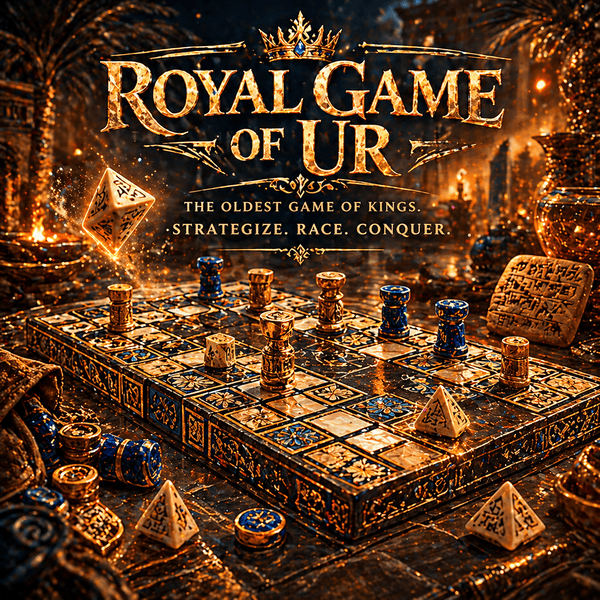
Royal Game of Ur - Rules, History & Strategy Guide
The Royal Game of Ur is a two-player race game from ancient Mesopotamia, dating to around 2600 BC. Each player rolls four tetrahedral dice and races seven pieces along a 14-square track, fighting for safe rosette squares and capturing enemy pieces. A game usually takes 15 to 30 minutes.
Reviewed & updated
History & Origins
The Royal Game of Ur is the oldest known board game in the world. The earliest surviving boards were excavated by Sir Leonard Woolley at the Royal Cemetery of Ur (in modern-day Iraq) in the 1920s, dating to roughly 2600 BC — over 4,500 years ago. The game spread across the ancient Near East and was played continuously for at least 3,000 years before fading from common play.
The rules were lost for centuries until British Museum curator Irving Finkel decoded a Babylonian clay tablet (dated ~177 BC) that explicitly described how to play. The tablet, written by a temple scribe named Itti-Marduk-balatu, gave us the dice mechanics, the path layout, and the rosette rules — turning a long-mysterious archaeological puzzle into a playable game again. Finkel's reconstruction is the version most commonly played today, including on Arcadia.
How to Play
Each player has seven pieces and races them along a 14-square track from start to finish. You roll four tetrahedral (4-sided) dice each turn — each die has two marked corners, so the total roll is 0 to 4. Move one piece that many squares, follow the rosette rules, and aim to bear off all seven pieces first.
- Roll all four tetrahedral dice. Each die shows either a marked or unmarked corner — count the marked corners. Total: 0 to 4.
- Move one of your pieces forward along your track by exactly the rolled total. A roll of 0 means no movement; turn passes.
- Land on a rosette (5 special squares) for two perks: your piece is safe from capture, and you get an extra roll.
- On the shared middle row, landing on an opponent's piece (non-rosette) sends it back to start. The middle row is the danger zone.
- You must roll exact movement to bear off (exit) a piece — overshooting the final square is not allowed. Win by bearing off all seven pieces first.
Strategy Tips
- Control the centre rosette (square 8 on the shared row). It's the most contested square on the board — safe + extra roll + blocks opponent passage.
- Don't leave single pieces exposed on the shared row unless absolutely necessary. A single piece on a non-rosette shared square is one bad roll away from being captured back to start.
- Stack pieces when possible — two of your pieces on the same square block your opponent from landing there at all (a friendly stack is impassable to enemies).
- Save your low rolls (1s and 2s) for fine-tuning bear-off. You need exact rolls to exit, so a 1 left in your pocket can finish a piece sitting on square 13.
- Don't fixate on one piece. Spread your race across all seven — a single chase piece is too easily captured. Move whichever piece keeps the most options open.
Variations
The Finkel reconstruction (used here) is the most common modern interpretation, but several variant rule sets exist. The "Burnt City" variant uses 10-piece sides and a different rosette layout. Some house rules treat rolls of 0 as a "skip" instead of a turn-pass, or allow rosette doubling. Arcadia uses Finkel's 7-piece, 4-dice ruleset with safe rosettes and extra rolls — closest to the 177 BC tablet description.
Play Royal Game of Ur on Arcadia
Play the Royal Game of Ur on Arcadia to step into 2600 BC Mesopotamia — race your pieces along the sacred path, fight for the centre rosette, and join the line of players that stretches back nearly five millennia.
Quick Answers
How old is the Royal Game of Ur?
About 4,600 years old. The earliest surviving boards date to ~2600 BC and were found in royal tombs at Ur, in modern-day Iraq. It's the oldest board game with confirmed rules — older than chess, backgammon, or Senet.
How were the rules rediscovered?
British Museum curator Irving Finkel translated a 177 BC Babylonian clay tablet that explicitly described the rules. The tablet was written by a temple astronomer/scribe named Itti-Marduk-balatu. Finkel's 1980s decoding turned a long-mysterious archaeological artefact back into a playable game.
What are the rosettes for?
Rosettes are five specially marked squares scattered along the track. Landing on a rosette gives your piece two perks: it's safe from capture (opponent cannot land there even on a shared-row rosette), and you get an extra roll. They're the most valuable squares to control.
How do the dice work?
Four tetrahedral (4-sided) dice. Each die has two marked corners and two unmarked. Roll all four and count the marked corners — total is 0 to 4. The probability distribution favours 2 (most common at 6/16) and disfavours 0 and 4 (each 1/16).
Can I play the Royal Game of Ur online for free?
Yes. Arcadia offers free Royal Game of Ur with three AI difficulty levels (Easy, Medium, Hard) using the Finkel reconstruction — no download or account required.
How do you win the Royal Game of Ur?
You win by bearing all seven of your pieces off the board before your opponent. Each piece must travel the full 14-square track and needs an exact roll to leave, so the endgame often turns on saving small rolls for the final squares.
Is the Royal Game of Ur luck or skill?
It blends both, much like backgammon. The four tetrahedral dice set the pace, but choosing which of seven pieces to move — when to fight for the centre rosette, when to stack for safety — rewards skill, and stronger players win noticeably more often. You can test this free on Arcadia against its AI difficulty levels in your browser, with nothing to download.
How long does a game of the Royal Game of Ur take?
Most games take 15 to 30 minutes. Captures on the shared middle row can stretch a close game out, since a piece sent back to the start must run the whole track again.
Is the Royal Game of Ur older than Senet?
Senet artefacts are slightly older — Egyptian boards date to around 3100 BC, against roughly 2600 BC for the boards from Ur. The Royal Game of Ur, however, is the oldest game whose rules survive in writing, thanks to the Babylonian tablet of 177 BC that Irving Finkel decoded. Senet, by contrast, is played today only through scholarly reconstruction.
Is the Royal Game of Ur related to backgammon?
Many historians place it in the same broad family of dice-driven race games. The twenty-squares layout spread across the ancient Near East over some 3,000 years, and its descendants are often seen as forerunners of the later tables games that produced backgammon. A direct unbroken lineage is hard to prove, but the mechanical DNA — race, capture, safe squares, exact bear-off — is clearly shared.
What happens when you land on an opponent’s piece in the Royal Game of Ur?
On an ordinary shared-row square, the opposing piece is captured and sent back to its start, forced to travel the whole track again. The exception is the rosette in the middle row: a piece sitting there cannot be landed on at all. This is what makes the shared row the tactical heart of the game.
What happens if you roll a zero in the Royal Game of Ur?
You cannot move and your turn passes to your opponent. In Finkel’s reconstruction there is no re-throw for a zero, though some modern house rules soften this into a skip or a re-roll. Keeping pieces on rosettes and in stacks limits the damage a dead turn can cause.
Where can you see an original Royal Game of Ur board?
The best-known board, excavated by Sir Leonard Woolley in the 1920s, is displayed at the British Museum in London. Finds from the Royal Cemetery at Ur were divided between the British Museum, the Penn Museum in Philadelphia and the Iraq Museum in Baghdad, so several original boards survive.
Related Games On Arcadia
Related Guides

MAIN MENU
PvP Games
 Battleship
 Crazy Eights
 Dots & Boxes Blitz
 Gomoku
 Ludo
Ludo Quoridor
 Snakes & Ladders
 Yahtzee
Free Games
 Alquerque
 Backgammon
 Bagh-Chal
 Balut
Balut Battle for TokyoBattleship
 Bingo
Bingo Brick Breaker
 Bridge
 Bunco
Bunco Callbreak
 Checkers
 Chess
Chess ChompCrazy Eights
 Cribbage
 Dara
Dara Derby Dash
 DominoesDots & Boxes Blitz
 Durak
Durak Emberdeep
 Euchre
 Fanorona
 Farkle
 Fox and Geese
 Fox and Hounds
 Generala
 Gin Rummy
 Go / WeiqiGomoku
 Hazard
 Hearts
 Hex
Hex Higher or Lower
 Hnefatafl
 Hounds and Jackals
 Indian Rummy
 Jungle
 Ludus Latrunculorum
 Liar's DiceLudo
 Mahjong Solitaire
 Mancala
 Minesweeper
 Nim
Nim Nine Men's Morris
 Onitama
 Patolli
 Peg Solitaire
 Pentago
 Pente
Pente Pig
Pig PylosQuoridor
 ReversiRoyal Game of Ur
 Scratch Cards
 Seega
Seega Senet
Senet Shax
Shax Ship, Captain, Crew
 Shut the Box
 Sixteen Soldiers
 SnakeSnakes & Ladders
 Klondike Solitaire
 Space Blaster
 Spades
 Sugar Pop
 Sungka
 Tangram
 Tile Rummy
 Tower
Tower Truco
Truco War
War Word Spy
 XII ScriptaYahtzee
NEED HELP?