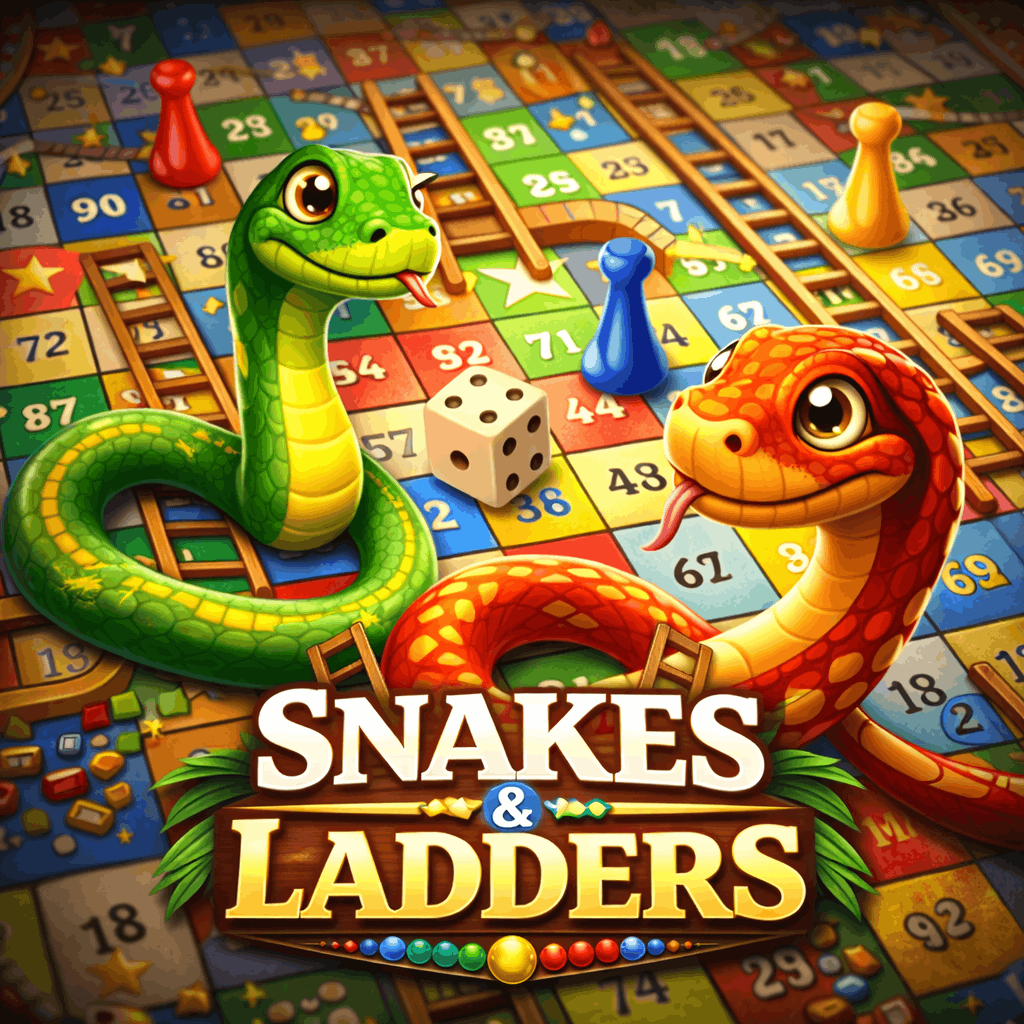
Snakes & Ladders - Rules, History & Strategy Guide
Snakes and Ladders is a luck-driven race game for two or more players on a 100-square board. Roll a die, move your token forward, climb ladders you land on, and slide down snakes, aiming to reach square 100 first. A typical game takes about 15 to 30 minutes.
Reviewed & updated
History & Origins
Snakes and Ladders descends from older Indian morality race games where ladders symbolized virtues and snakes represented setbacks. It later became a family board game classic because the swings are immediate and easy for all ages to understand.
Modern players love it for the same reason: every roll can rewrite the whole race. That emotional volatility is the game's personality.
How to Play
Players move their token along a numbered track according to die rolls while climbing ladders and sliding down snakes.
- Roll the die and move forward the exact number shown.
- Climb immediately if you land on the base of a ladder.
- Slide immediately if you land on the head of a snake.
- Keep racing toward the final square on the track.
- Reach the end first to win the game.
Strategy Tips
- There is little tactical control, so the real skill is keeping perspective and enjoying the swingy pace.
- In multiplayer races, stay mentally in the game because a big snake can reset any leader instantly.
- If house rules exist for exact finishing, remember them because they affect late-game odds.
Variations
Some boards require an exact final roll, some award extra turns on certain numbers, and themed digital versions remix the presentation while preserving the core race structure.
Play Snakes & Ladders on Arcadia
Play Snakes & Ladders on Arcadia to put these rules and ideas into practice right away.
Quick Answers
Is there real strategy in Snakes and Ladders?
Very little in the standard rules. The game is mostly about enjoying the dramatic swings created by ladders and snakes.
Do you need an exact roll to finish Snakes and Ladders?
That depends on the version. Some boards require exact finishing, while others let you win as soon as you reach or pass the final square.
Why has Snakes and Ladders lasted so long?
Because the rules are instant, the swings are memorable, and players of very different ages can enjoy the same race together.
Where did Snakes and Ladders originate?
It descends from Indian morality race games, often known as moksha patam or gyan chaupar, in which ladders stood for virtues and snakes for vices. The game reached England in the late 19th century as Snakes and Ladders, and Milton Bradley published the American version, Chutes and Ladders, in 1943.
What is the difference between Snakes and Ladders and Chutes and Ladders?
They are the same game. Chutes and Ladders is the American edition published by Milton Bradley in 1943, which swapped the snakes for playground slides to make the board friendlier for young children. The race mechanics are identical.
How many squares are on a Snakes and Ladders board?
The standard board is a 10×10 grid of 100 squares, numbered back and forth from the bottom row to the top. The number and placement of snakes and ladders varies from board to board, which is why some editions feel far crueller than others.
How long does a game of Snakes and Ladders take?
Mathematical analyses of the classic 100-square board put the average at roughly 39 rolls for a single player to finish, and a two-player race typically wraps up in 15 to 30 minutes. Games can run much longer when late snakes keep resetting the leaders.
What happens if two players land on the same square?
In the standard rules, nothing — tokens share squares peacefully and there is no capture. Some house rules add a bump that sends the earlier token back to the start, turning a pure race into something spikier, so agree on it before playing.
What did the snakes and ladders originally represent?
In the Indian original the board was a moral lesson: ladders represented virtues such as generosity and faith, while snakes represented vices such as anger and greed. Reaching the final square symbolised spiritual liberation, which is why early boards carry religious imagery rather than playground art.
Do you get an extra turn for rolling a six in Snakes and Ladders?
Only under some house rules — the base game has no bonus rolls. Common variants grant another roll after a six, or require a six to leave the start, both of which slightly change the pacing without adding real decisions.
Can you play Snakes and Ladders online for free?
Yes. Arcadia offers a free browser version of Snakes and Ladders with no download or account required. The classic climb-and-slide race is kept intact, swings and all.
Related Games On Arcadia
Related Guides

MAIN MENU
PvP Games
 Battleship
 Crazy Eights
 Dots & Boxes Blitz
 Gomoku
 Ludo
Ludo QuoridorSnakes & Ladders
 Yahtzee
Free Games
 Alquerque
 Backgammon
 Bagh-Chal
 Balut
Balut Battle for TokyoBattleship
 Bingo
Bingo Brick Breaker
 Bridge
 Bunco
Bunco Callbreak
 Checkers
 Chess
Chess ChompCrazy Eights
 Cribbage
 Dara
Dara Derby Dash
 DominoesDots & Boxes Blitz
 Durak
Durak Emberdeep
 Euchre
 Fanorona
 Farkle
 Fox and Geese
 Fox and Hounds
 Generala
 Gin Rummy
 Go / WeiqiGomoku
 Hazard
 Hearts
 Hex
Hex Higher or Lower
 Hnefatafl
 Hounds and Jackals
 Indian Rummy
 Jungle
 Ludus Latrunculorum
 Liar's DiceLudo
 Mahjong Solitaire
 Mancala
 Minesweeper
 Nim
Nim Nine Men's Morris
 Onitama
 Patolli
 Peg Solitaire
 Pentago
 Pente
Pente Pig
Pig PylosQuoridor
 Reversi
 Royal Game of Ur
 Scratch Cards
 Seega
Seega Senet
Senet Shax
Shax Ship, Captain, Crew
 Shut the Box
 Sixteen Soldiers
 SnakeSnakes & Ladders
 Klondike Solitaire
 Space Blaster
 Spades
 Sugar Pop
 Sungka
 Tangram
 Tile Rummy
 Tower
Tower Truco
Truco War
War Word Spy
 XII ScriptaYahtzee
NEED HELP?