Alquerque on Arcadia
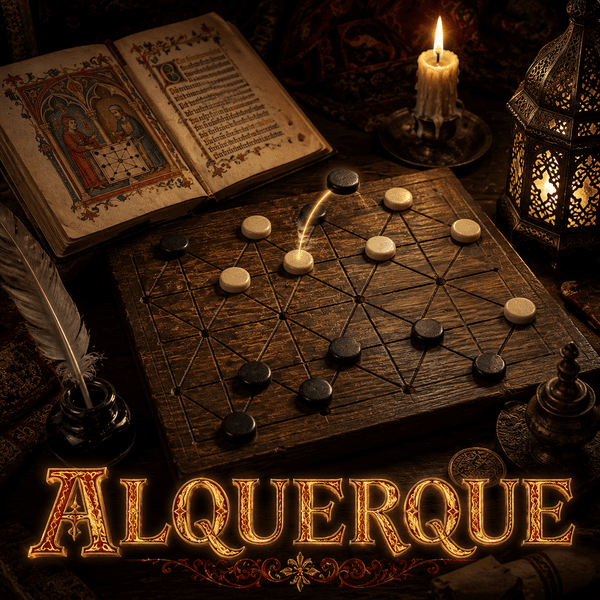
Alquerque is where checkers comes from. The game arrived in Iberia with the Moors as *el-quirkat*, and King Alfonso X's Libro de los Juegos (1283) recorded its rules in beautiful illuminated pages: a 5x5 lattice of points, twelve pieces each, and the short leap over an enemy that every checkers player knows. Move the pieces onto the dark squares of a chessboard, and draughts is born.
Arcadia's version follows the classic reconstruction: mandatory captures, chain leaps, and the double-X lattice where diagonals pass through only half the points. Your opponent is the Vizier.
How to Play
- Twelve pieces each start on the lattice with only the center point empty.
- Step one piece along a line to an adjacent empty point.
- Leap an adjacent enemy piece along a line to the empty point beyond: the leapt piece is captured.
- Captures are mandatory, and a leaping piece must keep leaping while fresh captures remain.
- Capture all twelve enemy pieces, or block the Vizier completely, to win.
Core Rules
- Pieces move along the lines, not the squares: orthogonal lines everywhere, diagonals only through the points where the X patterns cross.
- Both halves of a leap must follow lines on the lattice.
- If any capture is available, quiet steps are illegal.
- Chains branch: when a leaping piece has several onward jumps, you choose the direction.
- A player with no legal move loses. After 50 quiet moves, the side with more pieces wins.
Strategy: Feed the Chain, Never the Fork
- Mandatory captures make sacrifice the sharpest weapon: offer one piece to drag the Vizier onto a point where your chain takes two or three back.
- Count every chain to its end before stepping into range; the reply leap is forced, so you can calculate exactly what happens.
- The diagonal points (where the X lines cross) are worth more: pieces there have up to eight moves, pieces elsewhere only four.
- Keep your back line intact early; holes behind your wall become landing points for enemy leaps.
- The opening is nearly symmetric, so tempo decides: the first player to force a favorable exchange usually keeps the initiative to the end.
Practical Tips
- The red banner above the board warns when a capture is mandatory.
- Red dots mark leaps, green dots quiet steps.
- During a chain the game locks to your leaping piece; pick any highlighted branch.
- Watch the quiet-move counter when ahead on pieces: at the limit, material decides.
FAQ
Is Alquerque really the ancestor of checkers?
Yes. Around 1100, players in southern France moved alquerque's pieces and leap-capture onto the dark squares of a chessboard, creating *fierges*, which became draughts and checkers. The leap you know from checkers is alquerque's leap.
How is it different from checkers?
Pieces sit on line intersections rather than squares, move in any direction along the lines (no forward-only rule, no kings), and the diagonals exist on only half the points, which shapes every attack.
Are captures mandatory?
Yes, as in the classical game: if a leap is available you must take it, and a leaping piece continues while fresh captures remain. Medieval players even huffed pieces that failed to capture.
Where do the rules come from?
The core comes from Alfonso X's *Libro de los Juegos* (1283), the great medieval games manuscript, completed with the standard modern reconstruction for details the book leaves open.
Can I play Alquerque online for free?
Yes. Arcadia offers free Alquerque in your browser against an AI opponent, with mandatory chain captures on the classic lattice — no download or account required.
Related Games



Ready to play Alquerque?
Launch the free demo, learn the flow, and practice your tactics.