Nim on Arcadia
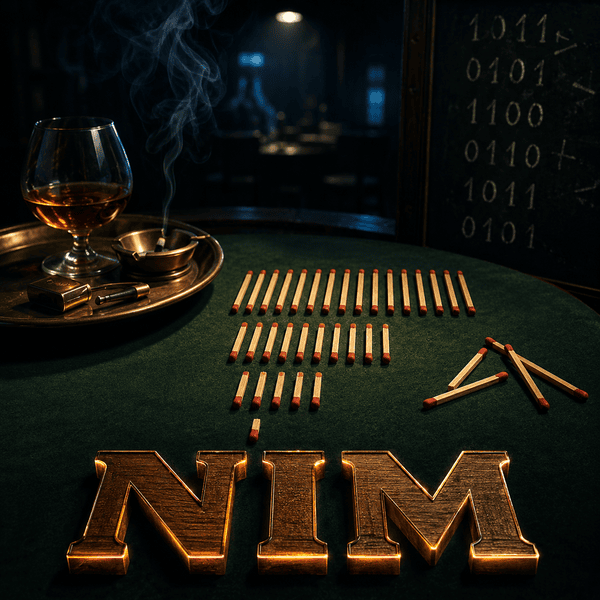
Nim is the purest strategy duel in gaming: four rows of matchsticks, take as many as you like from one row, and the last stick decides everything. Mathematicians solved it in 1901, the 1951 NIMROD computer made it the first game ever played by a machine, and the film *Last Year at Marienbad* made its 1-3-5-7 layout famous.
Arcadia's version gives you both classic rules (misère and normal), a Casual opponent that makes human mistakes, and NIMROD difficulty: a perfect player. From the classic 1-3-5-7 start you move first from a lost position — a perfect NIMROD, like the 1951 original that thrashed the public, cannot be beaten. Casual can.
How to Play
- The board holds four rows of 1, 3, 5 and 7 matchsticks.
- On your turn, take one or more sticks, all from the same row.
- Click a stick to grab it and everything to its right, then press Take.
- Misère rule: whoever takes the LAST stick loses. Normal rule: whoever takes it wins.
- Choose your rule and opponent on the start screen, then out-count the machine.
Core Rules
- You must take at least one stick per turn.
- All sticks in a single turn come from one row.
- There is no passing and no draw: every game ends.
- Misère (default): taking the final stick loses the game.
- Normal: taking the final stick wins the game.
Strategy: The Nim-Sum
Nim has a complete mathematical solution built on the nim-sum: write each row size in binary and XOR them together.
- If the nim-sum is zero after your move, your opponent is losing, whatever they do.
- From 1-3-5-7 the nim-sum is already zero, so the second player wins with perfect play.
- The misère twist only matters at the very end: when the move would leave nothing but single sticks, leave an ODD number of them for your opponent.
- Against Casual, force the balance and wait for a mistake. Against NIMROD, treat the game as theory practice: you start from a zero position, so every move you make hands it the win — hold out, watch how it restores the balance, and learn the line.
Practical Tips
- Learn the safe shapes: 1-1, 2-2, 3-3 and 1-2-3 all have nim-sum zero.
- Count in pairs: matching two equal rows is the easiest way to keep the balance.
- Endgame check: before emptying a row, count the single sticks that remain.
- The Take button shows exactly how many sticks you have selected; misclicks are undone by clicking again.
FAQ
What is the trick to winning Nim?
The nim-sum: XOR the row sizes in binary. Always move so the nim-sum becomes zero, and adjust at the very end under misère rules by leaving an odd number of single sticks.
What is the difference between misere and normal Nim?
Misère (the classic pub rule): whoever takes the last stick loses. Normal: whoever takes the last stick wins. The strategy is identical until only single sticks remain.
Can the NIMROD difficulty be beaten?
No — and that is the point. The 1-3-5-7 start has nim-sum zero, you move first, and a perfect second player wins from a zero position every time. Like the 1951 original that beat nearly every Festival of Britain visitor, NIMROD is a machine to learn from; switch to Casual for winnable games.
Why is the AI called NIMROD?
NIMROD was a light-bulb computer built for the 1951 Festival of Britain, the first computer created purely to play a game — this game. It famously beat most challengers.
Can I play Nim online for free?
Yes. Arcadia offers free Nim in your browser with both rule sets and two AI strengths — no download or account required.
Related Games

Ready to play Nim?
Launch the free demo, learn the flow, and practice your tactics.