Alquerque - Rules, History & Strategy Guide
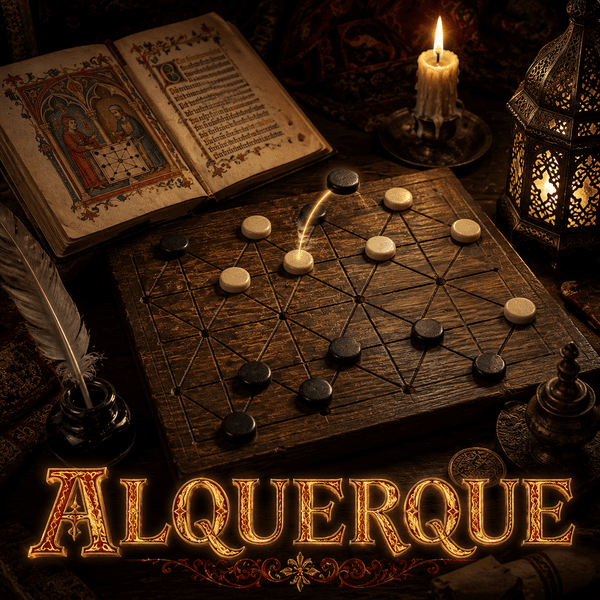
Alquerque is a two-player medieval strategy game and the direct ancestor of checkers. Each side moves twelve pieces along the lines of a 5×5 lattice, capturing by leaping over adjacent enemies; captures are mandatory and can chain. Recorded in Alfonso X’s Book of Games in 1283, a game takes ten to fifteen minutes.
Reviewed & updated
History & Origins
Alquerque reached Europe through Moorish Iberia as el-quirkat, a game already old in the Arab world, and entered the written record in style: King Alfonso X of Castile had its rules and problems illustrated in the Libro de los Juegos of 1283, one of the most beautiful games manuscripts ever made. Boards are scratched into cloister benches and church steps across Spain and the wider medieval world.
Its greatest legacy is its child. Around the twelfth century, players moved alquerque’s twelve pieces and its short leap onto the dark squares of a chessboard, and the result, fierges, evolved directly into draughts and checkers. Alquerque itself lived on in variants across North Africa and the Middle East, and in enlarged forms like the Zuni game kolowis awithlaknannai.
How to Play
Alquerque is checkers’ wilder grandfather: pieces move along marked lines in any direction, captures are compulsory, and one leap can cascade across the whole lattice.
- Set up twelve pieces per side on the 5x5 lattice of points, leaving only the center empty.
- On your turn, step one piece along a line to an adjacent empty point.
- If an adjacent enemy piece has an empty point directly beyond it along a line, you must leap it; the leapt piece is captured.
- A leaping piece keeps leaping while fresh captures remain, choosing its direction where chains branch.
- Win by capturing all enemy pieces or leaving your opponent without a legal move.
Strategy Tips
- Use the forcing power of mandatory captures: a deliberate sacrifice steers the enemy onto the exact point where your counter-chain begins.
- Calculate chains to the end; because replies are forced, alquerque tactics can be read out like checkers combinations.
- Prize the diagonal points: pieces on the X-crossings command up to eight lines, twice as many as the others.
- Keep a solid back rank early; every hole behind your wall is a future landing point for an enemy leap.
- When ahead on material, trade down aggressively; the mandatory-capture rule makes simplification easy to force.
Variations
The alquerque family is wide: de doze (the standard twelve-piece game), larger four-player forms in the Alfonso manuscript, North African quirkat variants, fox-and-geese style hunt games on the same lattice, and expanded boards like the Zuni kolowis awithlaknannai. And of course its most successful variant of all: checkers, played on the squares instead of the points.
Play Alquerque on Arcadia
Play Alquerque on Arcadia to master the leap that built checkers, seven centuries before your favorite draughts app.
Quick Answers
What does Alquerque mean?
The Spanish name comes from Arabic el-quirkat, the game the Moors brought to Iberia. Alfonso X’s 1283 Book of Games spells it alquerque and records the twelve-piece rules used today.
How did Alquerque become checkers?
Medieval players transferred its pieces and leap-capture onto the dark squares of a chessboard, added the forward-only rule and promotion, and draughts was born. The leap itself is unchanged.
Why do some points have no diagonals?
The lattice draws diagonal lines only through alternating points, forming the classic double-X pattern. Pieces on those crossings command eight directions; the others only four, which drives the strategy.
Are captures really mandatory?
Yes. If a leap exists you must take it, and chains must continue while captures remain. Historical players huffed (confiscated) a piece that failed to capture; the digital version simply enforces the rule.
Can I play Alquerque online for free?
Yes. Arcadia offers free Alquerque in your browser against an AI opponent, on the classic lattice with mandatory chain captures — no download or account required.
How old is Alquerque?
The game is at least a thousand years old: Arabic literature mentions qirkat by around the 10th century, and the Moors carried it into Iberia well before its full rules were written down. The oldest surviving rulebook is Alfonso X’s Libro de los Juegos, completed in 1283.
What is the Libro de los Juegos?
It is the illuminated “Book of Games” commissioned by King Alfonso X of Castile and completed in 1283 in Seville — one of the most important documents in board game history. Alongside chess problems, dice and tables games, it records the rules and problems of alquerque, which is why the game is known so well today.
How is Alquerque different from checkers?
Three ways stand out: pieces sit on the intersections of a lined lattice rather than on squares, they move and capture in any direction along those lines, and there are no kings or promotion. The board also starts almost full — 24 of the 25 points are occupied — so the tactics begin immediately.
Can you move backwards in Alquerque?
Yes. Every piece may step or leap in any direction a line allows, backwards and sideways included, from the first move to the last. That freedom is exactly what checkers later removed with its forward-only men, and it makes rearguard defence a genuine skill in alquerque.
Is Alquerque a game of luck or skill?
Pure skill: there are no dice and both players see everything. Because captures are compulsory, replies are often forced, so strong players calculate leaping chains several moves deep — the same reading skill checkers players use, on a wilder, more open board.
Why does Alquerque start with only one empty point?
The traditional setup fills 24 of the 25 points, leaving just the centre, so the opening move must step into the middle — where it can immediately be leapt. The Alfonso manuscript leaves some details unstated, so modern reconstructions handle this forced early exchange in slightly different ways.
What is Kolowis Awithlaknannai?
It is a member of the alquerque family played by the Zuni people of New Mexico, often translated as “fighting serpents”, using the same line-based movement and leaping captures on a long, stretched lattice. It is generally thought to have developed after contact with the Spanish, who carried alquerque to the Americas.
How long does a game of Alquerque take?
Ten to fifteen minutes is typical: the crowded start forces early trades, and mandatory captures keep the game moving. On Arcadia you can play free in your browser against the Vizier AI, with the classic lattice, chain leaps and compulsory captures enforced for you.
Related Games On Arcadia
Related Guides

MAIN MENU
PvP Games
 Battleship
 Crazy Eights
 Dots & Boxes Blitz
 Gomoku
 Ludo
Ludo Quoridor
 Snakes & Ladders
 Yahtzee
Free Games
Alquerque Backgammon
 Bagh-Chal
 Balut
Balut Battle for TokyoBattleship
 Bingo
Bingo Brick Breaker
 Bridge
 Bunco
Bunco Callbreak
 Checkers
 Chess
Chess ChompCrazy Eights
 Cribbage
 Dara
Dara Derby Dash
 DominoesDots & Boxes Blitz
 Durak
Durak Emberdeep
 Euchre
 Fanorona
 Farkle
 Fox and Geese
 Fox and Hounds
 Generala
 Gin Rummy
 Go / WeiqiGomoku
 Hazard
 Hearts
 Hex
Hex Higher or Lower
 Hnefatafl
 Hounds and Jackals
 Indian Rummy
 Jungle
 Ludus Latrunculorum
 Liar's DiceLudo
 Mahjong Solitaire
 Mancala
 Minesweeper
 Nim
Nim Nine Men's Morris
 Onitama
 Patolli
 Peg Solitaire
 Pentago
 Pente
Pente Pig
Pig PylosQuoridor
 Reversi
 Royal Game of Ur
 Scratch Cards
 Seega
Seega Senet
Senet Shax
Shax Ship, Captain, Crew
 Shut the Box
 Sixteen Soldiers
 SnakeSnakes & Ladders
 Klondike Solitaire
 Space Blaster
 Spades
 Sugar Pop
 Sungka
 Tangram
 Tile Rummy
 Tower
Tower Truco
Truco War
War Word Spy
 XII ScriptaYahtzee
NEED HELP?