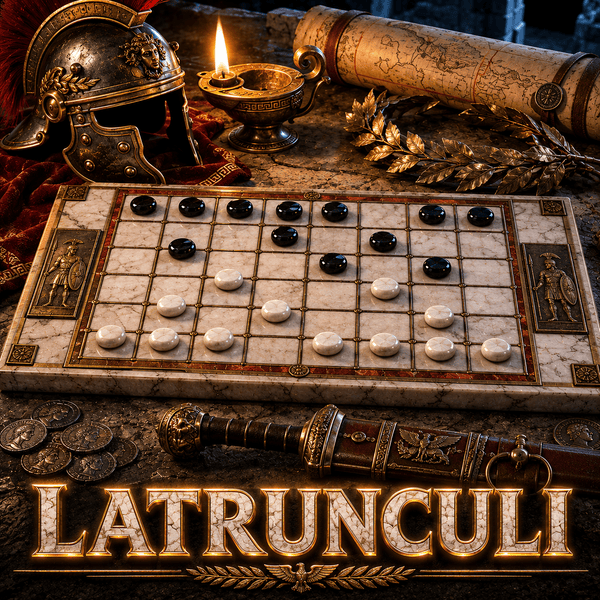
Ludus Latrunculorum - Rules, History & Strategy Guide
Latrunculi, or Ludus Latrunculorum, is the ancient Roman strategy game for two players, reconstructed by scholars from surviving boards and texts. Each side moves twelve identical men like rooks on an 8×8 board and captures by pinning an enemy between two of its own. There are no dice, and games take about ten to twenty minutes.
Reviewed & updated
History & Origins
Ludus latrunculorum, "the game of little soldiers" or "little bandits", was the strategy game of the Roman world. Boards scratched into stone and sets of glass counters have been excavated across the Empire, from the forts of Hadrian’s Wall to garrisons in Egypt and Syria, and Roman authors from Varro to Ovid mention the game and its skilled players. A famous epigram praises a champion whose "glass soldiers" never lost.
The game descends from the Greek petteia family of flanking games and stayed popular for centuries before fading in late antiquity. No complete rulebook survives, so modern play relies on reconstructions built from the boards themselves, the ancient references, and the mechanics of related custodian-capture games like hnefatafl and seega; the version played today uses an 8x8 board, twelve men per side, and rook movement.
How to Play
Latrunculi is a pure strategy duel with no dice: two even forces, orthogonal movement, and captures made by trapping an enemy man between two of yours.
- Set up twelve men per side: the full back row plus the middle four squares of the second row.
- On your turn, move one man any number of empty squares along a rank or file, like a rook.
- Capture by closing a trap: finish a move so an enemy man is orthogonally pinned between the man you moved and another of your men.
- Remember that stepping into a gap between two enemies yourself is safe; only the closing move captures.
- Win by reducing the enemy to two men, blockading him with no legal move, or leading on men after 60 captureless moves.
Strategy Tips
- Move in pairs: a man without a nearby partner threatens nothing, so advance men in mutually supporting duos.
- Fight for open files early; rook movement turns every open line into a highway for surprise flanks.
- Use safe entry as bait: sitting between two enemy men often forks two capture threats they cannot both answer.
- Count the exchange before wading into a cluster; the player who closes the final trap usually comes out ahead.
- Play the clock: with a material lead, simplify and let the 60-move siege rule convert your advantage.
Variations
Reconstructions differ mainly in board size (8x8, 8x12, and 7x8 boards all survive), starting rows, and whether pieces move one square or like rooks; some older rulesets add a "dux" piece borrowed from descriptions of related games. The custodian capture is common to the whole family, which stretches from Greek petteia through Egyptian seega to the Norse tafl games.
Play Ludus Latrunculorum on Arcadia
Play Ludus Latrunculorum on Arcadia to march your glass soldiers, close the pincers, and break the Brigand’s band.
Quick Answers
What does Ludus Latrunculorum mean?
Latin for "the game of little soldiers" (latrunculi were mercenaries or bandits). Romans often just called it latrunculi, and the men were commonly glass counters in two colors.
How is Latrunculi different from checkers or chess?
There is no jumping and no piece variety: every man moves like a rook, and captures happen by flanking an enemy between two of your men, not by landing on him.
Can a man be captured while standing between two enemies?
Only if an enemy move closes the trap. Walking into the gap voluntarily is safe, which makes safe entry a key tactical weapon.
Are the original rules known?
No. The boards and counters survive, but no rulebook does. Modern Latrunculi is a reconstruction consistent with the archaeology and with related custodian-capture games from the same family.
Can I play Ludus Latrunculorum online for free?
Yes. Arcadia offers free Latrunculi in your browser against an AI opponent — no download or account required.
How old is Ludus Latrunculorum?
The earliest surviving mention is by the Roman scholar Varro in the first century BC, and the game stayed popular for at least four centuries afterwards before fading in late antiquity. Its ancestry runs older still, back to the Greek flanking game petteia that Plato mentions.
Which ancient writers describe Latrunculi?
Varro discusses the game in the first century BC, Ovid mentions it in the Ars Amatoria, and the first-century poem Laus Pisonis praises a champion’s play at length — retreats, rescues, and encirclements. Together these sources sketch how the game felt, but none of them records the actual rules.
Where have Latrunculi boards been found?
Across the whole Roman world: scratched into stones at forts along Hadrian’s Wall, in garrison towns in Egypt and Syria, and in graves — a first-century burial at Stanway near Colchester held a board with glass counters still laid out as if mid-game. Grid sizes vary from site to site, which is why reconstructions disagree on the “correct” board.
Is Latrunculi related to the Greek game petteia?
Yes — historians treat latrunculi as the Roman development of the Greek petteia family of flanking games. Petteia was old enough for Plato to mention it, and Greek legend credited its invention to Palamedes during the siege of Troy.
Can you capture more than one piece in a single move in Latrunculi?
In most reconstructions, yes: if one move simultaneously pins two enemy men, each caught between the moved man and another of yours, both are taken. Multiple captures are rare in practice, but the threat of them is exactly why advancing unsupported men into enemy pairs is so dangerous.
Does Latrunculi have a king or dux piece?
The common 8×8 reconstruction uses twelve identical men per side and nothing else. Some reconstructions add a dux (“leader”) piece borrowed from descriptions of related games, but the version played here, like most modern sets, keeps plain, equal forces.
Is Latrunculi a game of luck or skill?
Pure skill: no dice, no hidden information, and completely equal forces make it the closest thing Rome had to chess. The ancient sources back this up — skilled players earned real reputations, and the Laus Pisonis treats mastery of the game as a mark of intellect.
How long does a game of Latrunculi take?
Typically 10–20 minutes. The 60-move captureless limit in the modern reconstruction stops endless sieges, and material losses tend to snowball once one side falls a man or two behind. Arcadia’s free browser version against an AI opponent is an easy way to learn pair tactics before facing human opponents.

MAIN MENU
PvP Games
 Battleship
 Crazy Eights
 Dots & Boxes Blitz
 Gomoku
 Ludo
Ludo Quoridor
 Snakes & Ladders
 Yahtzee
Free Games
 Alquerque
 Backgammon
 Bagh-Chal
 Balut
Balut Battle for TokyoBattleship
 Bingo
Bingo Brick Breaker
 Bridge
 Bunco
Bunco Callbreak
 Checkers
 Chess
Chess ChompCrazy Eights
 Cribbage
 Dara
Dara Derby Dash
 DominoesDots & Boxes Blitz
 Durak
Durak Emberdeep
 Euchre
 Fanorona
 Farkle
 Fox and Geese
 Fox and Hounds
 Generala
 Gin Rummy
 Go / WeiqiGomoku
 Hazard
 Hearts
 Hex
Hex Higher or Lower
 Hnefatafl
 Hounds and Jackals
 Indian Rummy
 JungleLudus Latrunculorum
 Liar's DiceLudo
 Mahjong Solitaire
 Mancala
 Minesweeper
 Nim
Nim Nine Men's Morris
 Onitama
 Patolli
 Peg Solitaire
 Pentago
 Pente
Pente Pig
Pig PylosQuoridor
 Reversi
 Royal Game of Ur
 Scratch Cards
 Seega
Seega Senet
Senet Shax
Shax Ship, Captain, Crew
 Shut the Box
 Sixteen Soldiers
 SnakeSnakes & Ladders
 Klondike Solitaire
 Space Blaster
 Spades
 Sugar Pop
 Sungka
 Tangram
 Tile Rummy
 Tower
Tower Truco
Truco War
War Word Spy
 XII ScriptaYahtzee
NEED HELP?