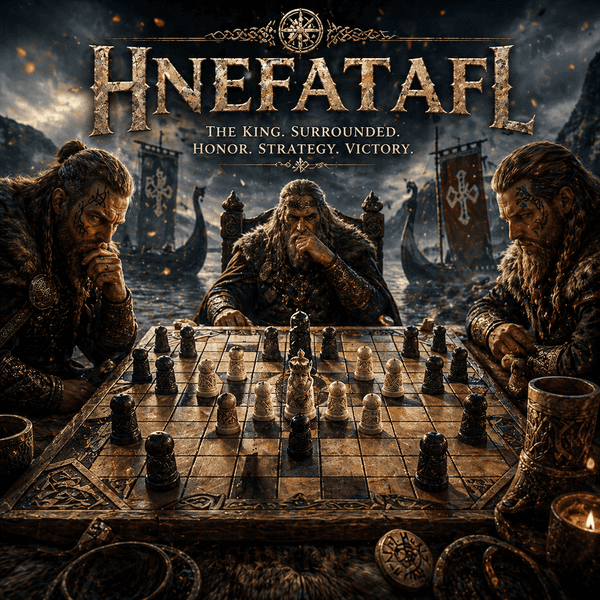
Hnefatafl - Rules, History & Strategy Guide
Hnefatafl is the Viking-age asymmetric strategy game for two players: a king and twelve defenders try to reach a corner of the 11×11 board, while twenty-four attackers try to surround and capture the king. Pieces move like rooks and capture by flanking. Games are played with modern reconstructed rules and take roughly fifteen to thirty minutes.
Reviewed & updated
History & Origins
Hnefatafl was the dominant board game across the Viking world from roughly 400 to 1300 AD, played from Iceland to Lapland. The name translates roughly as "king's board" or "fist-table," and references in the Icelandic sagas and Anglo-Saxon poetry place it firmly in the leisure life of warriors and nobility.
When chess arrived in Scandinavia in the late medieval period, it gradually displaced Hnefatafl, which was nearly extinct by the 1500s. Modern reconstructions are based on archaeological finds — partial boards from Viking ship burials, fragmentary rule descriptions in 18th-century Welsh sources — combined with informed guesswork. The version most commonly played today (and on Arcadia) is the 11×11 "Tablut" variant, named after the Sami version Linnaeus documented in 1732.
How to Play
Hnefatafl is asymmetric: one player commands a king plus 12 defenders, the other commands 24 attackers. The defenders try to escort the king to one of the four corner squares; the attackers try to capture the king by surrounding it on all four sides.
- The king starts on the centre square (the "throne"). Defenders surround the king. Attackers are placed in groups along the four edges.
- Pieces move like a rook in chess — any number of empty squares horizontally or vertically. No diagonal movement.
- Only the king may stop on the throne or in a corner square. Other pieces may pass through the empty throne but cannot stop there.
- Capture by flanking: move so an enemy piece is sandwiched between two of your pieces (or between one of your pieces and a corner/throne).
- Defender wins: the king reaches any corner square. Attacker wins: the king is captured (surrounded on all four sides, or three sides + the throne).
Strategy Tips
- As defender, get the king out early. The king is most vulnerable when surrounded by his own forces in the centre — a trapped king on the throne is an attacker's dream.
- As attacker, control the four "axis lines" extending from the throne. If you can keep the king from reaching any of those four corridors, you slowly suffocate the escape.
- Watch for "shieldwall" formations along the edges — three or four defenders in a row can be captured all at once if the attacker brackets the line at both ends.
- The corners are safe ground for the king but trap zones for everyone else — pieces can be captured against a corner the same way they're captured against a friendly piece.
- In the opening, attackers should split their forces to prevent the king from running to a single corner unimpeded. Don't mass everyone on one side.
Variations
Hnefatafl has many regional variants: Tablut (9×9, Sami), Brandubh (7×7, Irish), Tawlbwrdd (11×11, Welsh), and Alea Evangelii (19×19, Anglo-Saxon). Board size, piece count, and capture rules vary, but the core asymmetric "king vs. attackers" structure stays the same. Arcadia's version uses the 11×11 Tablut layout with corner-escape victory.
Play Hnefatafl on Arcadia
Play Hnefatafl on Arcadia to step into the Viking world — pick a side, command the king or the encirclement, and find out why this game outlasted empires.
Quick Answers
What does Hnefatafl mean?
Roughly "king's table" or "fist-table" in Old Norse. "Hnef" means king or fist; "tafl" is a Scandinavian word for board game (it's where the modern Swedish word "tavla" comes from).
How is the king captured in Hnefatafl?
The king must be surrounded on all four orthogonal sides by attacking pieces (or three sides plus the throne or a board edge). Standard piece-capture by sandwiching does not capture the king.
Is Hnefatafl older than chess?
Yes — Hnefatafl was widespread across Northern Europe by 400 AD, predating chess's arrival in Europe by several centuries. The two games likely coexisted for a few hundred years before chess displaced Hnefatafl in popularity.
Which side is harder to play?
Modern analysis suggests defender (king + 12) has a slight edge in the standard 11×11 Tablut variant, but the asymmetric play styles reward different skills. Defenders need to plan escape routes; attackers need to coordinate encirclement.
Can I play Hnefatafl online for free?
Yes. Arcadia offers free Hnefatafl against a heuristic AI that understands flanking captures, encirclement scoring, and king-corridor defence — no download or account required.
Are the original Hnefatafl rules known?
No complete medieval rule set survives. Modern play is a reconstruction built from archaeological boards, saga references, and Linnaeus’s 1732 notes on Sami Tablut, refined into standards such as the Copenhagen Hnefatafl rules used in online tournament play. Different reconstructions disagree on details, so always check which rule set a given game uses.
What are the Copenhagen Hnefatafl rules?
Copenhagen is the most widely used modern tournament rule set for 11×11 Hnefatafl. Its signature additions include the shieldwall capture along board edges and an attacker win by surrounding all the defenders, on top of the familiar corner escape and four-sided king capture. It is a modern reconstruction, not a recovered medieval original.
Why does the king escape to the corners instead of the edges?
Both versions exist. The Tablut that Linnaeus documented is usually read as an edge-escape game, but modern reconstructions mostly use corner escape because reaching one of 4 corners is far harder than reaching any of 40 edge squares, which balances the sides better.
Can the king help make captures in Hnefatafl?
It depends on the reconstruction. In the Copenhagen rules the king is armed and can act as one half of a flanking pair, while other rule sets play an unarmed king who never captures. The choice matters most in the endgame, when the king often has to fight his own way along the edge.
Is Hnefatafl a game of luck or skill?
Pure skill: there are no dice and no hidden information, just two uneven armies with perfect information. Unlike chess, the two sides play towards different goals, so mastering Hnefatafl really means learning two games — escort play and siege play.
How long does a game of Hnefatafl take?
Casual 11×11 games usually run 15–30 minutes, and attacker blunders can end matters far sooner, because one open corridor is all the king needs. On Arcadia you can play free in the browser against the AI, which makes it easy to fit a full game into a short break.
Is Hnefatafl mentioned in the Viking sagas?
Yes. Tafl play appears in the riddles of Hervarar saga, and in Orkneyinga saga Earl Rognvald Kali lists skill at tafl first among his nine accomplishments. These references prove the game’s cultural standing, but frustratingly none of them explains the rules.
What archaeological evidence exists for Hnefatafl?
Boards and playing pieces turn up across northern Europe, including the well-preserved tenth-century board from Ballinderry in Ireland and pieces in amber, glass, bone, and walrus ivory from graves and trading towns. The finds show that board sizes varied widely, which is one reason so many regional variants are reconstructed today.
Related Games On Arcadia
Related Guides

MAIN MENU
PvP Games
 Battleship
 Crazy Eights
 Dots & Boxes Blitz
 Gomoku
 Ludo
Ludo Quoridor
 Snakes & Ladders
 Yahtzee
Free Games
 Alquerque
 Backgammon
 Bagh-Chal
 Balut
Balut Battle for TokyoBattleship
 Bingo
Bingo Brick Breaker
 Bridge
 Bunco
Bunco Callbreak
 Checkers
 Chess
Chess ChompCrazy Eights
 Cribbage
 Dara
Dara Derby Dash
 DominoesDots & Boxes Blitz
 Durak
Durak Emberdeep
 Euchre
 Fanorona
 Farkle
 Fox and Geese
 Fox and Hounds
 Generala
 Gin Rummy
 Go / WeiqiGomoku
 Hazard
 Hearts
 Hex
Hex Higher or LowerHnefatafl
 Hounds and Jackals
 Indian Rummy
 Jungle
 Ludus Latrunculorum
 Liar's DiceLudo
 Mahjong Solitaire
 Mancala
 Minesweeper
 Nim
Nim Nine Men's Morris
 Onitama
 Patolli
 Peg Solitaire
 Pentago
 Pente
Pente Pig
Pig PylosQuoridor
 Reversi
 Royal Game of Ur
 Scratch Cards
 Seega
Seega Senet
Senet Shax
Shax Ship, Captain, Crew
 Shut the Box
 Sixteen Soldiers
 SnakeSnakes & Ladders
 Klondike Solitaire
 Space Blaster
 Spades
 Sugar Pop
 Sungka
 Tangram
 Tile Rummy
 Tower
Tower Truco
Truco War
War Word Spy
 XII ScriptaYahtzee
NEED HELP?