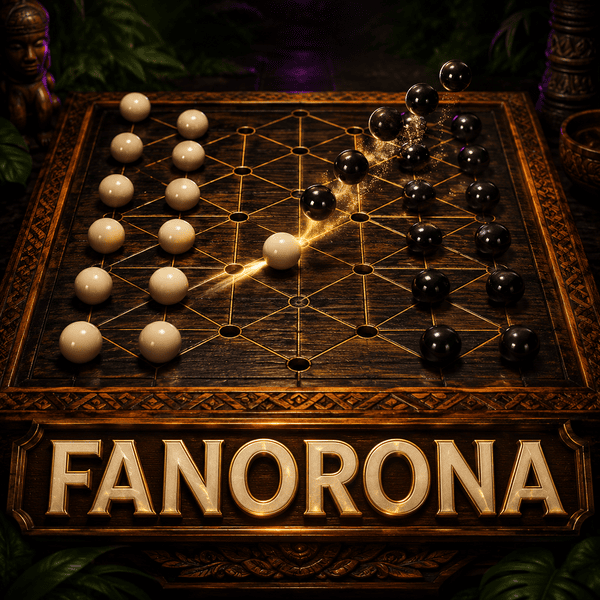
Fanorona - Rules, History & Strategy Guide
Fanorona is Madagascar’s national board game, a two-player capture duel on a 5×9 grid of 45 points. Stones step along marked lines and capture entire enemy lines by approaching or withdrawing, with chains sweeping several stones per turn. Capturing everything wins; a typical game lasts 15–30 minutes.
Reviewed & updated
History & Origins
Fanorona grew out of the older stone-lined boards of Madagascar and became the island’s national game, wrapped in Malagasy legend and royal history. Tradition holds that a diviner once used a game of Fanorona to delay a king long enough to change the fate of a kingdom — a story that captures how seriously the game was taken as a test of foresight.
Descended from the same draughts family as checkers, Fanorona keeps the familiar idea of jumping stones but replaces it with two radically different capture methods and long forced chains. That combination gives it a reputation as one of the deepest of the traditional capture games, and it has been studied by mathematicians and solved for its smaller variants.
How to Play
You play the ivory stones against an onyx AI on a 5×9 grid of 45 points, where diagonals exist only on the strong even points. The goal is to capture every enemy stone.
- Move one stone a single step along a line to an adjacent empty point.
- Capture by approach when your step lands next to an enemy line ahead; capture by withdrawal when your step moves directly away from an enemy line behind.
- When a single step could capture both ways, you choose which enemy line is removed.
- After a capture the same stone may keep striking — each strike must change direction and never revisit a visited point.
- Capturing is mandatory whenever a capture exists; the first player to clear all enemy stones wins.
Strategy Tips
- Look for double-threat steps where one move can capture two different lines and take the larger haul.
- Because capture is forced, bait the AI into a mandatory move that fractures its formation.
- Plan whole chains before committing — a well-aimed zig-zag can clear a third of the board in one turn.
- Fight for the strong diagonal points; they offer the most directions to strike and to escape.
- Keep your back rank intact early, since broken lines invite withdrawal captures.
Variations
The most common form is Fanoron-Tsivy on the 5×9 board, but smaller boards — Fanoron-Telo (3×3) and Fanoron-Dimy (5×5) — are used for teaching and quick play. House rules vary on how draws and repeated positions are handled, and competitive Malagasy play uses strict conventions for the mandatory-capture and chain rules.
Play Fanorona on Arcadia
Play Fanorona on Arcadia to strike by advance or retreat, chain your captures, and sweep the board in Madagascar’s national game of strategy.
Quick Answers
How is Fanorona different from checkers?
You capture by moving toward OR away from enemy stones, a single move can clear an entire line of them, and multi-capture chains plus a mandatory-capture rule add depth that checkers does not have.
What is the difference between approach and withdrawal captures?
Approach removes the enemy line directly ahead of the point you move into. Withdrawal removes the enemy line directly behind the point you move away from. If one step does both, you choose which line falls.
Do I have to capture in Fanorona?
Yes. If any capturing move exists you must play one — you cannot make a quiet move while a capture is available. This forcing rule is central to the game.
How do capture chains work?
After a capture the same stone may strike again, but each new strike must change direction and may not return to a point already visited that turn. You may stop the chain whenever you choose.
Can I play Fanorona online for free?
Yes. Arcadia offers free Fanorona against an AI opponent, with full approach and withdrawal captures and chains — no download or account required.
Is Fanorona a solved game?
Yes — computer analysis published in 2008 weakly solved standard 5×9 Fanorona, proving that perfect play by both sides ends in a draw. Smaller boards were analysed in the same research. For human play the result is academic, since the forced-capture chains create constant opportunities to go wrong.
How many pieces does each player have in Fanorona?
Each side starts with 22 stones on a board of 45 intersections, leaving only the central point empty. Because 44 of the 45 points begin occupied, every opening move contests that single central gap, and the first captures cascade from there.
What are strong points on a Fanorona board?
Strong points are the intersections where diagonal lines cross, giving a stone up to eight directions to move or strike; weak points connect only along rows and columns, giving four. They alternate across the 5×9 grid, and fighting for the strong points is a recurring strategic theme.
What game is Fanorona descended from?
Fanorona is generally traced to Alquerque, the medieval Mediterranean capture game that also fed into modern draughts. Malagasy players transformed the inherited jump-capture idea into the approach-and-withdrawal system, which is unique to Fanorona.
How long does a game of Fanorona take?
Casual games usually finish in 15–30 minutes — quicker than comparable checkers matches, because mandatory chain captures can strip several stones in a single turn. Endgames between experienced players can stretch longer once few stones remain and captures become harder to force.
What are Fanoron-Telo and Fanoron-Dimy?
They are the small variants: Fanoron-Telo on a 3×3 board and Fanoron-Dimy on 5×5, with the full 5×9 game called Fanoron-Tsivy. Children traditionally learn on the small boards first, since the capture rules are identical and only the scale changes.
Is Fanorona hard to learn?
The rules take minutes: step to an adjacent point, capture by approach or withdrawal, keep chaining while you legally can. Judging which capture to take — and which one you will be forced into next — is where the depth lives, and a few practice games against Arcadia’s free AI make the patterns click quickly.
Why is Fanorona called Madagascar’s national game?
It has been woven into Malagasy court life, divination, and legend for centuries, with boards carved into rock and stone at royal sites in the central highlands. Stories credit games of Fanorona with influencing royal decisions, and it remains a living pastime across the island today.
Related Games On Arcadia
Related Guides

MAIN MENU
PvP Games
 Battleship
 Crazy Eights
 Dots & Boxes Blitz
 Gomoku
 Ludo
Ludo Quoridor
 Snakes & Ladders
 Yahtzee
Free Games
 Alquerque
 Backgammon
 Bagh-Chal
 Balut
Balut Battle for TokyoBattleship
 Bingo
Bingo Brick Breaker
 Bridge
 Bunco
Bunco Callbreak
 Checkers
 Chess
Chess ChompCrazy Eights
 Cribbage
 Dara
Dara Derby Dash
 DominoesDots & Boxes Blitz
 Durak
Durak Emberdeep
 EuchreFanorona
 Farkle
 Fox and Geese
 Fox and Hounds
 Generala
 Gin Rummy
 Go / WeiqiGomoku
 Hazard
 Hearts
 Hex
Hex Higher or Lower
 Hnefatafl
 Hounds and Jackals
 Indian Rummy
 Jungle
 Ludus Latrunculorum
 Liar's DiceLudo
 Mahjong Solitaire
 Mancala
 Minesweeper
 Nim
Nim Nine Men's Morris
 Onitama
 Patolli
 Peg Solitaire
 Pentago
 Pente
Pente Pig
Pig PylosQuoridor
 Reversi
 Royal Game of Ur
 Scratch Cards
 Seega
Seega Senet
Senet Shax
Shax Ship, Captain, Crew
 Shut the Box
 Sixteen Soldiers
 SnakeSnakes & Ladders
 Klondike Solitaire
 Space Blaster
 Spades
 Sugar Pop
 Sungka
 Tangram
 Tile Rummy
 Tower
Tower Truco
Truco War
War Word Spy
 XII ScriptaYahtzee
NEED HELP?