Bagh-Chal - Rules, History & Strategy Guide
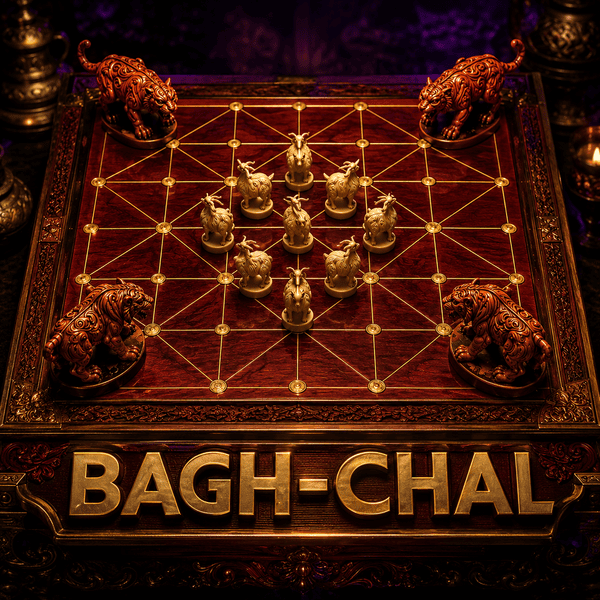
Bagh-Chal is Nepal’s asymmetric hunt game for two players: four tigers face twenty goats on a 5×5 grid of lines. Goats drop onto the board one per turn and then shuffle to smother the tigers, while tigers leap over goats to eat them. Games are quick, usually ten to twenty minutes.
Reviewed & updated
History & Origins
Bagh-Chal — literally “moving tigers” in Nepali — is the national board game of Nepal, played for generations on brass boards and carved temple steps across the Kathmandu Valley. It belongs to a wider family of Asian hunt games in which unequal forces face off: a few powerful hunters against a swarm of weaker prey. The tigers embody raw striking power, the goats collective defence.
Its endurance comes from perfect asymmetry. The two sides play by entirely different rules and pursue opposite goals, yet the game is finely balanced and needs no dice or cards. That purity — hidden depth behind a handful of rules and a 5×5 grid — is why Bagh-Chal travelled out of the Himalayas into game collections and digital boards worldwide.
How to Play
You command twenty goats against four tigers controlled by the computer. The tigers start on the corners; you win by immobilising all of them.
- Placement phase: on each turn, drop one goat onto any empty point while the tigers move between your drops.
- Once all twenty goats are placed, move a goat one step along a line to an adjacent empty point.
- Tigers move one step along a line, or capture by leaping in a straight line over a single adjacent goat into the empty point beyond.
- Tigers can leap and capture a lone goat at any time, including during the placement phase — only a goat backed by another piece (or with no empty landing point beyond it) is safe.
- Tigers win by eating five goats; goats win by leaving no tiger with a legal move.
Strategy Tips
- Never leave an empty point in line directly behind a goat that a tiger faces — that is a free leap.
- Place goats in pairs and walls so each protects the other from being jumped.
- Herd the tigers toward corners and edges where their escape and leap lines are fewest.
- Sacrifice a goat only when it locks down a tiger for good — tempo matters more than material.
- Treat the opening placements as the whole game: a solid front beats a scattered herd.
Variations
Regional cousins abound — from Aadu Puli Aatam in South India to Rimau-rimau in Malaysia and Catch the Hare in medieval Europe — each tweaking the board size, tiger count, or capture rules. Some versions add more tigers or a larger grid; the core tension of nimble hunters against a smothering herd stays the same.
Play Bagh-Chal on Arcadia
Play Bagh-Chal on Arcadia to command the herd, wall off the leaps, and smother all four tigers in Nepal’s national game of pursuit.
Quick Answers
How do you win Bagh-Chal as the goats?
You win by blocking every tiger so that none of the four can move — no step and no leap. It is a game of encirclement, not capture.
How do tigers capture goats?
A tiger leaps in a straight line over one adjacent goat into the empty point directly beyond it, just like a short jump in checkers. Five captured goats wins the game for the tigers.
Can goats be captured while being placed?
Yes. In authentic Bagh-Chal, tigers can leap and eat goats at any point once they are on the board, including during the placement phase. The only protection is positional — a goat backed by another piece, or with no empty landing point in line beyond it, cannot be jumped.
Is Bagh-Chal a game of luck?
Not at all. There are no dice or cards — every outcome is decided by positioning, which is why strong placement in the opening is so important.
Can I play Bagh-Chal online for free?
Yes. Arcadia offers free Bagh-Chal against an AI that plays the four tigers — no download or account required.
What does Bagh-Chal mean?
Bagh-Chal means "moving tigers" in Nepali — bagh is the word for tiger. The name reflects the tiger side’s role as the mobile hunters of the game, in contrast to the goats, which win by standing firm and smothering movement.
How many pieces are used in Bagh-Chal?
Bagh-Chal uses four tigers and twenty goats on a 5×5 grid of twenty-five points joined by lines. The tigers start on the four corner points, while all twenty goats begin off the board and are dropped one per turn during the placement phase.
Is it better to play the tigers or the goats in Bagh-Chal?
Beginners usually find the tigers easier, because any loose goat placement hands them a capture in the opening. The goats demand more patience: they must absorb early pressure, build connected walls, and only then squeeze the tigers into corners. Learning both sides is the fastest way to understand the game’s balance.
Can a tiger jump two goats at once in Bagh-Chal?
No. A tiger leaps over exactly one adjacent goat in a straight line, landing on the empty point directly beyond it. Unlike checkers, standard Bagh-Chal has no chained captures, so a tiger takes at most one goat per turn.
Can Bagh-Chal end in a draw?
In casual play, yes — the sides can fall into a loop where the same moves repeat and neither side makes progress. Many modern rule sets therefore forbid returning to an earlier board position, which pushes the game towards a decisive finish.
What games are similar to Bagh-Chal?
Bagh-Chal belongs to a wide family of Asian hunt games in which a few powerful hunters face a swarm of weaker prey. Close cousins include Aadu Puli Aatam in South India, Rimau-rimau in Malaysia, and the medieval European Fox and Geese line, each varying the board, the number of hunters, or the capture rules.
Can goats move before all twenty are placed?
No. During the placement phase the goat player only drops goats, one per turn, while the tigers move and hunt between drops. Goats gain the ability to step to adjacent empty points only after the full herd of twenty is on the board.
Is Bagh-Chal hard to learn?
The rules take a couple of minutes: goats drop then step, tigers step or leap, and each side has one clear goal. Playing the goats well is the hard part, since a single careless placement can cost a capture. Practising free against the AI tigers on Arcadia — no download or account needed — is a quick way to build sound placement habits.
Related Games On Arcadia
Related Guides

MAIN MENU
PvP Games
 Battleship
 Crazy Eights
 Dots & Boxes Blitz
 Gomoku
 Ludo
Ludo Quoridor
 Snakes & Ladders
 Yahtzee
Free Games
 Alquerque
 BackgammonBagh-Chal
 Balut
Balut Battle for TokyoBattleship
 Bingo
Bingo Brick Breaker
 Bridge
 Bunco
Bunco Callbreak
 Checkers
 Chess
Chess ChompCrazy Eights
 Cribbage
 Dara
Dara Derby Dash
 DominoesDots & Boxes Blitz
 Durak
Durak Emberdeep
 Euchre
 Fanorona
 Farkle
 Fox and Geese
 Fox and Hounds
 Generala
 Gin Rummy
 Go / WeiqiGomoku
 Hazard
 Hearts
 Hex
Hex Higher or Lower
 Hnefatafl
 Hounds and Jackals
 Indian Rummy
 Jungle
 Ludus Latrunculorum
 Liar's DiceLudo
 Mahjong Solitaire
 Mancala
 Minesweeper
 Nim
Nim Nine Men's Morris
 Onitama
 Patolli
 Peg Solitaire
 Pentago
 Pente
Pente Pig
Pig PylosQuoridor
 Reversi
 Royal Game of Ur
 Scratch Cards
 Seega
Seega Senet
Senet Shax
Shax Ship, Captain, Crew
 Shut the Box
 Sixteen Soldiers
 SnakeSnakes & Ladders
 Klondike Solitaire
 Space Blaster
 Spades
 Sugar Pop
 Sungka
 Tangram
 Tile Rummy
 Tower
Tower Truco
Truco War
War Word Spy
 XII ScriptaYahtzee
NEED HELP?