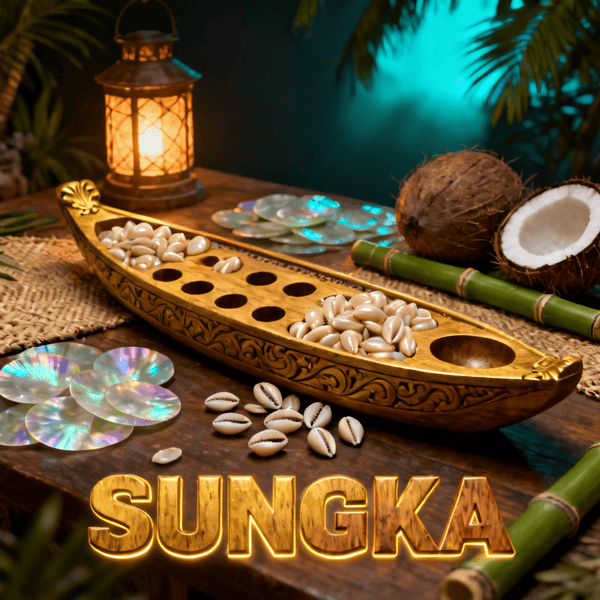
Sungka on Arcadia
Sungkâ is the Philippine member of the Southeast Asian mancala family — a living household game, not a museum piece. Two rows of seven holes, a large store called a head at each end, and 98 seeds that never leave the board until somebody runs dry.
What makes this family different from other mancalas is simple and decisive: you sow into your own head as you pass it, but never into your opponent's. Add relay sowing — scoop up whatever hole your last seed fills and keep going — and a single turn can run lap after lap before it finally dies.
Arcadia's version plays the full round structure, burnt holes included, against an AI with three strengths.
How to Play
- Every one of the fourteen small holes starts with seven seeds. The bottom row and the right-hand head are yours.
- Click one of your holes to scoop every seed out of it and drop one into each hole you pass. The direction used here runs along your own row toward your head, through your head, then along the opponent's row. Their head is always skipped.
- If your last seed lands in your own head, you sow again from any of your holes.
- If it lands in a hole that already had seeds, pick that whole hole up and carry on sowing — the relay.
- If it lands in an empty hole on your side, you take that seed plus everything in the hole facing it, and your turn ends.
- If it lands in an empty hole on their side, the turn ends and that seed stays where it fell.
Rounds, Sweeps and Burnt Holes
- A round ends the moment the player whose turn it is has no seeds in any of their holes.
- Everything still lying in the other player's holes is swept into that player's head, so all 98 seeds are banked at the end of every round.
- Both players then refill their own holes from their own head, seven seeds a hole, in their own direction of play.
- Holes you cannot fill are burnt: out of play for the whole round, skipped during sowing, and worthless to both sides.
- The loser of the round opens the next one — the only compensation the trailing player gets.
- Lose your last fillable hole and the match is over. In this version a match also stops after seven rounds, with the bigger head winning.
Strategy: Counting to Your Head
Chain your free turns first. A hole holding exactly as many seeds as the steps to your head ends in your head and buys another move. From the opening layout that is the hole farthest from your head, and stringing those together before touching anything else is the standard strong start.
Follow the relay, not the first lap. The obvious-looking scoop often dies two laps later in an empty hole on the opponent's side. Trace where the chain actually stops before you commit — that is where the whole game is decided.
Empty a hole on purpose. A capture needs your last seed to drop into an empty hole of your own with a loaded hole facing it. Emptying that hole a turn early, then arriving on it exactly, is the classic set-up.
Play the round, not the move. Starving your own row hands the sweep to your opponent. Ending a round with a full row of seeds you never got to sow is how comfortable leads evaporate.
Practical Tips
- The ★ marker on a hole means that scoop finishes in your head — a free extra turn, relay laps included.
- Watch the seeds-in-hand counter during a long relay; it tells you how far the chain still has to run.
- Burnt holes are drawn hatched and crossed. Sowing steps straight over them, so a burnt row shortens the lap for everyone.
- Falling behind is not fatal: the loser opens the next round, and the opening in Sungka is worth a lot.
- Three AI strengths — Gentle, Steady and Sharp. Sharp searches your reply as well as its own chain.
The Southeast Asian Mancala Family
Sungkâ is not an isolated game. Its close relatives are congkak in Malaysia, congklak or dakon in Indonesia and Brunei, chonka in Sri Lanka, ohvalhu in the Maldives, and chongka in the Marianas and in Taiwan, carried there by Filipino migration. Game scholars group them together because of one shared trait: unlike most mancalas, a player sows into their own store while passing it.
How the mancala idea reached Southeast Asia in the first place is not known. Mancala games as a whole are ancient — the oldest known boards come from a ruined fort in Roman Egypt and date to the 4th century AD — but that is a fact about the family, not about Sungka, and no reliable origin date exists for the Philippine game itself.
FAQ
How many seeds are used in Sungka?
98 — seven seeds in each of the fourteen small holes. The two heads start empty, and no seed ever leaves the board, so at the end of every round the two heads together hold all 98.
What is the relay rule in Sungka?
If your last seed lands in a hole that already contained seeds, you scoop up that entire hole — your new seed included — and keep sowing from there. Chains of several laps are normal, and this is the main thing that separates Sungka from the Kalah-style Mancala most Westerners know.
How do you capture in Sungka?
Land your last seed in an empty hole on your own side. You take that seed plus everything in the opponent's hole directly opposite, straight into your head, and your turn ends. If the facing hole is empty you bank only your own seed.
What are burnt holes?
Between rounds each player refills their own holes seven seeds at a time from their own head. Any hole they cannot fill is burnt — out of play for that round and skipped during sowing. Burnt holes are how a bad round turns into a losing position.
Is Sungka the same as congkak?
They are close relatives in the same Southeast Asian family — congkak is the Malaysian version, congklak or dakon the Indonesian and Bruneian one. Board sizes and small rules differ from place to place, and even the direction of sowing is described differently by different sources.
Can I play Sungka online for free?
Yes. Arcadia runs free Sungka in your browser against an AI at three strengths, with the full round structure and burnt holes — no download and no account.
Related Games

Ready to play Sungka?
Launch the free demo, learn the flow, and practice your tactics.