Sungka - Rules, History & Strategy Guide
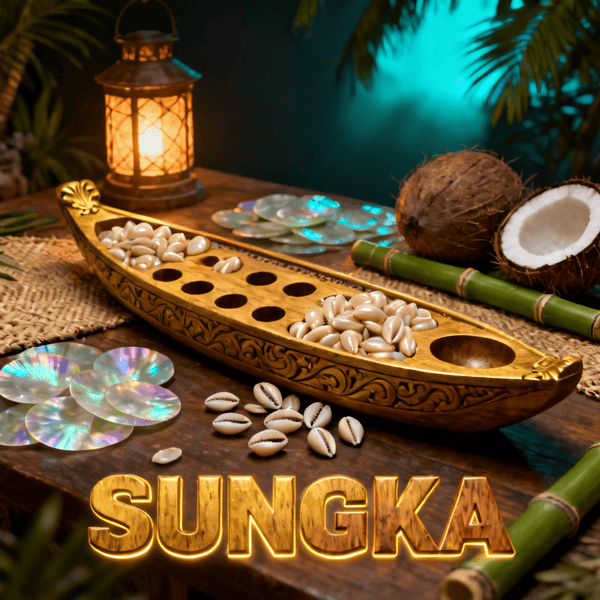
Sungka is the Philippine member of the Southeast Asian mancala family, played on two rows of seven holes with a large store, the head, at each end. Players sow 98 seeds one per hole, dropping into their own head but never the opponent’s, and relay onward whenever the last seed fills an occupied hole. The bigger head wins.
Reviewed & updated
History & Origins
Sungkâ is the Philippine member of the Southeast Asian mancala family, whose relatives include congkak in Malaysia, congklak and dakon in Indonesia and Brunei, chonka in Sri Lanka, ohvalhu in the Maldives, and chongka in the Marianas and Taiwan, carried there by Filipino migration. What sets this whole family apart from other mancalas is that a player’s own store counts as a hole during sowing.
The oldest known mancala boards come from a ruined fort of Roman Egypt and date to the 4th century AD — but that is the mancala family as a whole, not sungka, and the route by which these games reached Southeast Asia is unknown. There is no reliable origin date for sungka itself. Boards are traditionally carved as elongated wooden boats, and the seeds are often cowrie shells.
How to Play
Two rows of seven holes with a large store at each end. Every small hole starts with seven seeds — 98 in all — and you win by gathering more of them into your store than your opponent does.
- Scoop up all the seeds from one of your own holes and drop one into each hole around the board, passing through your own store but never your opponent’s.
- If your last seed lands in your own store, you go again from any of your holes.
- If your last seed lands in a hole that already had seeds, pick up everything there and keep sowing. This relay is what makes a Sungka turn long.
- If your last seed lands in an empty hole on your side, you capture the seeds in the opponent’s hole directly opposite, plus your own last seed, into your store — and your turn ends.
- If your last seed lands in an empty hole on the opponent’s side, your turn simply ends and that seed stays there.
- The round ends when the player to move has no seeds left; the remaining seeds go to the other player.
- Refill from your own store, seven seeds a hole. Any hole you cannot fill is burnt: it is skipped for the rest of that round.
Strategy Tips
- Count to your store. Any hole holding exactly the number of seeds needed to end there gives you a free extra turn — chain those and one turn can run a long way.
- Extra turns are worth more than captures early, because each one buys you another look at the board.
- Set up captures by emptying a hole on your side and watching the opposite hole fill; the payoff is both piles at once.
- Watch what your relay leaves behind. A long chain that ends by loading your opponent’s side hands them the material.
- Burnt holes shorten the circuit, which changes every count. Recount from scratch at the start of each new round.
Variations
Hole counts across this family range from three to nine or more a side, and the rules shift with them, so a congkak or dakon board you meet elsewhere may behave differently. Traditionally sungka opens with both players sowing at the same time, which cannot work against a computer — Arcadia therefore alternates turns with you moving first. Sources also disagree about which way round the board the seeds travel, so no direction is claimed here as the historically correct one.
Play Sungka on Arcadia
Play Sungka on Arcadia: chain relay laps, time your captures and outcount the AI across a full multi-round match.
Quick Answers
How is Sungka different from Mancala?
"Mancala" is the family name; sungka is one member of it. The Southeast Asian branch is distinguished by counting your own store as a hole while sowing, and by relay sowing — landing on an occupied hole means you scoop it up and keep going, which Kalah-style mancala does not do.
How many seeds are used in Sungka?
Ninety-eight: seven in each of the fourteen small holes, with both stores starting empty.
What is a burnt hole?
From the second round on, you refill your holes from your own store with seven seeds each. If you do not have enough seeds to fill them all, the ones left unfilled are burnt — they are skipped entirely for that round, which shortens the circuit and changes every count.
How do you capture in Sungka?
By landing your final seed in an empty hole on your own side. You then take everything in the opponent’s hole directly opposite, along with your last seed, into your store. If that opposite hole is empty you bank only the single seed.
Can I play Sungka online for free?
Yes. Arcadia runs Sungka free in your browser against three levels of AI, with full relay sowing, captures and multi-round play — no download and no account.
What is the difference between Sungka and Mancala?
Mancala is the family name for hundreds of sowing games; Sungka is one specific Philippine member of it. Against the Kalah-style Mancala sold in the West, Sungka uses seven holes a side instead of six, and adds relay sowing: when your last seed lands in a hole that already had seeds, you scoop that hole up and keep going.
Do both players really move at the same time in Sungka?
Traditionally yes — a game opens with both players sowing simultaneously, which is part of the noise and the fun of it. That cannot work against a computer opponent in a turn-based interface, so this version alternates turns with you moving first. Everything else, including the relay and the burnt holes, follows the normal rules.
Which direction do you sow in Sungka?
Sources disagree, and congkak is usually described as running the opposite way to sungka, so there is no single direction you can call the correct one. What matters is that one direction is used consistently. In this version you sow along your own row toward your head, through your head, and on into the opponent’s row.
How old is Sungka?
There is no reliable origin date for Sungka itself, and how the mancala idea reached Southeast Asia is unknown. The family is genuinely ancient — the oldest known mancala boards come from a ruined fort in Roman Egypt and date to the 4th century AD — but that is a fact about mancala in general, not about the Philippine game.
How do you win at Sungka?
By banking more of the 98 seeds in your head than your opponent banks in theirs. Rounds end when the player to move has nothing left to sow; the other player sweeps their remaining seeds. Refill seven seeds a hole from your head, and a player who cannot fill even one hole has lost the match.
What does it mean when a hole is burnt in Sungka?
A burnt hole is one a player could not refill with seven seeds at the start of a round. It stays out of play for that whole round: nothing is sown into it and sowing skips straight over it. Burnt holes are how a lost round compounds into a lost match, since a shrinking row banks fewer seeds.
Is Sungka a game of luck or skill?
Pure skill. There are no dice and nothing hidden — both players can see every seed and count every lap. The difficulty is arithmetic rather than uncertainty: working out where a relay chain will actually stop, several laps ahead, is genuinely hard even though the position is fully visible.
What is the best first move in Sungka?
Look for a hole holding exactly as many seeds as there are steps to your head, because that scoop ends in your head and earns another turn. From the opening layout of seven seeds per hole, that is the hole farthest from your head, and chaining free turns before opening the position is the standard strong start.
Related Games On Arcadia
Related Guides

MAIN MENU
PvP Games
 Battleship
 Crazy Eights
 Dots & Boxes Blitz
 Gomoku
 Ludo
Ludo Quoridor
 Snakes & Ladders
 Yahtzee
Free Games
 Alquerque
 Backgammon
 Bagh-Chal
 Balut
Balut Battle for TokyoBattleship
 Bingo
Bingo Brick Breaker
 Bridge
 Bunco
Bunco Callbreak
 Checkers
 Chess
Chess ChompCrazy Eights
 Cribbage
 Dara
Dara Derby Dash
 DominoesDots & Boxes Blitz
 Durak
Durak Emberdeep
 Euchre
 Fanorona
 Farkle
 Fox and Geese
 Fox and Hounds
 Generala
 Gin Rummy
 Go / WeiqiGomoku
 Hazard
 Hearts
 Hex
Hex Higher or Lower
 Hnefatafl
 Hounds and Jackals
 Indian Rummy
 Jungle
 Ludus Latrunculorum
 Liar's DiceLudo
 Mahjong Solitaire
 Mancala
 Minesweeper
 Nim
Nim Nine Men's Morris
 Onitama
 Patolli
 Peg Solitaire
 Pentago
 Pente
Pente Pig
Pig PylosQuoridor
 Reversi
 Royal Game of Ur
 Scratch Cards
 Seega
Seega Senet
Senet Shax
Shax Ship, Captain, Crew
 Shut the Box
 Sixteen Soldiers
 SnakeSnakes & Ladders
 Klondike Solitaire
 Space Blaster
 Spades
 Sugar PopSungka
 Tangram
 Tile Rummy
 Tower
Tower Truco
Truco War
War Word Spy
 XII ScriptaYahtzee
NEED HELP?