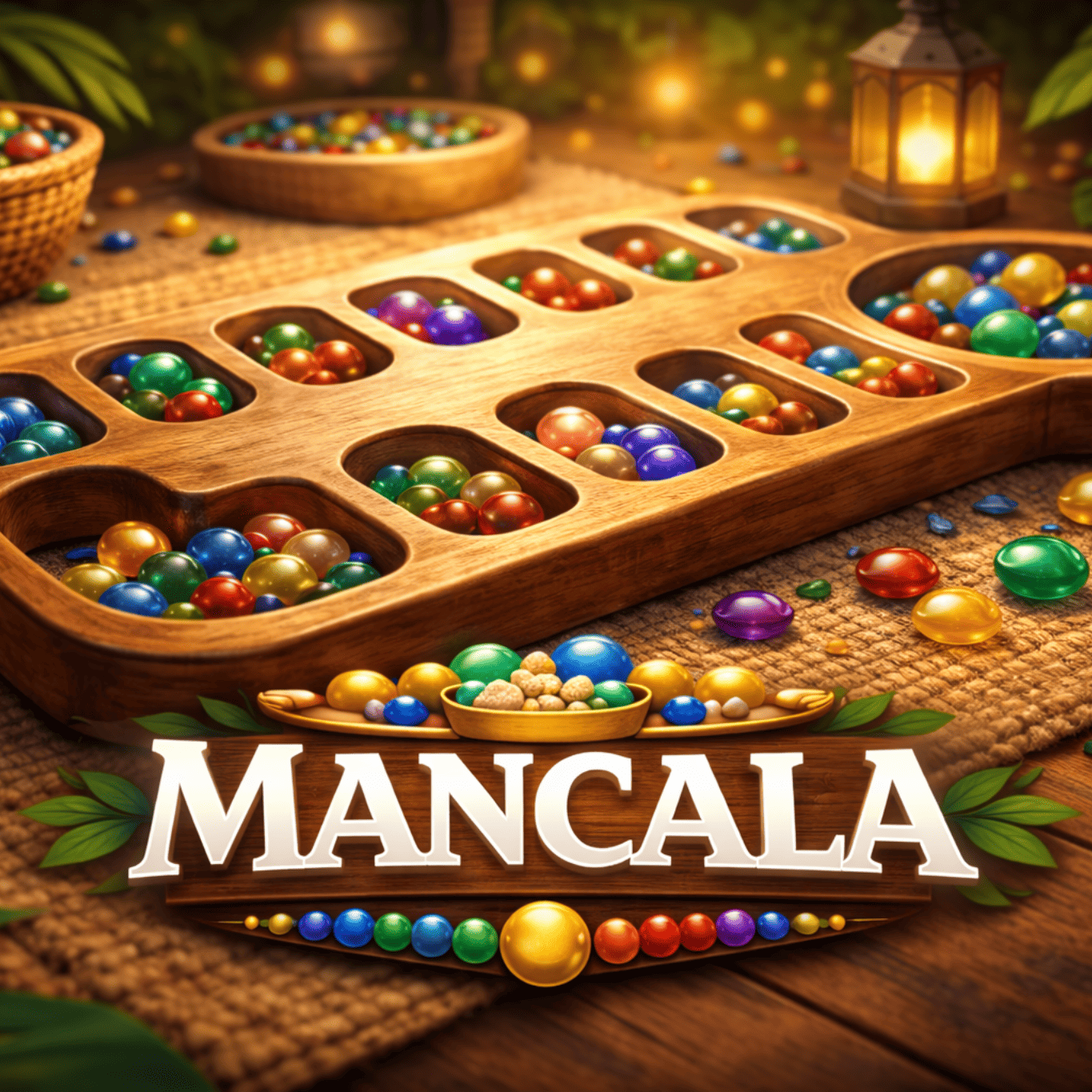
Mancala - Rules, History & Strategy Guide
Mancala is a two-player count-and-capture board game; the Kalah version uses six pits and a store per side with 48 stones. Players scoop stones from a pit and sow them counter-clockwise, earning extra turns and captures, and whoever banks the most stones wins. Games take about 10 to 15 minutes.
Reviewed & updated
History & Origins
Mancala is among the oldest known board games, with archaeological evidence dating back over 7,000 years to sites in Africa and the Middle East. The word mancala comes from the Arabic naqala, meaning to move.
The Kalah variant played on Arcadia became the most popular Western version in the mid-twentieth century, but hundreds of mancala-family games exist across the world, from Oware in West Africa to Congkak in Southeast Asia.
How to Play
The goal is to collect more stones in your store than your opponent.
- Pick up all stones from one of your six pits.
- Sow them counter-clockwise, one per pit, including your store but skipping the opponent's.
- If your last stone lands in your store, take another turn.
- If your last stone lands in an empty pit on your side, capture that stone and all opposite stones.
- The game ends when one side is empty. The player with more stones wins.
Strategy Tips
Mancala rewards counting ahead and controlling tempo.
- Opening from the third or fourth pit often earns a free turn.
- Count stones in each pit to set up captures two or three moves ahead.
- Keep stones on your side to maintain capture threats.
- Starve your opponent's side when you have a store lead to end the game.
Variations
Major mancala variants include Kalah, Oware, Bao, and Congkak. Board sizes range from 2x6 to 4x8. Some variants allow relay sowing, where a turn continues automatically when the last stone lands in an occupied pit.
Play Mancala on Arcadia
Play Mancala on Arcadia to practice captures, chain extra turns, and test ancient strategy against a modern AI.
Quick Answers
How do you play Mancala?
Pick up stones from one pit and sow them counter-clockwise. Capture stones by landing in empty pits on your side. The player with the most stones in their store wins.
Can I play Mancala online for free?
Yes. Arcadia offers free Mancala against an AI opponent with no download or signup required.
What is the best opening move in Mancala?
Starting from the third or fourth pit is generally strong because it often lands your last stone in your store, earning a bonus turn.
How many stones do you need to win Mancala?
The Kalah board holds 48 stones in total, so banking 25 guarantees victory. If the game ends with both players on 24, it is a draw. Strong players stop counting individual captures and instead track each store’s running total against that 25-stone threshold.
Is Mancala a solved game?
Yes — the standard Kalah version with six pits and four stones per pit was solved by computer analysis in 2000, and it is a win for the first player with perfect play. Human games remain competitive because the winning line is far too long to memorise.
Is Mancala luck or skill?
Mancala is pure skill. There are no dice and no hidden information — both players see every stone at all times, so every loss traces back to a countable mistake. That perfect-information structure puts it in the same family as chess and checkers rather than backgammon.
What happens to the stones left on the board when Mancala ends?
When one side runs out of stones, the opponent sweeps every stone remaining on their own side into their store. This end-of-game sweep is why starving your own side while holding a store lead is a legitimate winning plan, and why a big pile hoarded in one pit can suddenly become decisive.
How long does a game of Mancala take?
A typical game lasts 5 to 15 minutes, making it one of the quickest classic board games. Because rounds are short, playing several in a row is normal — on Arcadia you can play unlimited free games against the AI in your browser to drill openings and capture setups.
What is the difference between Mancala and Kalah?
Mancala is the family name for hundreds of related sowing games played across Africa, the Middle East and Asia, while Kalah is the specific Western commercial version, patented by William Julius Champion in the 1950s. When people say Mancala in Europe or North America, they almost always mean Kalah.
Can you get more than one extra turn in a row in Mancala?
Yes. Every time your last stone lands in your store you move again, and there is no cap, so free turns can chain. Well-planned openings can string together several extra moves before the opponent responds, which is why the first turn of Kalah carries such a large advantage.
Why is Mancala called a sowing game?
Because the core motion — scooping up a pit and dropping stones one by one around the board — mirrors sowing seeds, game historians class the whole family as sowing or count-and-capture games. Many traditional versions were literally played with seeds, in pits scooped from the earth.
Related Games On Arcadia
Related Guides

MAIN MENU
PvP Games
 Battleship
 Crazy Eights
 Dots & Boxes Blitz
 Gomoku
 Ludo
Ludo Quoridor
 Snakes & Ladders
 Yahtzee
Free Games
 Alquerque
 Backgammon
 Bagh-Chal
 Balut
Balut Battle for TokyoBattleship
 Bingo
Bingo Brick Breaker
 Bridge
 Bunco
Bunco Callbreak
 Checkers
 Chess
Chess ChompCrazy Eights
 Cribbage
 Dara
Dara Derby Dash
 DominoesDots & Boxes Blitz
 Durak
Durak Emberdeep
 Euchre
 Fanorona
 Farkle
 Fox and Geese
 Fox and Hounds
 Generala
 Gin Rummy
 Go / WeiqiGomoku
 Hazard
 Hearts
 Hex
Hex Higher or Lower
 Hnefatafl
 Hounds and Jackals
 Indian Rummy
 Jungle
 Ludus Latrunculorum
 Liar's DiceLudo
 Mahjong SolitaireMancala
 Minesweeper
 Nim
Nim Nine Men's Morris
 Onitama
 Patolli
 Peg Solitaire
 Pentago
 Pente
Pente Pig
Pig PylosQuoridor
 Reversi
 Royal Game of Ur
 Scratch Cards
 Seega
Seega Senet
Senet Shax
Shax Ship, Captain, Crew
 Shut the Box
 Sixteen Soldiers
 SnakeSnakes & Ladders
 Klondike Solitaire
 Space Blaster
 Spades
 Sugar Pop
 Sungka
 Tangram
 Tile Rummy
 Tower
Tower Truco
Truco War
War Word Spy
 XII ScriptaYahtzee
NEED HELP?