Jungle on Arcadia
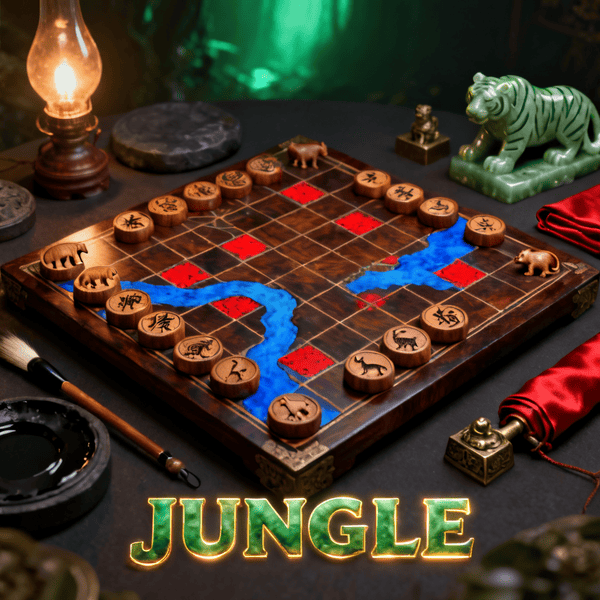
Jungle — Dou Shou Qi (鬥獸棋), the "Game of Fighting Animals", also sold as Animal Chess or Jungle Chess — is a Chinese board game for two players. Eight animals per side line up on a 7×9 board split by two rivers, and each animal outranks the one below it: elephant, lion, tiger, leopard, wolf, dog, cat, rat.
Its history is genuinely obscure. David Parlett notes that R. C. Bell, the great cataloguer of board games, knew nothing of its ancestry, and D. B. Pritchard likewise calls the origins unclear, suggesting it may be a development of xiangqi. What survives is the game itself: sharp, small and surprisingly deep.
Arcadia's version plays in the browser against an AI opponent on three levels — no download, no account.
How to Play
- You take the amber animals on the bottom three ranks; the AI takes the blue animals at the top. You move first.
- Click one of your animals to select it, then click a highlighted square to move. Every move is one square up, down, left or right — never diagonally.
- Land on an enemy animal of the same or lower rank to capture it.
- Only the rat may swim. Lion and tiger leap the rivers instead.
- Get any animal into the enemy den — the starred square on the far side — and you win at once.
Core Rules
- The board. Seven files (a–g) by nine ranks. Your den is d1; the AI's den is d9.
- Ranks. Elephant 8, lion 7, tiger 6, leopard 5, wolf 4, dog 3, cat 2, rat 1. An animal captures any enemy of equal or lower rank.
- The rat exception. The rat can capture the elephant, but only from a land square. The elephant, in this standard ruleset, can still capture the rat.
- Your own den. You may never move into it. The enemy den is the target.
- No legal move. A player who cannot move loses.
- Arcadia adds one house rule to stop endless shuffling: 120 moves with no capture ends the game as a draw.
Strategy
- The rat does double duty. It is your elephant-killer and your river gate. Park it in the water and the enemy lion and tiger lose their leaps on that side.
- Watch the traps. Chasing a piece onto your own trap squares is how small animals kill big ones. Equally, never park your elephant on an enemy trap next to their cat.
- Trade down, not across. Every exchange that removes a high enemy animal for a low one of yours makes the run to the den easier.
- Count the den guard. A den is only safe if a defender can reach it in fewer moves than the attacker. Keep one animal within two squares of d1.
- Use the lion sideways. The lion's horizontal leap crosses the whole river in one move and is the fastest way to switch flanks.
Practical Tips
- Selected animals show green dots for quiet moves and a red outline for captures.
- The number on each animal is its rank — check it before you trade.
- Start on Cub to learn the geometry, then move to Hunter and Elephant; the higher levels search several moves ahead and will punish a loose den.
- The captured tray under the scorebar shows exactly which animals are gone from each side.
Rivers, Traps and Dens
The rivers. Two blocks of six squares (files b–c and e–f, ranks 4–6). Only the rat may enter or leave the water. A rat sitting in the river cannot be touched by anything on land — only another rat in the water can take it — and the shield works both ways: while it is swimming it cannot capture anything on dry land either, elephant included.
Leaping. The lion and the tiger jump a river from one bank to the first dry square beyond, capturing an equal or lower-ranked animal standing there. The tiger jumps up and down only; the lion also jumps sideways. Any rat in the water, yours or the enemy's, blocks the leap — which is why the rat is the most valuable rank-1 piece in any board game.
Traps. Three traps surround each den: c1, e1 and d2 are yours; c9, e9 and d8 belong to the AI. Either side may walk on any trap. An animal standing in an enemy trap drops to rank 0 and can be captured by any enemy piece, however small. Its rank returns the moment it steps off.
FAQ
What is the Jungle board game?
Jungle, or Dou Shou Qi (鬥獸棋, "Game of Fighting Animals"), is a Chinese two-player board game played on a 7×9 grid with eight ranked animals per side. It is also sold in English as Animal Chess or Jungle Chess.
How do you win at Jungle?
Move any one of your animals into the opponent's den, or capture every enemy animal. A player who has no legal move on their turn also loses.
Why can the rat beat the elephant?
It is the game's one deliberate loop in the rank ladder — the smallest animal brings down the largest. The rat may only do it from a land square, never from the water, and in the standard rules the elephant can still capture the rat in return.
Which animals can cross the river?
Only the rat may actually enter the water. The lion and the tiger jump straight over a river to the first dry square beyond it, and may capture an equal or lower-ranked animal on the landing square — unless a rat of either colour is sitting in the water in between, which blocks the jump.
What do the traps do in Jungle?
Each den is surrounded by three traps. Any animal may step onto any trap, but one standing in an opponent's trap has its rank reduced to 0, so any enemy animal can capture it. The rank comes straight back when it moves off.
Can I play Jungle online for free?
Yes. Arcadia runs Jungle free in your browser against an AI opponent on three difficulty levels, with no download and no account required.
Related Games


Ready to play Jungle?
Launch the free demo, learn the flow, and practice your tactics.