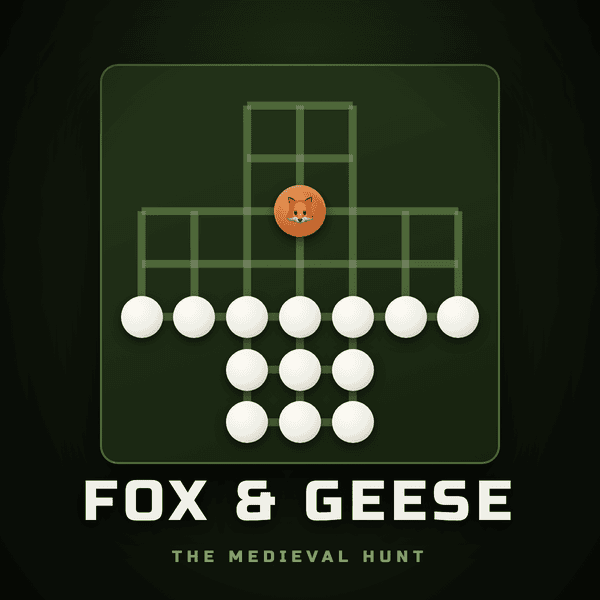
Fox and Geese on Arcadia
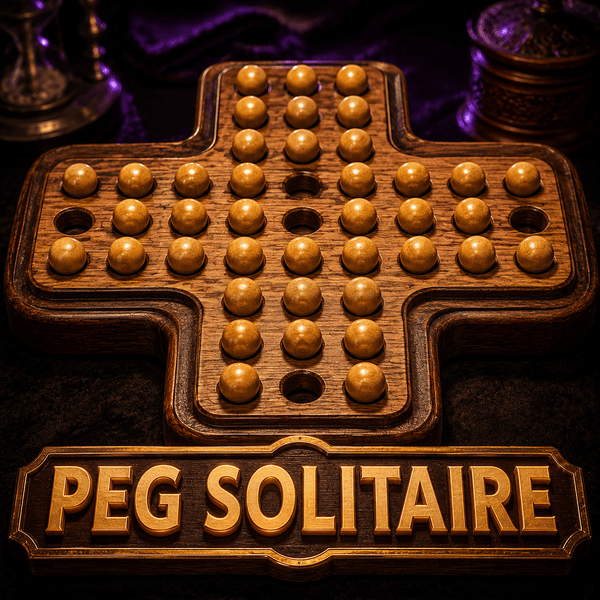
Fox and Geese is the great medieval hunt game: one leaping fox against a marching wall of geese, played on the same 33-point cross as peg solitaire. Its ancestor halatafl appears in the Icelandic sagas; Edward IV of England owned silver sets; and it crossed the Atlantic to become a fireside classic that Laura Ingalls Wilder wrote into the Little House books.
Arcadia's version lets you play either side against the AI: hunt as the fox and thin the flock with chain jumps, or command thirteen geese and smother the fox in a closing wall.
How to Play
- Thirteen geese start on the lower arm and the row above it; the fox starts on the center point.
- Geese step one point along a line, forward or sideways — never backward, and they can never jump.
- The fox steps one point in any direction, or leaps an adjacent goose to the empty point beyond, eating it. Leaps can chain.
- The geese win by pinning the fox so it has no legal move.
- The fox wins when fewer than six geese remain — too few to close a trap.
Core Rules
- The board is a cross of 33 points; pieces move along the marked lines.
- Geese move forward and sideways only; the fox moves in all four directions.
- Only the fox captures, by the short leap; chain jumps are allowed and always optional.
- Geese cannot be leapt when a goose (or the board edge) blocks the landing point: a solid wall is leap-proof.
- Geese traditionally move first.
Strategy: The Wall vs the Wedge
Playing the geese - March as an unbroken phalanx: any goose with an empty point directly behind it is an invitation. - Do not chase; herd. Advance the whole line and shrink the fox's territory a row at a time. - Steer the fox toward an arm of the cross: three walls do half your work.
Playing the fox - Attack the flanks: wing geese are the first to step out of line. - Bait the wall: retreating a step often tempts a goose forward into jump range. - Count to six: every capture weakens the wall geometrically. Below nine geese the wall leaks; below six you have won.
Practical Tips
- Red dots mark the fox's capturing leaps; green dots are quiet steps.
- During a chain the fox may stop any time: press End turn.
- Playing geese, watch the counter: it turns dangerous under nine and lost under six.
- Try both sides — the fox teaches you what the wall must never do.
FAQ
How do the geese win if they cannot capture?
By immobilizing the fox: surrounding it so it has no step and no leap left. The classic finish pins the fox in a corner arm of the cross behind an unbroken wall.
Can the fox jump more than one goose?
Yes — leaps chain like in checkers: if the fox lands next to another jumpable goose, it may leap again in the same turn. Chains are optional; the fox may stop after any jump.
Is Fox and Geese balanced?
With perfect play the geese should win, which is why history kept adding geese (13 up to 17) while restricting their movement. Human geese usually crack first — one gap in the wall and the fox feasts.
How old is Fox and Geese?
At least 700 years: its ancestor halatafl is mentioned in the Icelandic Grettis saga around 1300, English royalty played it in the 1400s, and it stayed a household staple into the 19th century.
Can I play Fox and Geese online for free?
Yes. Arcadia offers free Fox and Geese in your browser against an AI opponent, and you can play either the fox or the geese — no download or account required.




Ready to play Fox and Geese?
Launch the free demo, learn the flow, and practice your tactics.