Fox and Geese vs Hnefatafl: Asymmetric Hunt Games
The Verdict
Play Fox and Geese if you want asymmetry you can learn in two minutes: one fox jumps like a draughts king, thirteen geese cannot capture at all, and a game takes 10-15 minutes. Play Hnefatafl if you want the deeper of the two — both sides capture by sandwiching, the king must reach a corner, and games run 20-40 minutes. Fox and Geese favours the geese with perfect play; Hnefatafl's balance depends heavily on which historical rule set you adopt.
Side by Side
| Fox and Geese | Hnefatafl | |
|---|---|---|
| Players | 2 (asymmetric) | 2 (asymmetric) |
| Average game length | 10-15 min | 20-40 min |
| Luck vs skill | 100% skill | 100% skill |
| Board | 33-point cross | 11x11 (or 7x7 / 13x13) |
| Force sizes | 1 fox vs 13 geese | 13 defenders vs 24 attackers |
| Can both sides capture? | No - fox only | Yes - both sides |
| Capture method | Jump over (draughts-style) | Sandwich between two pieces |
| Win condition | Trap the fox / thin the flock | King reaches corner / king captured |
| First recorded | ~14th c. Norse halatafl | ~4th c. Norse tafl family |
How the asymmetry differs
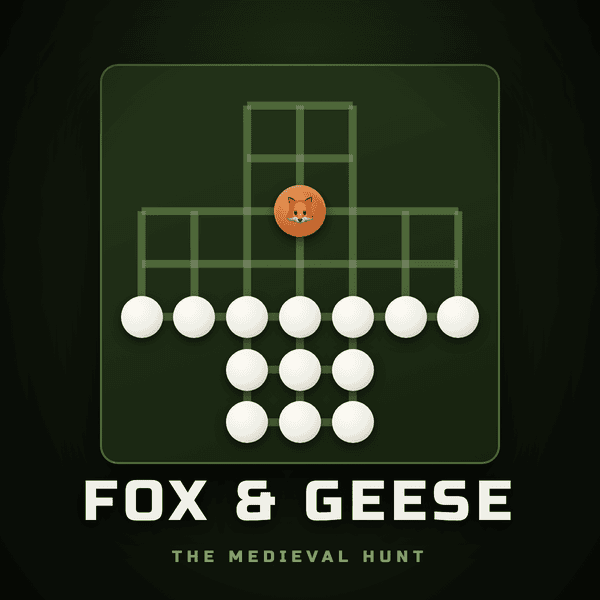
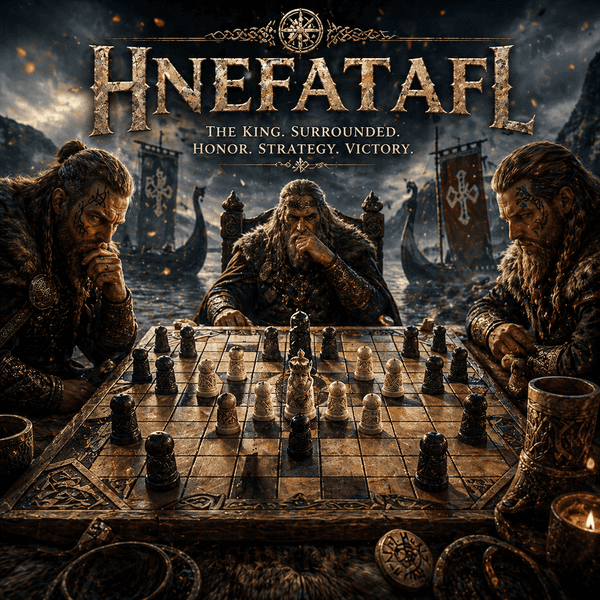
Fox and Geese is the more extreme of the two. The geese literally cannot capture - their only tool is formation, advancing as an unbroken wall so the fox has no empty point to leap into. The fox, meanwhile, captures exactly like a draughts king, chaining jumps when the landing point offers another. Hnefatafl is asymmetric in force and objective rather than in ability: both sides capture the same way, by sandwiching an enemy piece between two of their own, but the defenders are outnumbered roughly two to one and must escort their king to a corner while the attackers try to surround it.
Which is harder to learn?
Fox and Geese, comfortably, is the easier entry. There are two rules worth stating - the fox jumps, the geese do not - and a child can play a legal game immediately. Hnefatafl needs more: the sandwich capture, the king's special squares, whether the king is armed or unarmed, and which corner-escape variant you are using. That last point matters more than it should, because surviving tafl rules are fragmentary and modern sets disagree, so two Hnefatafl players often need to agree a rule set before starting.
Which is the better game?
Hnefatafl has more depth per game, and its two-way capture keeps both sides tactically active throughout. Fox and Geese is tighter and more puzzle-like: the geese are solving a containment problem while the fox hunts for a single loose move, which makes it excellent for short sessions and for teaching the idea of asymmetric objectives. Both are traditionally played twice with sides swapped, since neither is balanced in the way chess is.
Pick Fox and Geese if…
- you want asymmetric strategy you can teach in two minutes
- you like short 10-15 minute games
- you enjoy containment puzzles more than open tactical fights
- you are introducing a child to strategy games
Pick Hnefatafl if…
- you want the deeper of the two hunt games
- you prefer both sides being able to capture
- you enjoy Norse history and reconstructed rule sets
- you want longer 20-40 minute sessions
FAQ
Are Fox and Geese and Hnefatafl the same family of game?
They are cousins. Both come from the Norse tafl tradition of asymmetric board games, and a game called halatafl - generally identified with Fox and Geese - is mentioned in the 14th-century Icelandic Grettis saga. Hnefatafl is the older and more elaborate branch.
Which game is more balanced?
Neither is balanced by design. With perfect play on the standard 33-point cross board the geese should beat the fox, and Hnefatafl's balance swings on the rule set - armed king and corner-escape variants favour different sides. Both are conventionally played twice with sides swapped.
Can the geese capture the fox in Fox and Geese?
No. The geese never capture. They win only by trapping the fox so it has no legal move, which means advancing shoulder to shoulder and never leaving a gap directly behind a goose.
How do captures work in Hnefatafl?
By sandwiching: move a piece so an enemy piece sits directly between two of yours along a row or column, and it is removed. Unlike Fox and Geese there is no jumping, and both sides use the same method.
Which is older, Fox and Geese or Hnefatafl?
Hnefatafl. The tafl family is attested from around the 4th century in Scandinavia, while Fox and Geese appears in written sources much later, around the 14th century, though its board is closely related to earlier tafl boards.
Are these games solved?
Small tafl boards have been analysed exhaustively, and Fox and Geese on the standard cross board is understood to be a geese win with perfect play. Full 11x11 Hnefatafl has not been solved, partly because there is no single agreed rule set to solve.

MAIN MENU
PvP Games
 Battleship
 Crazy Eights
 Dots & Boxes Blitz
 Gomoku
 Ludo
Ludo Quoridor
 Snakes & Ladders
 Yahtzee
Free Games
 Alquerque
 Backgammon
 Bagh-Chal
 Balut
Balut Battle for TokyoBattleship
 Bingo
Bingo Brick Breaker
 Bridge
 Bunco
Bunco Checkers
 Chess
Chess ChompCrazy Eights
 Cribbage
 Dara
Dara Derby Dash
 DominoesDots & Boxes Blitz
 Durak
Durak Emberdeep
 Fanorona
 Farkle
 Fox and Geese
 Fox and Hounds
 Generala
 Gin Rummy
 Go / WeiqiGomoku
 Hazard
 Hex
Hex Higher or Lower
 Hnefatafl
 Hounds and Jackals
 Indian Rummy
 Jungle
 Ludus Latrunculorum
 Liar's DiceLudo
 Mahjong Solitaire
 Mancala
 Minesweeper
 Nim
Nim Nine Men's Morris
 Onitama
 Patolli
 Peg Solitaire
 Pentago
 Pente
Pente Pig
Pig PylosQuoridor
 Reversi
 Royal Game of Ur
 Scratch Cards
 Seega
Seega Senet
Senet Shax
Shax Ship, Captain, Crew
 Shut the Box
 Sixteen Soldiers
 SnakeSnakes & Ladders
 Klondike Solitaire
 Space Blaster
 Spades
 Sugar Pop
 Sungka
 Tangram
 Tile Rummy
 Tower
Tower Truco
Truco War
War Word Spy
 XII ScriptaYahtzee
NEED HELP?