Fox and Geese - Rules, History & Strategy Guide
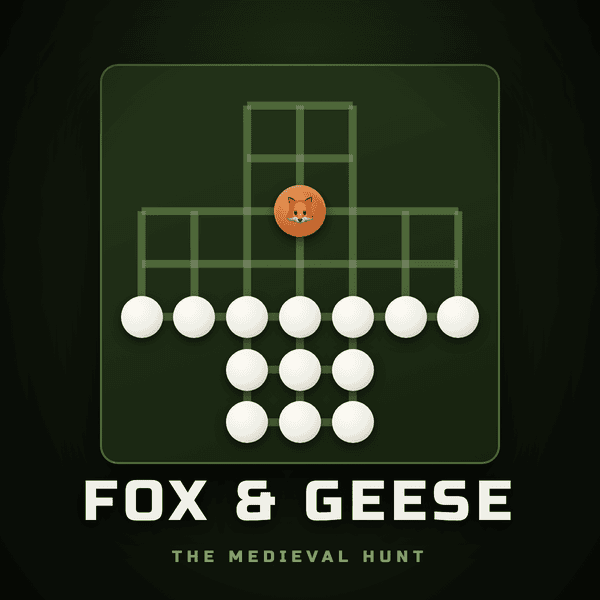
Fox and Geese is an asymmetric medieval hunt game on a 33-point cross board. One fox jumps over geese to capture them, draughts-style; thirteen geese cannot capture at all and instead advance as a wall to hem the fox in. Geese win by trapping the fox; the fox wins by thinning the flock below the number needed to trap it.
Reviewed & updated
History & Origins
Fox and Geese is the best known of the medieval hunt games, descended from the Norse halatafl mentioned in the Icelandic sagas. It spread across Europe by the 15th century — Edward IV of England owned two silver sets — and crossed the Atlantic with settlers, where it became a fireside classic; Laura Ingalls Wilder’s Little House books describe it played on the frontier.
The game is gloriously asymmetric: one fox against a flock of geese on a cross-shaped board of 33 points. The fox kills by leaping; the geese win by smothering. Over the centuries the goose count has ranged from thirteen to seventeen with various movement restrictions, as players tuned the balance between hunter and herd.
How to Play
One player is the lone fox, the other commands thirteen geese. The fox eats geese by jumping them; the geese, who cannot jump at all, try to crowd the fox into a corner it cannot escape.
- Set up the cross board: thirteen geese fill one arm and the first row beyond it; the fox starts on the center point.
- Geese move one step along a line — forward or sideways, never backward.
- The fox moves one step in any direction, or jumps an adjacent goose to the empty point beyond, capturing it; jumps can chain.
- The fox wins when too few geese remain to trap it (fewer than six).
- The geese win by pinning the fox so it has no move left.
Strategy Tips
- As geese, advance in an unbroken wall: any goose with an empty point behind it is dinner.
- As geese, sacrifice at the edges only; the trap is finished by pressing the fox toward a corner arm.
- As the fox, hunt the flanks: stragglers on the wings create chain-jump opportunities.
- As the fox, never enter a corner arm while the wall is intact — that is exactly where the geese want you.
- Count the herd: below nine geese the wall becomes porous, and below six the geese have mathematically lost.
Variations
Variants tune the balance: seventeen geese with sideways-only restrictions, diagonal lines added on some boards, two foxes on larger crosses, and the fortress variant asalto, where soldiers storm a guarded citadel on the same board. The board itself is the same 33-point cross used for peg solitaire — one board, two classic games.
Play Fox and Geese on Arcadia
Play Fox and Geese on Arcadia to run the medieval hunt from both sides: leap as the fox, or close the wall as the flock.
Quick Answers
How is Fox and Geese different from Fox and Hounds?
Fox and Hounds is played on a checkerboard with four hounds that never capture; Fox and Geese uses the 33-point cross board, thirteen geese, and a fox that captures by jumping. Same predator, different hunt.
Can the geese jump the fox?
No. Geese only step one point at a time, forward or sideways. Their power is numbers and formation, not capture — the wall, not the bite.
How does the fox capture geese?
By the short leap: jumping over an adjacent goose onto the empty point directly beyond, along a marked line. Multiple jumps chain in a single turn, and a careless flock can lose three geese at once.
How old is Fox and Geese?
At least 700 years. Its ancestor halatafl appears in Icelandic sagas from the 1300s, English royalty played it in the 1400s, and it remained a household game through the 19th century.
Can I play Fox and Geese online for free?
Yes. Arcadia offers free Fox and Geese in your browser against an AI opponent, and you can play either the fox or the geese — no download or account required.
How many geese are there in Fox and Geese?
Historical sets vary from 13 to 17 geese; this version uses 13, the most common configuration for the 33-point cross board. Fewer geese make the fox stronger, which is why the count is the main dial for balancing the game.
Can the geese capture the fox?
No — and that asymmetry is the whole game. Geese move one step at a time and can never jump or capture. Their only weapon is formation: advancing shoulder to shoulder so the fox has no empty square to leap into.
How does the fox capture geese?
By jumping, exactly like draughts: the fox leaps over an adjacent goose into the empty point directly beyond, and that goose is removed. When another jump is available from the landing point, the fox can chain captures in a single turn — which is how a careless goose wall collapses.
How do the geese win at Fox and Geese?
By trapping the fox so it has no legal move — surrounded by geese and board edges. That means advancing as an unbroken line and never leaving a gap directly behind a goose, because a gap is a jump.
How does the fox win?
By capturing enough geese that trapping becomes impossible. In this version the fox wins once the flock drops below six, since fewer than six geese cannot seal off every escape square regardless of how well they are played.
Is Fox and Geese a fair game?
Not inherently — it is asymmetric by design, and with perfect play on the standard 33-point board the geese should win. The fox relies on the geese making one loose move. That imbalance is why the game is traditionally played twice, swapping sides.
What is the best strategy for the geese?
Advance in a solid line and never break formation to chase. Move the rear geese up to fill gaps rather than pushing the front rank forward, keep the fox in front of your wall, and accept slow progress — every hasty advance opens a jump.
How old is Fox and Geese?
It descends from the Norse family of hunt games; a game called hnefatafl-adjacent halatafl is mentioned in the 14th-century Icelandic Grettis saga. Edward IV of England bought "two foxes and 26 hounds" sets in the 15th century, and the game stayed popular across Europe for centuries.

MAIN MENU
PvP Games
 Battleship
 Crazy Eights
 Dots & Boxes Blitz
 Gomoku
 Ludo
Ludo Quoridor
 Snakes & Ladders
 Yahtzee
Free Games
 Alquerque
 Backgammon
 Bagh-Chal
 Balut
Balut Battle for TokyoBattleship
 Bingo
Bingo Brick Breaker
 Bridge
 Bunco
Bunco Checkers
 Chess
Chess ChompCrazy Eights
 Cribbage
 Dara
Dara Derby Dash
 DominoesDots & Boxes Blitz
 Durak
Durak Emberdeep
 Fanorona
 FarkleFox and Geese
 Fox and Hounds
 Generala
 Gin Rummy
 Go / WeiqiGomoku
 Hazard
 Hex
Hex Higher or Lower
 Hnefatafl
 Hounds and Jackals
 Indian Rummy
 Jungle
 Ludus Latrunculorum
 Liar's DiceLudo
 Mahjong Solitaire
 Mancala
 Minesweeper
 Nim
Nim Nine Men's Morris
 Onitama
 Patolli
 Peg Solitaire
 Pentago
 Pente
Pente Pig
Pig PylosQuoridor
 Reversi
 Royal Game of Ur
 Scratch Cards
 Seega
Seega Senet
Senet Shax
Shax Ship, Captain, Crew
 Shut the Box
 Sixteen Soldiers
 SnakeSnakes & Ladders
 Klondike Solitaire
 Space Blaster
 Spades
 Sugar Pop
 Sungka
 Tangram
 Tile Rummy
 Tower
Tower Truco
Truco War
War Word Spy
 XII ScriptaYahtzee
NEED HELP?