Tangram on Arcadia
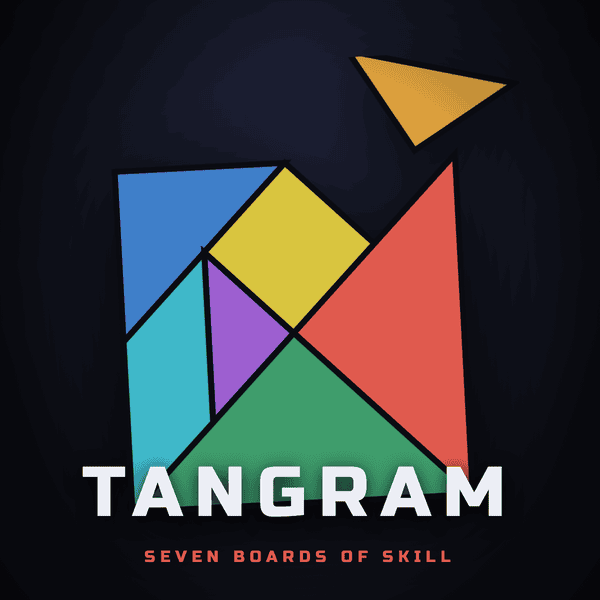
Tangram is the world's most famous dissection puzzle: seven flat pieces cut from a single square, endlessly recombined into figures. The *qiqiao ban* ("seven boards of skill") emerged in China around 1800 and swept the world within a generation; Napoleon reputedly whiled away his exile on it, and thousands of published figures survive from the 19th-century craze.
Arcadia's version gives you the classic seven pieces with drag, 45-degree rotation, a flippable parallelogram, and satisfying snap-into-place solving across a growing set of silhouette figures.
How to Play
- Every puzzle shows a dark silhouette: recreate it using all seven pieces.
- Drag pieces from the tray onto the figure.
- Select a piece and press Rotate to turn it in 45-degree steps.
- The parallelogram sometimes needs the Flip button: it has left- and right-handed forms.
- Pieces snap and lock when placed correctly. Place all seven to solve the figure.
The Seven Pieces
- Two large triangles, each covering a quarter of the original square.
- One medium triangle, half the size of a large one.
- Two small triangles, the puzzle's finishing tools.
- One square, which sits diagonally as often as flat.
- One parallelogram, the only piece with a mirror form: flipping it is legal and often required.
- Every figure uses all seven pieces with no overlaps.
Strategy: Read the Silhouette
- Find the large triangles first: they cover half the figure's area, and their right angles betray their position in most silhouettes.
- Corners tell the truth: a 90-degree corner in the outline needs a right angle, a 45-degree spike needs a triangle tip.
- The parallelogram is the troublemaker: when a figure refuses to close, try flipping it.
- Long straight edges usually mean two pieces lying edge-to-edge, not one big piece.
- Solve the skeleton before the details: body first, then ears, fins, and flames.
Practical Tips
- Snapped pieces lock and brighten; drag them off to rethink a placement.
- The Hint button flashes the outline of one missing piece.
- Use the figures menu (▦) to jump between puzzles; solved figures glow green.
- Your progress saves in your browser automatically.
FAQ
What are the seven tangram pieces?
Two large triangles, one medium triangle, two small triangles, one square, and one parallelogram — all cut from a single square. Together they rebuild the square and thousands of other figures.
Can tangram pieces be flipped over?
Only the parallelogram ever needs it: it is the one piece without mirror symmetry, so classic rules allow turning it over. Arcadia gives it a Flip button.
Where does Tangram come from?
China, around 1800, as the *qiqiao ban* or "seven boards of skill". Trade ships carried it west within years, sparking puzzle crazes in Europe and America by the 1810s.
Do all figures really use every piece?
Yes — that is the tangram rule: all seven pieces, no overlaps, nothing left over. The challenge is that the same seven shapes must become a square, a rocket, or a fish.
Can I play Tangram online for free?
Yes. Arcadia offers free Tangram in your browser with drag-and-snap pieces, rotation, hints, and saved progress — no download or account required.
Related Games

Ready to play Tangram?
Launch the free demo, learn the flow, and practice your tactics.