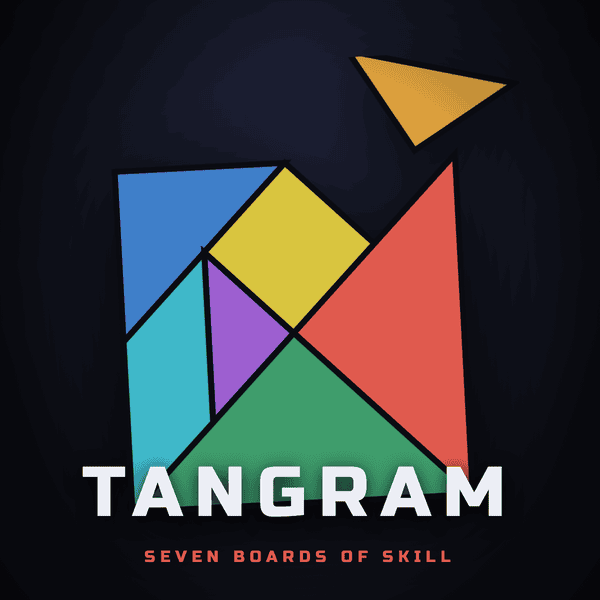
Tangram - Rules, History & Strategy Guide
Tangram is a Chinese dissection puzzle using seven flat pieces called tans — five triangles, a square and a parallelogram — cut from one larger square. You rearrange all seven, without overlapping, to fill a silhouette. Every piece must be used every time, and thousands of solvable figures exist.
Reviewed & updated
History & Origins
Tangram appeared in China around 1800 under the name qiqiao ban, the "seven boards of skill", and became one of the fastest-travelling games in history: within fifteen years, trade ships had carried it to Europe and America, where publishers raced to print figure books and newspapers reported a full-blown puzzle craze. Napoleon reputedly owned an ivory set in exile, and Lewis Carroll and Edgar Allan Poe were later devotees.
The puzzle’s power is mathematical economy: one square, seven pieces, thousands of published silhouettes. It has never gone out of production since, and modern mathematicians still study its figures — including the famous paradoxes, pairs of silhouettes that look identical but differ by one hidden piece.
How to Play
Tangram is a dissection puzzle: all seven pieces, cut from one square, must rebuild a target silhouette exactly — no overlaps, nothing left over.
- Study the silhouette: every figure is the same seven pieces in a new arrangement.
- Drag pieces onto the figure; rotate them in 45-degree steps to match the outline.
- Flip the parallelogram when needed — it is the only piece with a mirror form.
- Fit the two large triangles first; they cover half of every figure.
- Place all seven pieces to complete the figure, then move to the next silhouette.
Strategy Tips
- Area-read the figure: the two large triangles are half the puzzle, so find their right angles in the outline first.
- Corners are evidence: 90-degree outline corners demand a right angle, 45-degree spikes demand a triangle tip.
- Suspect the parallelogram whenever a figure almost closes: half its placements need the flip.
- Long straight outline edges are usually two pieces butted together, not one.
- In paradox-style figures, compare areas: a missing foot or head is always exactly one small piece of area moved elsewhere.
Variations
The tangram family includes dozens of historical dissection sets: the 15-piece Chie no Ita from Japan, the egg-shaped Magic Egg, the circular Broken Heart, and modern double-set puzzles for two players racing the same figure. The classic seven-piece square remains the canon, and every variant keeps the same rule: all pieces, no overlaps.
Play Tangram on Arcadia
Play Tangram on Arcadia to bend seven ancient pieces into rockets, fish, and mountains — the same seven that puzzled Napoleon.
Quick Answers
Why is it called the seven boards of skill?
That is the translation of qiqiao ban, the Chinese name for the seven-piece set. The English word "tangram" appeared in the 1810s during the western puzzle craze; its exact origin is still debated.
Is flipping pieces allowed in Tangram?
Only the parallelogram has a mirror form, and flipping it is part of the classic rules — many published figures are impossible without it. The other six pieces are symmetric, so flipping changes nothing.
How many tangram figures exist?
Over 6,500 distinct figures had been published by 1900 alone, and enthusiasts keep inventing more. Mathematicians have also proven exactly thirteen convex shapes are possible — every other figure is concave.
What is a tangram paradox?
A pair of figures that appear identical although one seems to be missing a piece — the missing area hides in slightly different proportions. Dudeney’s two monks and the missing-square paradoxes are the famous examples.
Can I play Tangram online for free?
Yes. Arcadia offers free Tangram in your browser with drag-and-drop pieces, rotation, flipping, hints, and saved progress — no download or account required.
What are the seven tangram pieces?
Two large right triangles, one medium right triangle, two small right triangles, one square and one parallelogram. Every piece is a multiple of the smallest triangle, which is why the set reassembles into a perfect square — and why so many different silhouettes are possible from the same seven shapes.
Do you have to use all seven pieces?
Yes — that is the defining rule. A tangram solution uses all seven tans, laid flat, touching but never overlapping. Puzzles that let you leave pieces out are a different genre; the constraint of using every piece is exactly what makes tangram hard and satisfying.
Can you flip the tangram parallelogram?
Yes, and you often must. The parallelogram is the only piece without mirror symmetry, so it has two distinct forms depending on which face is up. Many silhouettes are solvable only with it flipped — if a figure seems impossible, turning that piece over is usually the answer.
How many tangram puzzles are there?
Thousands of figures have been published since the 1800s. Mathematically, Fu Traing Wang and Chuan-Chih Hsiung proved in 1942 that exactly 13 convex shapes can be made from the seven tans — but the non-convex figures (people, animals, boats, letters) are effectively unlimited.
Where did tangram come from?
China, where it is called qīqiǎobǎn — the "seven boards of skill". It appears in Chinese sources by the early 19th century and reached Europe and America around 1817, triggering a genuine craze: puzzle books sold in the thousands and even Napoleon and Lewis Carroll were reported enthusiasts.
Is tangram a game of luck or skill?
Pure skill — there is no randomness at all. A silhouette either has a solution or it does not, and finding it is spatial reasoning: reading the outline for the two large triangles first, then fitting the smaller pieces into what remains.
What is the best strategy for solving a tangram?
Place the two large triangles first. They occupy half the total area, so they are the most constrained pieces and the silhouette usually reveals where they must go. Work down by size, keep the parallelogram for last, and if you stall, flip it before assuming the figure is unsolvable.
Is tangram good for children?
It is used widely in primary maths teaching, because it builds spatial reasoning, fractions intuition (each piece is a clean fraction of the whole) and shape recognition without any reading or arithmetic. The pieces are self-checking: a wrong placement simply will not fit.
Related Games On Arcadia
Related Guides

MAIN MENU
PvP Games
 Battleship
 Crazy Eights
 Dots & Boxes Blitz
 Gomoku
 Ludo
Ludo Quoridor
 Snakes & Ladders
 Yahtzee
Free Games
 Alquerque
 Backgammon
 Bagh-Chal
 Balut
Balut Battle for TokyoBattleship
 Bingo
Bingo Brick Breaker
 Bridge
 Bunco
Bunco Checkers
 Chess
Chess ChompCrazy Eights
 Cribbage
 Dara
Dara Derby Dash
 DominoesDots & Boxes Blitz
 Durak
Durak Emberdeep
 Fanorona
 Farkle
 Fox and Geese
 Fox and Hounds
 Generala
 Gin Rummy
 Go / WeiqiGomoku
 Hazard
 Hex
Hex Higher or Lower
 Hnefatafl
 Hounds and Jackals
 Indian Rummy
 Jungle
 Ludus Latrunculorum
 Liar's DiceLudo
 Mahjong Solitaire
 Mancala
 Minesweeper
 Nim
Nim Nine Men's Morris
 Onitama
 Patolli
 Peg Solitaire
 Pentago
 Pente
Pente Pig
Pig PylosQuoridor
 Reversi
 Royal Game of Ur
 Scratch Cards
 Seega
Seega Senet
Senet Shax
Shax Ship, Captain, Crew
 Shut the Box
 Sixteen Soldiers
 SnakeSnakes & Ladders
 Klondike Solitaire
 Space Blaster
 Spades
 Sugar Pop
 SungkaTangram
 Tile Rummy
 Tower
Tower Truco
Truco War
War Word Spy
 XII ScriptaYahtzee
NEED HELP?