Peg Solitaire - Rules, History & Strategy Guide
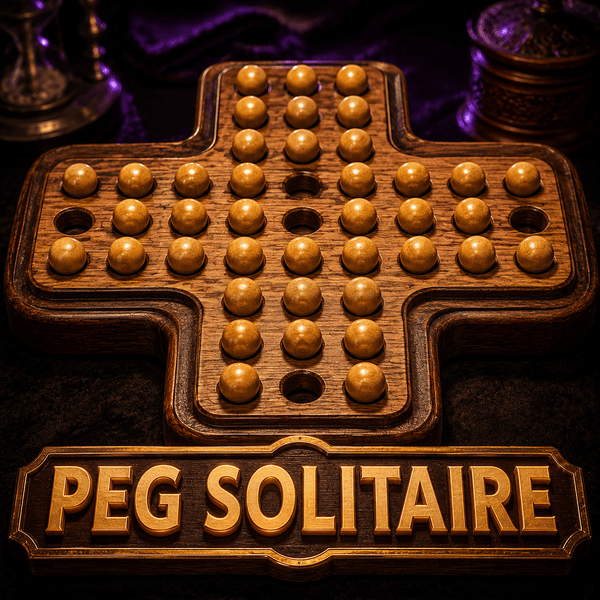
Peg Solitaire is a single-player logic puzzle played on a 33-hole cross-shaped board that starts with 32 pegs and an empty centre. You jump pegs over neighbours to remove them, aiming to finish with one peg — ideally in the centre. A round takes only a few minutes; mastering it takes far longer.
Reviewed & updated
History & Origins
Peg Solitaire — also called Solo Noble or, in India, Brainvita — has been a fixture of parlours and puzzle collections since at least 17th-century France, where an engraving of a noblewoman with the board dates it firmly to the court era. The familiar 33-hole cross board became the English standard, while a 37-hole version took hold on the continent.
Because it is a pure logic puzzle with no opponent and no luck, Peg Solitaire has drawn the attention of mathematicians for centuries. It has been analysed with group theory and used to teach problem-solving, yet its appeal is immediate: anyone can pick it up, and almost everyone gets stuck a few pegs short of a perfect solve.
How to Play
You play alone on a cross-shaped board that starts full except for the centre hole, and try to finish with a single peg.
- Select a peg, then choose an empty hole two spaces away in a straight line.
- A jump is legal only horizontally or vertically over exactly one adjacent peg into the empty hole beyond.
- The peg you jump over is removed from the board.
- Keep jumping while legal moves remain, using Undo to explore different lines.
- Reduce the board to one peg to win — and landing that last peg in the centre hole is the perfect game.
Strategy Tips
- Work toward the centre: clear the arms first and funnel pegs inward to keep late jumps available.
- Avoid stranding isolated pegs with no neighbour to jump or be jumped.
- Think in packages — sequences that clear a whole region cleanly rather than one peg at a time.
- Keep the remaining pegs connected; a lone peg in a corner usually ruins a perfect finish.
- Plan two or three moves ahead and Undo freely to test a cleaner sweep.
Variations
Beyond the 33-hole English cross, popular shapes include the 37-hole French board, triangular peg boards (the “cracker barrel” version found in American diners), and square grids. Some challenges start from a different empty hole or set a target ending square, changing which perfect solutions are possible.
Play Peg Solitaire on Arcadia
Play Peg Solitaire on Arcadia to jump, clear, and chase the perfect one-peg finish in the timeless solo puzzle.
Quick Answers
What is the goal of Peg Solitaire?
To clear the board down to a single peg by jumping pegs over one another. Finishing with the last peg in the centre hole is the classic perfect game.
How does a jump work?
Select a peg and jump it horizontally or vertically over one adjacent peg into an empty hole directly beyond. The jumped peg is then removed.
Is Peg Solitaire always solvable?
The standard English cross board can be solved down to one peg in the centre, but most lines of play dead-end earlier. Careful sequencing separates a full solve from a stall.
Is there any luck in Peg Solitaire?
None. It is a pure logic puzzle — every result is determined entirely by the jumps you choose, which is why unlimited undo helps you plan ahead.
Can I play Peg Solitaire online for free?
Yes. Arcadia offers free Peg Solitaire with unlimited undo and best-score tracking — no download or account required.
What is the fewest number of moves to solve Peg Solitaire?
Eighteen moves, where a move is one peg making a single jump or an unbroken chain of jumps. Ernest Bergholt found the 18-move solution to the standard English game in 1912, and John Beasley proved in 1964 that nothing shorter is possible.
How many jumps does it take to finish Peg Solitaire?
Exactly 31. The English board starts with 32 pegs and every jump removes exactly one, so any winning line — whatever route it takes — makes precisely 31 jumps. The skill lies not in the number of jumps but in their order.
What is the difference between the English and French Peg Solitaire boards?
The English board has 33 holes; the French board adds four diagonal holes for 37. Famously, the French board cannot be solved from a full board with the centre vacant down to a single centre peg — traditional French play starts with a different hole empty instead.
Who invented Peg Solitaire?
Nobody knows. A romantic legend credits a prisoner in the Bastille, but the first hard evidence is a 1697 French engraving showing the Princess of Soubise posed beside a board, which places the game at the court of Louis XIV. It has been a fixture of European parlours ever since.
Can the last peg finish anywhere on the board?
No. For the standard centre-start game, parity arguments prove the lone survivor can only ever finish on one of five holes — the centre or the middle hole of each outer edge. That is why the classic target of finishing in the centre is demanding but not arbitrary.
Is the triangular peg game the same as Peg Solitaire?
It is the same jumping mechanic on a different board: 15 holes in a triangle, with 14 pegs and one empty hole to start. Popular in American diners as the Cracker Barrel puzzle, it is a shorter challenge than the 33-hole cross but still punishes careless early jumps.
Has Peg Solitaire been fully solved by computers?
Yes. The English board has been exhaustively analysed, so every winnable and unwinnable position is known, and the mathematics behind it — from parity invariants to the pagoda functions described in Winning Ways — predates full computer solutions. On Arcadia you can lean on unlimited undo to explore lines the way a solver would.
Why is Peg Solitaire called Solitaire when that usually means cards?
In Britain, Solitaire traditionally refers to this peg puzzle, while the solo card game is called Patience; in North America the card game claimed the name. The peg game also travels under other names — Solo Noble in older sources and Brainvita in India.
Related Games On Arcadia
Related Guides

MAIN MENU
PvP Games
 Battleship
 Crazy Eights
 Dots & Boxes Blitz
 Gomoku
 Ludo
Ludo Quoridor
 Snakes & Ladders
 Yahtzee
Free Games
 Alquerque
 Backgammon
 Bagh-Chal
 Balut
Balut Battle for TokyoBattleship
 Bingo
Bingo Brick Breaker
 Bridge
 Bunco
Bunco Callbreak
 Checkers
 Chess
Chess ChompCrazy Eights
 Cribbage
 Dara
Dara Derby Dash
 DominoesDots & Boxes Blitz
 Durak
Durak Emberdeep
 Euchre
 Fanorona
 Farkle
 Fox and Geese
 Fox and Hounds
 Generala
 Gin Rummy
 Go / WeiqiGomoku
 Hazard
 Hearts
 Hex
Hex Higher or Lower
 Hnefatafl
 Hounds and Jackals
 Indian Rummy
 Jungle
 Ludus Latrunculorum
 Liar's DiceLudo
 Mahjong Solitaire
 Mancala
 Minesweeper
 Nim
Nim Nine Men's Morris
 Onitama
 PatolliPeg Solitaire
 Pentago
 Pente
Pente Pig
Pig PylosQuoridor
 Reversi
 Royal Game of Ur
 Scratch Cards
 Seega
Seega Senet
Senet Shax
Shax Ship, Captain, Crew
 Shut the Box
 Sixteen Soldiers
 SnakeSnakes & Ladders
 Klondike Solitaire
 Space Blaster
 Spades
 Sugar Pop
 Sungka
 Tangram
 Tile Rummy
 Tower
Tower Truco
Truco War
War Word Spy
 XII ScriptaYahtzee
NEED HELP?