Shax on Arcadia
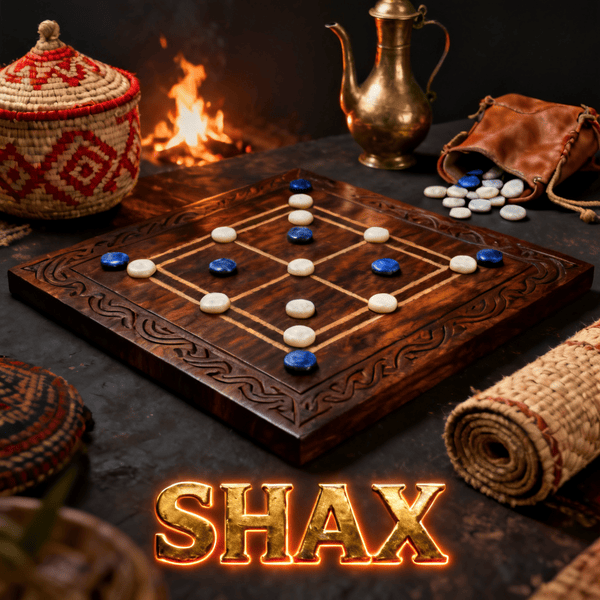
Shax is the Somali mill game, played across the Horn of Africa and known elsewhere as jar, djelga, mororova and shah. It is a Twelve Men's Morris variant on the familiar 24-point morris board: three concentric squares joined by four midlines, no diagonals.
The game is centuries old and still very much alive. It has left a deep mark on Somali literature and proverbs, and in a historically nomadic society a shax board was also a meeting point — a way for clans to keep in contact.
What makes shax its own game is arithmetic: twelve pieces each is exactly twenty-four, so the board is completely full when placement ends. Every rule below follows from that one fact.
How to Play
Phase 1 — Placement (24 drops): 1. Players alternate placing one piece on any empty point. 2. Three of your pieces in a line is a jare ("cut") — but a jare made during placement removes nothing. 3. Keep track of who makes the first jare. That is the whole prize of the placement phase.
The two opening removals: 1. When the last point is filled, the player who made the first jare removes one enemy piece. 2. Then the other player removes one enemy piece too — whether or not they ever made a jare. 3. Those two removals open the only two empty points on the board. Without them nobody could move at all. 4. If no jare was made during placement, nothing may be removed, nobody can move, and the game is a draw.
Phase 2 — Movement: 1. Slide one piece along a line to an adjacent empty point. 2. Now a jare does capture: form one and remove an enemy piece. 3. There is no flying — even on three pieces you still move one step at a time. 4. If the player to move has no legal move, their opponent must open an intersection for them. A freeing move never captures, even if it makes a jare.
Core Rules
- 24 points: three concentric squares plus four connecting midlines, no diagonals.
- 12 pieces each — 24 in total, so placement fills every point.
- A jare is three of your pieces on one marked line.
- Jare during placement: no capture. Jare during movement: capture one piece.
- End of placement: first-jare player removes one, then the opponent removes one.
- Any enemy piece may be removed, including one sitting in a jare — unlike Nine Men's Morris, which shields pieces inside a mill.
- No jare during placement at all: the game is drawn.
- Movement is one step along a line to an adjacent empty point. No flying, ever.
- A player with no legal move must be freed: the opponent is obliged to open an intersection, and that move captures nothing.
- You lose when you drop below three pieces, or when you have no legal move and none can be opened for you.
Strategy: Placement Is the Real Game
Race for the first jare. Both players get one opening removal regardless, so the first jare is not about material — it is about order. Removing first means you choose which piece leaves the board, and you decide where the first empty point appears.
Think about the two holes. Because placement fills everything, the only mobility in the entire game comes from those two removals. Take a piece that opens a point *next to your own pieces*, not next to your opponent's.
Occupy the busy junctions. The four points where a midline meets the middle square (and the middle-square corners) touch the most neighbours. In a board this crowded, degree is mobility, and mobility is survival.
Build a swinging jare. The engine of the movement phase is a piece that steps out of a line and back in, capturing every second turn. Set that shape up during placement.
Weaponise the freeing rule. Being frozen is not a loss — it forces your opponent to move a piece they wanted to leave alone. Sometimes the strongest thing you can do is run out of moves at the right moment.
Practical Tips
- A gold ring around a piece means it is part of a jare right now.
- Red rings mark the enemy pieces you may remove.
- Teal dots are the points your selected piece can step to.
- During placement the counter shows how many pieces are still in hand; when both reach zero the board is full and the removals begin.
- Pick your opponent on the start screen: easy plays loose, medium searches a few moves deep, hard looks further and defends the freeing rule properly.
- Playing hard? Watch the phase badge — the moment it flips to "Phase 2 · Movement", every jare counts.
FAQ
What is a jare in Shax?
A jare is three of your pieces in a row along a marked line — the shax word for a mill, literally a "cut". During placement a jare captures nothing; during the movement phase forming one lets you remove an enemy piece.
Why does forming a mill during placement not capture anything?
Because twelve pieces each fills all 24 points exactly. If mills captured during placement the board maths would break down. Instead, the first jare earns the right to remove first once the board is full — and both players then remove one piece each, which is what opens the two empty points that make movement possible.
Can you remove a piece that is part of a jare?
In this version, yes — any enemy piece may be taken, including one standing in a jare. Nine Men's Morris protects pieces inside a mill unless every enemy piece is in one, and if you have played our [Nine Men's Morris](/games/nine-mens-morris) you will notice the difference. The recorded rules of shax simply do not address the question, so rather than import the morris convention we left the choice open. On a board that starts completely full, protecting mills would leave the two opening removals with very few legal targets.
Can you fly in Shax when you are down to three pieces?
No. Shax has no flying rule. A player reduced to three pieces still moves one step at a time along a line, which makes the endgame much harsher than in Nine Men's Morris.
What happens if a player cannot move?
The opponent is required to open an intersection by moving one of their own pieces. If that freeing move happens to form a jare, no piece may be removed for it. If no move can free the blocked player, the blocked player loses.
Where is Shax played?
Shax is played across the Horn of Africa, particularly in Somalia. It also travels under the names jar, djelga, mororova and shah.
Can I play Shax online for free?
Yes. Arcadia runs free Shax in your browser against an AI opponent across three difficulty levels — no download and no account required.
Related Games

Ready to play Shax?
Launch the free demo, learn the flow, and practice your tactics.