Shax - Rules, History & Strategy Guide
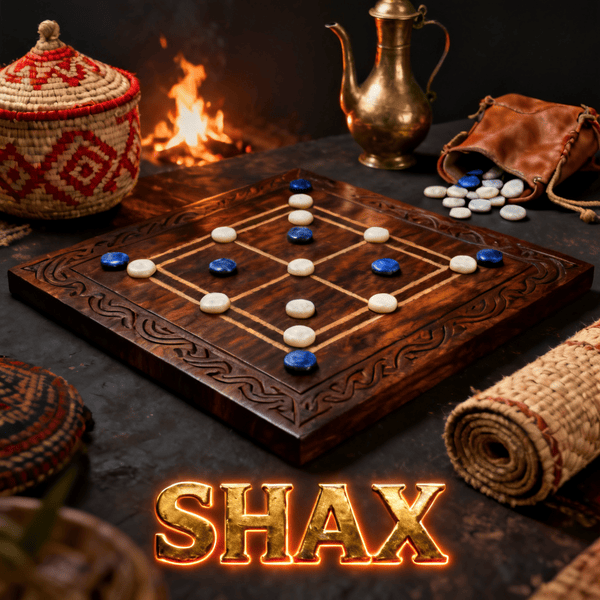
Shax is the Somali mill game, a Twelve Men's Morris variant on the 24-point morris board. Each player places twelve pieces until every point is occupied, and mills formed while placing, called jare, capture nothing. The player who makes the first jare removes first when the board fills, and only then can pieces move and capture.
Reviewed & updated
History & Origins
Shax is a mill game played across the Horn of Africa and especially in Somalia, where it is centuries old and still played today — commonly by scratching the board into the ground and playing with stones or sticks. It is also known as jar, djelga, mororova and shah.
Its cultural weight goes well beyond the board. Shax has significantly influenced Somali literature and proverbs, which draw on its positions and strategies, and in the historically nomadic Somali way of life the game served as a means of communication between clans.
How to Play
Shax uses the same 24-point board as Nine Men’s Morris, but each player has twelve pieces — so placement fills every single point. That one fact drives every unusual rule in the game.
- Take turns placing one piece at a time until all 24 points are occupied.
- Three of your pieces in a line is a jare ("cut"). During placement a jare captures nothing — but note who makes the first one.
- When the board is full, the player who made the first jare removes one enemy piece, then the opponent removes one too, whether or not they ever made a jare.
- Those two removals open the only two empty points on the board. Without them nobody could move at all.
- Now players alternate sliding one piece along a line to an adjacent empty point, and a jare formed by moving does capture.
- If the player to move has no legal move, their opponent must open an intersection for them — and that freeing move captures nothing, even if it makes a jare.
Strategy Tips
- Race for the first jare. Both players remove a piece anyway, so the prize is not the capture but removing first — which decides where the two empty points appear.
- Aim to open the gap beside your own pieces, not your opponent’s: whoever is adjacent to empty space has the mobility.
- During placement, take the high-degree junctions. On a full board the number of lines a point touches simply is its mobility.
- There is no flying in Shax, so being reduced to three pieces is close to lost — you cannot jump out of trouble.
- Freezing your opponent completely does not win outright, because you are then obliged to open a point for them.
Variations
Shax sits in the wider morris family alongside Nine Men’s Morris and the Southern African morabaraba, and the recorded rules leave some details open. In particular, no source states whether a piece standing in a jare is shielded from removal the way Nine Men’s Morris shields pieces in a mill. Arcadia allows any enemy piece to be taken, which keeps the two opening removals workable on a board that starts completely full.
Play Shax on Arcadia
Play Shax on Arcadia: fill the board, win the race for the first jare, and outmanoeuvre the AI in the Somali mill game.
Quick Answers
How is Shax different from Nine Men’s Morris?
Same board, different game. Shax gives each player twelve pieces instead of nine, so placement fills all 24 points; a mill made while placing captures nothing; the first mill only earns the right to remove first once the board is full; and there is no flying rule when you are down to three pieces.
What is a jare?
A jare is the Somali term for a mill — three of your pieces in a row along a marked line. The word literally means "cut". During placement it captures nothing; during the movement phase it lets you remove an enemy piece.
Why does the board fill up completely?
Because twelve pieces each is exactly 24, and the board has exactly 24 points. That is why mills cannot capture during placement — and why the two removals at the end of placement are what make movement possible at all.
What happens if a player cannot move?
Their opponent is required to open an intersection by moving one of their own pieces. If that freeing move happens to form a jare, no piece may be removed for it. A player who cannot move and cannot be freed loses.
Can I play Shax online for free?
Yes. Arcadia runs Shax free in your browser against three levels of AI across both the placement and movement phases, with no download and no account.
Is Shax the same as Nine Men's Morris?
It uses the same board — 24 points on three concentric squares joined by four midlines, no diagonals — but it is not the same game. Shax gives each player twelve pieces instead of nine, so placement fills every point and mills made during placement capture nothing. It also has no flying rule, so a player down to three pieces still moves one step at a time.
What are the other names for Shax?
Shax is also attested as jar, djelga, mororova and shah. The name you meet depends on where in the Horn of Africa you are playing; the rules travel with the game.
How do you win at Shax?
You win when your opponent cannot continue. That means either reducing them below three pieces, or leaving them with no legal move that anyone can open up for them. Because there is no flying, a small material edge in the endgame is usually decisive.
What happens if no jare is made during the placement phase?
Nothing can be removed, so no point opens up, and with all 24 points occupied neither player can move. The position is a dead draw and should be scored as one. In practice it is very rare across 24 placements, but the rules have to account for it.
Can a player be forced to move in Shax?
Yes, and it is one of the most distinctive rules in the game. If the player to move has no legal move, their opponent is required to open an intersection by moving one of their own pieces. If that freeing move happens to form a jare, no piece may be removed for it.
What is the best opening strategy in Shax?
Race for the first jare, because both players remove one piece at the end of placement anyway — the first jare only decides who removes first, and that choice sets where the two empty points appear. Aim to open a gap next to your own pieces rather than your opponent's. Beyond that, take the high-degree junctions: in a full board, the number of lines a point touches is the same thing as mobility.
How is Shax different from Seega and Dara?
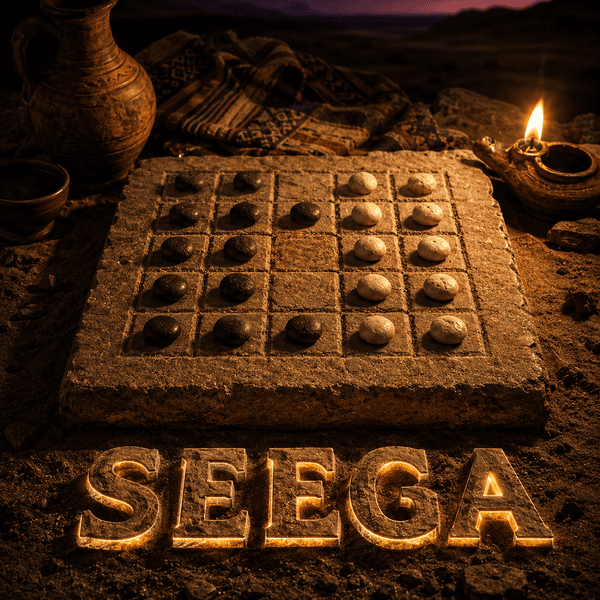
All three are African two-phase games where you place every piece before anything moves. Seega captures by trapping a stone between two of yours; Dara captures by making exactly three in a row on a 5×6 grid. Shax is the morris cousin: it captures on three-in-a-line along the marked lines of the 24-point board, and it is the only one of the three where the board is completely full when placement ends.
How old is Shax and what does it mean in Somali culture?
Shax is centuries old and still widely played across the Horn of Africa, particularly in Somalia. It has had a marked influence on Somali literature and proverbs, where its terms and situations are used as everyday metaphors. In the historically nomadic Somali way of life, a shax board also worked as a means of communication between clans.
Related Games On Arcadia
Related Guides

MAIN MENU
PvP Games
 Battleship
 Crazy Eights
 Dots & Boxes Blitz
 Gomoku
 Ludo
Ludo Quoridor
 Snakes & Ladders
 Yahtzee
Free Games
 Alquerque
 Backgammon
 Bagh-Chal
 Balut
Balut Battle for TokyoBattleship
 Bingo
Bingo Brick Breaker
 Bridge
 Bunco
Bunco Callbreak
 Checkers
 Chess
Chess ChompCrazy Eights
 Cribbage
 Dara
Dara Derby Dash
 DominoesDots & Boxes Blitz
 Durak
Durak Emberdeep
 Euchre
 Fanorona
 Farkle
 Fox and Geese
 Fox and Hounds
 Generala
 Gin Rummy
 Go / WeiqiGomoku
 Hazard
 Hearts
 Hex
Hex Higher or Lower
 Hnefatafl
 Hounds and Jackals
 Indian Rummy
 Jungle
 Ludus Latrunculorum
 Liar's DiceLudo
 Mahjong Solitaire
 Mancala
 Minesweeper
 Nim
Nim Nine Men's Morris
 Onitama
 Patolli
 Peg Solitaire
 Pentago
 Pente
Pente Pig
Pig PylosQuoridor
 Reversi
 Royal Game of Ur
 Scratch Cards
 Seega
Seega SenetShax
 Ship, Captain, Crew
 Shut the Box
 Sixteen Soldiers
 SnakeSnakes & Ladders
 Klondike Solitaire
 Space Blaster
 Spades
 Sugar Pop
 Sungka
 Tangram
 Tile Rummy
 Tower
Tower Truco
Truco War
War Word Spy
 XII ScriptaYahtzee
NEED HELP?