Sixteen Soldiers on Arcadia
Sixteen Soldiers is a two-player abstract strategy game from Sri Lanka — and one of the most-played board games alive. In Bangladesh it is sholo guti, "sixteen pieces", scratched into courtyard dirt and played with pebbles by millions. In India the same game is known as cows and leopards. It also travels under Bead 16, 16 Guti and Sola Goti.
Henry Parker documented it in *Ancient Ceylon* (1909) under the Sinhalese name Hēwākam Keliya, the War Game, and noted the Indian and Bangladeshi name *sōlah guttiya*, "sixteen balls". Arcadia's version keeps the rules Parker described intact and puts a minimax opponent on the other side of the board, at three strengths.
How to Play
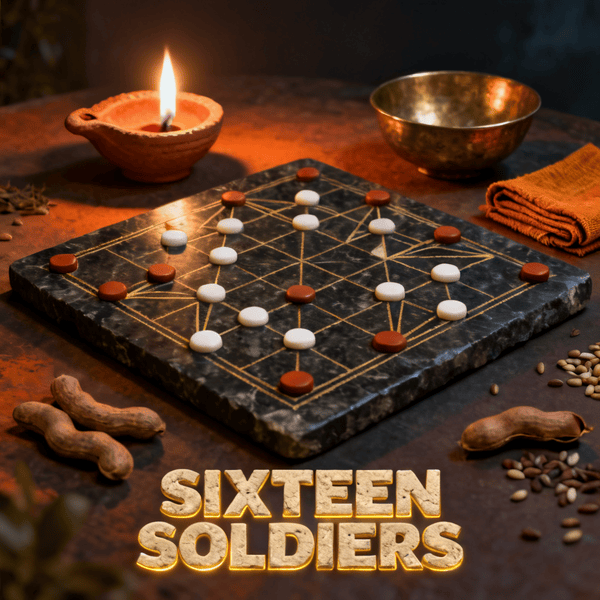
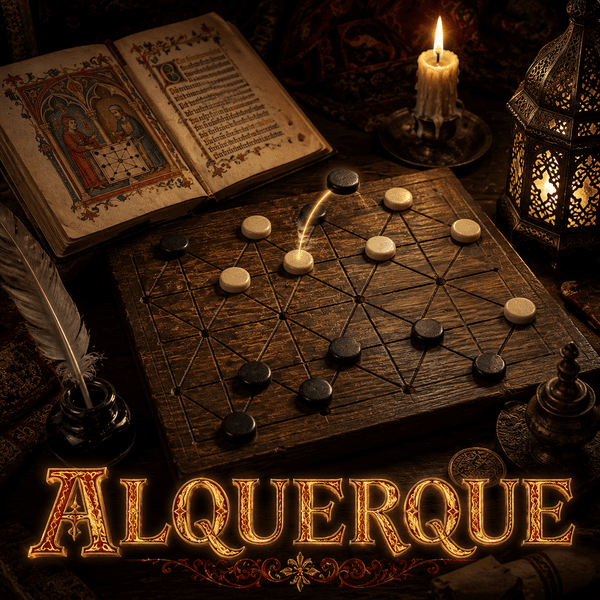
- The board is a standard alquerque lattice of 25 points with a triangular extension on two opposite sides, six points each — 37 points in total. Each triangle hangs from a single attachment point at the middle of the lattice edge and widens outward. Soldiers sit on the intersections.
- Each player has 16 soldiers, filling the two lattice rows nearest to them plus their own triangle. The lattice's middle row — all five points — starts empty.
- Players alternate. On your turn you use one soldier and either move or capture — never both.
- A move is one step to a vacant adjacent point along a marked line.
- A capture is the short leap: hop an adjacent enemy into the empty point directly beyond it, in a straight line following the board pattern. The leapt soldier is removed — traditionally, it is "chopped".
- Captures are not compulsory, and after one leap the same soldier may keep leaping. You may stop the chain at any point.
- Capture all sixteen enemy soldiers to win.
Core Rules
- Any direction, from move one. Unlike most draughts variants there is no forward-only restriction and no promotion: every soldier moves and captures in every direction the lines allow, for the whole game.
- Both halves of a leap must follow a line. The alquerque diagonals only pass through half the points, so a soldier on an "odd" point has four ways out, not eight.
- The triangles are part of the pattern, not an annexe. Their slanting sides are the short alquerque diagonals carried straight on past the edge, so leaps cross the join in either direction — a soldier in a triangle can be leapt into the lattice and back out again.
- Optional captures. Declining a chop is a legal and often useful choice.
- Chains may be broken off. A capturing soldier can stop after any leap in the chain.
- The win condition is annihilation — take all sixteen. Arcadia adds two house rules so a game always ends: a player with no legal move loses by blockade, and after 60 turns without a capture the side with more soldiers wins.
Strategy: Points, Not Squares
Count the lines, not the pieces. Seven points connect to eight neighbours: the centre, the four "even" interior points, and the mouth of each triangle. The four outer corners of the triangles connect to only two. A soldier parked in a triangle corner is nearly out of the game, so empty your triangle early rather than late — and fight for the two mouths, which are the busiest junctions on the board.
The empty middle row is the opening. Nobody has a capture on move one; both sides simply pour into the five vacant points. Whoever occupies that row on good terms dictates the first exchanges.
Every empty point is a landing zone. Because captures work in all directions, a hole you create behind your own line is a hole the opponent can leap into. Advance so that the point behind each soldier is filled.
Optional capture is a real weapon. Taking one soldier often hands back a three-chain. Count the reply before you chop — sometimes the strongest move is a quiet step that closes the landing square.
Trade down when ahead. Material is decisive here: with no promotion, ten soldiers against six is close to won. Simplify once you lead.
Practical Tips
- Red dots mark leaps; green dots mark quiet steps. Both are always offered, because captures are optional.
- Mid-chain, the End turn button stops the sequence — use it when the next leap would expose your soldier.
- Start on Easy to learn the lattice, then move to Hard, which searches three plies deep with alpha-beta pruning.
- Watch the no-capture counter. Long stand-offs are normal in sholo guti; at the limit the bigger army wins.
- The outer corners of the triangles are the weakest points on the board — two lines out and no more. Get those soldiers into the lattice early.
FAQ
What is Sixteen Soldiers called in Bangladesh and India?
In Bangladesh it is sholo guti — "sixteen pieces" — and it is enormously popular there. In India the same game is known as cows and leopards. Other names include Bead 16, 16 Guti and Sola Goti; in Sri Lanka, Henry Parker recorded it as Hēwākam Keliya, the War Game.
Can soldiers move backwards in Sixteen Soldiers?
Yes. This is the key difference from most draughts variants: soldiers move and capture in any direction from the very first move. There is no forward-only rule and no promotion, so no piece ever becomes more powerful than another.
Are captures compulsory in Sixteen Soldiers?
No. Captures are optional, and a chain of leaps may be broken off after any single leap. That makes declining a capture a genuine strategic option — often the right one when taking would open a longer counter-chain.
What board is Sixteen Soldiers played on?
A standard alquerque board — a 5x5 lattice of points with orthogonal and diagonal lines — with two triangular extensions on opposite sides, six points each, for 37 points in all. Each triangle narrows to a single attachment point at the middle of the lattice edge. In villages it is often just scratched into the ground and played with stones.
Can I play Sixteen Soldiers online for free?
Yes. Arcadia offers free Sixteen Soldiers in your browser against a minimax AI at three strengths, with no download and no account. Your wins, losses and games played are stored locally on your device.


Ready to play Sixteen Soldiers?
Launch the free demo, learn the flow, and practice your tactics.