Sixteen Soldiers vs Alquerque: 16 Pieces or 12?
The Verdict
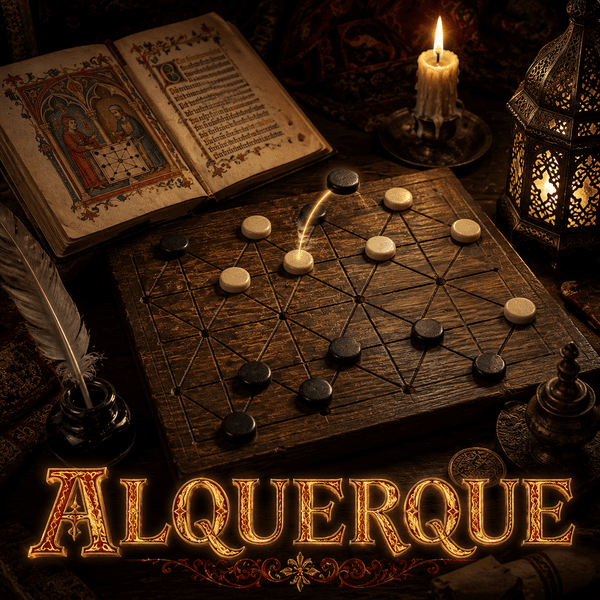
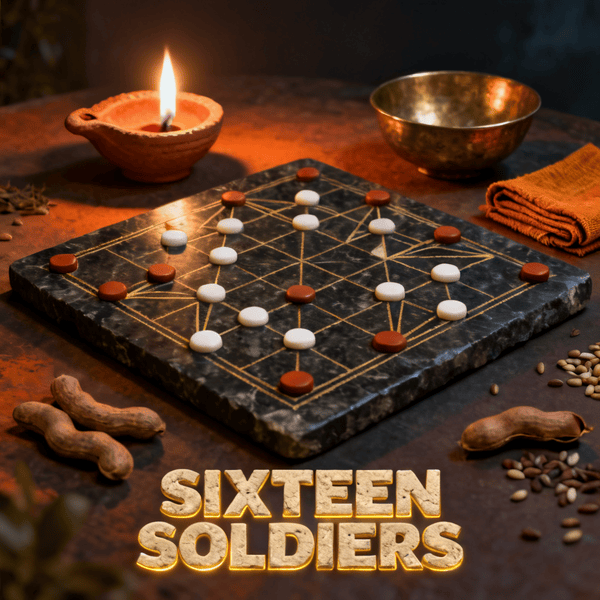
Both are leap-capture games on a lined lattice, and Sixteen Soldiers is the South Asian relative of the medieval Alquerque. The differences are the board and the army: Alquerque is a plain 5x5 lattice of 25 points with twelve pieces a side, while Sixteen Soldiers adds two triangular extensions for 37 points and sixteen pieces a side. Alquerque makes captures mandatory; Sixteen Soldiers lets you choose, which changes how endgames finish.
Side by Side
| Sixteen Soldiers | Alquerque | |
|---|---|---|
| Players | 2 | 2 |
| Board | 37 points - 5x5 lattice + 2 triangles | 25 points - plain 5x5 lattice |
| Pieces per side | 16 | 12 |
| Empty points at start | 5 (the middle row) | 1 (the centre) |
| Movement | One step along any marked line | One step along any marked line |
| Capture | Short leap, any direction, chains | Short leap, any direction, chains |
| Captures mandatory? | No | Yes |
| Average game length | 15-25 min | 10-15 min |
| Origin | Sri Lanka, Bangladesh, India | Recorded in Alfonso X's book, 1283 |
The triangles are the real difference
Alquerque is a clean 5x5 lattice: twenty-five points, twelve pieces a side, one empty point in the middle. Sixteen Soldiers takes that same lattice and adds a triangular extension pointing away from each player, bringing the board to thirty-seven points and the armies to sixteen. Those triangles are not decoration. They are narrow, which means pieces in them have fewer escape routes, and a soldier driven back into its own triangle is often much easier to trap than one in the open lattice.
Mandatory captures, and why it matters
In Alquerque, if a capture is available you must take it. That single rule creates the sacrifice tactics familiar from draughts: offer a piece, force the reply, and collect two in return. Sixteen Soldiers leaves the choice to you, so those forcing sequences do not exist in the same way - you cannot bait an opponent into a capture they are obliged to make. The trade-off is that Sixteen Soldiers endgames can drag, because a player who is behind is never compelled to walk into anything.
Which came first?
Alquerque is the better documented of the two. Arabic sources mention qirkat by around the 10th century and its full rules survive in Alfonso X's Libro de los Juegos, completed in 1283, which makes it the direct ancestor of modern draughts. Sixteen Soldiers belongs to the same broad lattice-and-leap family and is played across Sri Lanka, Bangladesh and India - as sholo guti, meaning 'sixteen pieces', and as cows and leopards - but its documented history is thinner and no reliable invention date exists.
Pick Sixteen Soldiers if…
- you want the bigger board and the longer game
- you like having the choice of whether to capture
- you are interested in South Asian traditional games
- you want more pieces and a slower build-up
Pick Alquerque if…
- you want the tighter, faster game
- you enjoy forced-capture sacrifice tactics
- you want the direct ancestor of draughts
- you prefer 10-15 minute sessions
FAQ
Is Sixteen Soldiers the same as Alquerque?
They are close relatives rather than the same game. Both move one step along marked lines and capture by short leaps that can chain, but Sixteen Soldiers plays on a 37-point board with sixteen pieces a side and optional captures, while Alquerque uses a plain 25-point lattice with twelve pieces and mandatory captures.
What is sholo guti?
Sholo guti is the Bangladeshi name for Sixteen Soldiers and means 'sixteen pieces'. It is one of the most widely played board games in Bangladesh, traditionally on a board scratched into the ground with pebbles or seeds as soldiers. In India the same game is often called cows and leopards.
Why does Sixteen Soldiers start with an empty middle row?
The sixteen pieces fill the two lattice rows nearest each player plus that player's triangle - five plus five plus six. That leaves the lattice's middle row of five points empty, which is what stops either side having a capture available on the very first move.
Can you capture backwards in both games?
Yes. Unlike draughts, where ordinary men only capture forwards, both Alquerque and Sixteen Soldiers allow leaps in any direction along a marked line from the very start, including sideways and backwards.
Which is closer to modern checkers?
Alquerque, clearly. It is the recognised ancestor of draughts: when the game reached medieval France it was transplanted onto a chessboard and the forward-only movement restriction was added, producing the game we now call checkers.

MAIN MENU
PvP Games
 Battleship
 Crazy Eights
 Dots & Boxes Blitz
 Gomoku
 Ludo
Ludo Quoridor
 Snakes & Ladders
 Yahtzee
Free Games
 Alquerque
 Backgammon
 Bagh-Chal
 Balut
Balut Battle for TokyoBattleship
 Bingo
Bingo Brick Breaker
 Bridge
 Bunco
Bunco Callbreak
 Checkers
 Chess
Chess ChompCrazy Eights
 Cribbage
 Dara
Dara Derby Dash
 DominoesDots & Boxes Blitz
 Durak
Durak Emberdeep
 Euchre
 Fanorona
 Farkle
 Fox and Geese
 Fox and Hounds
 Generala
 Gin Rummy
 Go / WeiqiGomoku
 Hazard
 Hearts
 Hex
Hex Higher or Lower
 Hnefatafl
 Hounds and Jackals
 Indian Rummy
 Jungle
 Ludus Latrunculorum
 Liar's DiceLudo
 Mahjong Solitaire
 Mancala
 Minesweeper
 Nim
Nim Nine Men's Morris
 Onitama
 Patolli
 Peg Solitaire
 Pentago
 Pente
Pente Pig
Pig PylosQuoridor
 Reversi
 Royal Game of Ur
 Scratch Cards
 Seega
Seega Senet
Senet Shax
Shax Ship, Captain, Crew
 Shut the Box
 Sixteen Soldiers
 SnakeSnakes & Ladders
 Klondike Solitaire
 Space Blaster
 Spades
 Sugar Pop
 Sungka
 Tangram
 Tile Rummy
 Tower
Tower Truco
Truco War
War Word Spy
 XII ScriptaYahtzee
NEED HELP?