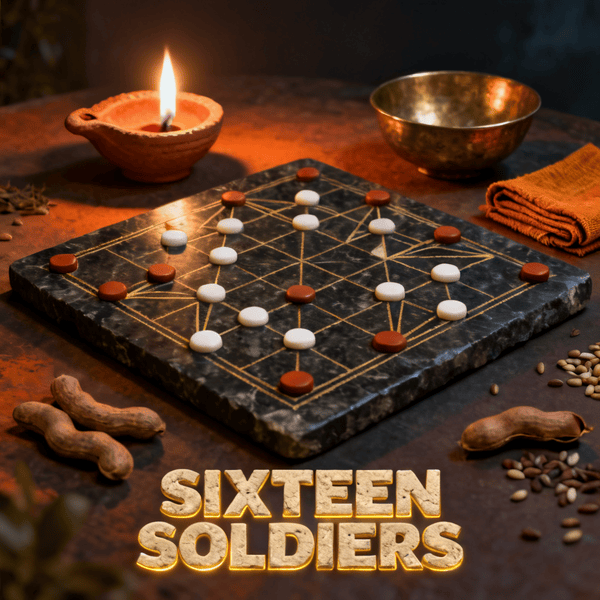
Sixteen Soldiers - Rules, History & Strategy Guide
Sixteen Soldiers is a two-player capture game from Sri Lanka, played across Bangladesh and India as sholo guti. Each side has sixteen pieces on a 37-point alquerque board with two triangular extensions. Pieces step along any marked line and capture by short leaps in any direction, chaining freely. Take every enemy soldier to win.
Reviewed & updated
History & Origins
Sixteen Soldiers is a two-player abstract from Sri Lanka, played across South Asia and hugely popular in Bangladesh under the name sholo guti — "sixteen pieces". In India it is known as cows and leopards. In villages it is often played by scratching the board into the ground and using stones for soldiers.
Henry Parker documented it in Ancient Ceylon (1909) as Hēwākam Keliya, the War Game, noting it was also played in India and Bangladesh as sōlah guttiya, "sixteen balls". Parker records that the pieces are called soldiers and that a captured soldier is said to be "chopped". Its closest relatives are the Sri Lankan games peralikatuma and Kotu Ellima, which use four triangular extensions instead of two and 23 and 24 pieces a side respectively; it is also related to the Indonesian Permainan-Tabal.
How to Play
The board is an alquerque lattice with a triangular extension on two opposite sides — 37 points in all. Each player has sixteen soldiers and wins by capturing every enemy soldier.
- Set up: your sixteen soldiers fill your half of the lattice and the triangle nearest you. The lattice’s middle row of five points is left empty.
- On your turn you use one soldier, and you either move or capture — never both.
- To move, step a soldier to any vacant adjacent point along a marked line.
- To capture, leap a soldier over an adjacent enemy into the vacant point directly beyond, in a straight line along the board pattern. The leapt soldier is removed.
- Captures are not compulsory, and a soldier may keep leaping for as long as leaps are available — you may stop whenever you like.
- Soldiers move and capture in any direction from the very first move. There is no forward-only restriction and no promotion.
Strategy Tips
- Because captures are optional, a chain is a choice: stopping short often leaves your soldier safe where finishing would hang it.
- The five empty points in the middle row are the whole opening. Whoever controls that band controls where the first leaps happen.
- Count the reply before you leap. With capture in every direction, the point you land on is as exposed as the one you left.
- The triangle apexes are dead ends — a soldier parked out there has almost no mobility.
- Trade evenly early and look for the double: one well-placed leap that threatens two chains at once usually wins material.
Variations
Some regions of South Asia play on a board with four triangles rather than two. Scale the same idea up and you get its Sri Lankan cousins: peralikatuma with 23 soldiers a side and Kotu Ellima with 24, both on four-triangle boards. Strip the triangles away entirely and you are back to plain alquerque, played on the bare 25-point lattice with twelve pieces a side.
Play Sixteen Soldiers on Arcadia
Play Sixteen Soldiers on Arcadia: chain your leaps across the 37-point board and chop all sixteen enemy soldiers.
Quick Answers
What is sholo guti?
Sholo guti is the Bangladeshi name for Sixteen Soldiers, and it means "sixteen pieces". It is the same game Henry Parker recorded in Sri Lanka as Hēwākam Keliya, and the one played in India as cows and leopards.
How is Sixteen Soldiers different from alquerque?
It uses the alquerque lattice but adds a triangular extension on two opposite sides, giving 37 points instead of 25, and each player has sixteen pieces instead of twelve. Both games let a piece move and capture in any direction; the omni-directional rule is what separates them from draughts, not from each other.
Are captures compulsory in Sixteen Soldiers?
No. Unlike most draughts variants you may decline a capture entirely, and mid-chain you may stop after any leap. That optionality is a real part of the strategy, because finishing a chain often walks your soldier into a reply.
How do you win at Sixteen Soldiers?
By capturing all sixteen of your opponent’s soldiers. There is no promotion and no territory to claim — it is a pure elimination game.
Can I play Sixteen Soldiers online for free?
Yes. Arcadia runs sholo guti free in your browser against three levels of AI, with full chained leaping, and no download or account required.
What is sholo guti?
Sholo guti is the Bangladeshi name for Sixteen Soldiers, and it means "sixteen pieces". It is one of the most widely played board games in Bangladesh, usually on a board scratched into the ground with pebbles or seeds as soldiers. The same game is called cows and leopards in India.
How many pieces does each player have in Sixteen Soldiers?
Sixteen each, which is where the name comes from. They fill the two lattice rows nearest each player plus the triangular extension on that player's side — five plus five plus six. The lattice's middle row, all five points, is left empty at the start, so neither side has a capture on the first move.
Can you capture backwards in Sixteen Soldiers?
Yes, and this is the rule that separates it from most draughts variants. Pieces move and capture in every direction the lines allow, from the very first move. There is no forward-only restriction and no promotion, so every soldier stays equal for the whole game.
Are captures compulsory in Sixteen Soldiers?
No. Captures are optional. A piece may also continue capturing in the same turn with chained leaps, and it may stop at any point in the chain. Choosing not to take is a real tactic, because a greedy chop often opens a longer reply.
How do you win Sixteen Soldiers?
By capturing all sixteen of your opponent's soldiers. There is no promotion and no race to the far side, so the whole game is an attrition fight. A captured soldier is traditionally said to be "chopped".
What board is Sixteen Soldiers played on?
A standard alquerque board — a 5x5 lattice of points crossed by orthogonal and diagonal lines — with two triangular extensions attached on opposite sides, six points each, making 37 in all. Each triangle narrows to a single attachment point at the middle of a lattice edge and widens outward. Pieces sit on the intersections, not in the spaces, and travel along the marked lines.
Is Sixteen Soldiers the same as checkers?
They are relatives, not the same game. Both use the short leap to capture, but Sixteen Soldiers is played on the points of an alquerque lattice rather than the squares of a chequered board, captures are optional, and there is no forward-only rule and no kinging.
What games are closest to Sixteen Soldiers?
Alquerque, whose board it extends, and two other Sri Lankan games: peralikatuma, played with four triangular extensions and 23 pieces a side, and Kotu Ellima, with four extensions and 24 pieces a side. The Indonesian game Permainan-Tabal is also related.

MAIN MENU
PvP Games
 Battleship
 Crazy Eights
 Dots & Boxes Blitz
 Gomoku
 Ludo
Ludo Quoridor
 Snakes & Ladders
 Yahtzee
Free Games
 Alquerque
 Backgammon
 Bagh-Chal
 Balut
Balut Battle for TokyoBattleship
 Bingo
Bingo Brick Breaker
 Bridge
 Bunco
Bunco Callbreak
 Checkers
 Chess
Chess ChompCrazy Eights
 Cribbage
 Dara
Dara Derby Dash
 DominoesDots & Boxes Blitz
 Durak
Durak Emberdeep
 Euchre
 Fanorona
 Farkle
 Fox and Geese
 Fox and Hounds
 Generala
 Gin Rummy
 Go / WeiqiGomoku
 Hazard
 Hearts
 Hex
Hex Higher or Lower
 Hnefatafl
 Hounds and Jackals
 Indian Rummy
 Jungle
 Ludus Latrunculorum
 Liar's DiceLudo
 Mahjong Solitaire
 Mancala
 Minesweeper
 Nim
Nim Nine Men's Morris
 Onitama
 Patolli
 Peg Solitaire
 Pentago
 Pente
Pente Pig
Pig PylosQuoridor
 Reversi
 Royal Game of Ur
 Scratch Cards
 Seega
Seega Senet
Senet Shax
Shax Ship, Captain, Crew
 Shut the BoxSixteen Soldiers
 SnakeSnakes & Ladders
 Klondike Solitaire
 Space Blaster
 Spades
 Sugar Pop
 Sungka
 Tangram
 Tile Rummy
 Tower
Tower Truco
Truco War
War Word Spy
 XII ScriptaYahtzee
NEED HELP?