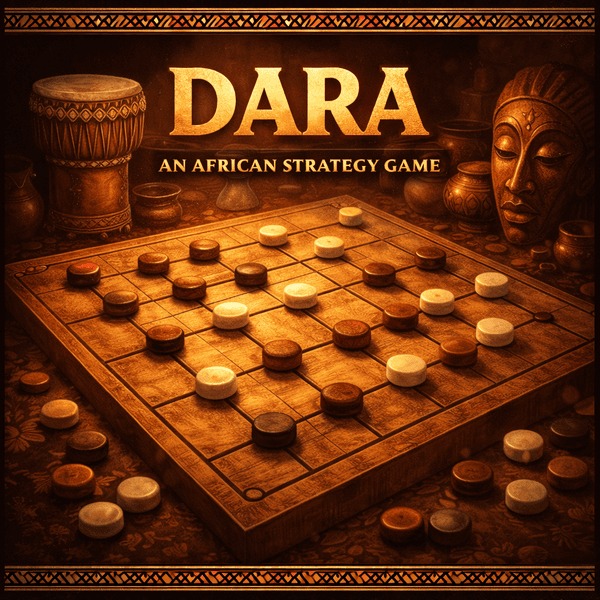
Dara - Rules, History & Strategy Guide
Dara is a traditional Nigerian abstract strategy game for two players on a 5×6 grid. Each player places 12 pieces, then slides them one square at a time; every new three-in-a-row captures an enemy piece. Reduce your opponent below three pieces to win, usually within 10–20 minutes.
Reviewed & updated
History & Origins
Dara originated with the Dakarkari people of northern Nigeria and has been played in West African villages for centuries, traditionally on grids drawn in sand using stones, sticks, or shells as pieces.
Like Nine Men's Morris and other classic alignment games, Dara captures a universal idea — three in a row to capture — but its 5×6 board and two-phase structure give it a distinct rhythm that rewards both setup and timing.
How to Play
Dara has two clear phases: a placement phase where each player drops 12 pieces, then a movement phase where pieces slide one square at a time to form rows of three.
- Players alternate placing one piece per turn into any empty square. No captures happen during placement.
- Once both players have placed all 12 pieces, the movement phase begins.
- On your turn, slide one of your pieces to an orthogonally adjacent empty square.
- Whenever a slide forms a new row of exactly three of your pieces in a horizontal or vertical line, you capture one of your opponent's pieces.
- Captured pieces are removed from the board permanently. Reduce your opponent below three pieces (or unable to form any new three-in-a-rows) to win.
Strategy Tips
- Avoid placing all your pieces in pre-formed three-in-a-rows during placement — those don't count for captures, only NEW alignments do.
- Look for "double threats" where one slide simultaneously breaks an old row and forms a new one, capturing on each move.
- Cluster your pieces near the center for maximum sliding flexibility in the movement phase.
- Watch for opponent setups two moves ahead and block them by occupying the gap.
Variations
Some West African Dara variants use 6×6 boards or vary piece counts. Diagonal three-in-a-rows are sometimes allowed but are excluded in the most common rule set used here.
Play Dara on Arcadia
Play Dara on Arcadia to learn this traditional Nigerian strategy game and put the placement-then-movement combo into practice against a thinking opponent.
Quick Answers
How do you win at Dara?
Reduce your opponent's pieces below three by capturing them through repeated three-in-a-row formations. With fewer than three pieces left, they cannot form any more rows and lose.
Do diagonals count in Dara?
In the standard rule set, only horizontal and vertical three-in-a-rows count. Diagonal alignments are ignored, which is what makes the 5×6 board feel different from games like Tic-Tac-Toe.
Can I play Dara online for free?
Yes. Arcadia offers free Dara with no download or account required, against an AI opponent that understands both placement and movement strategy.
What happens if you make four in a row in Dara?
Nothing — only a line of exactly three counts as a capture. Sliding a piece so that it forms a row of four earns no capture at all, which is why careless placement can block your own scoring lines later. Strong players deliberately build shapes that can pivot into fresh rows of exactly three.
Can you capture during the placement phase in Dara?
No. All 24 pieces go down first, twelve per player, with no captures allowed. Rows that already exist when placement ends score nothing either — only lines newly formed by a slide in the movement phase trigger a capture.
How many pieces do you need to play Dara?
Each player has 12 pieces on a 5×6 board of 30 squares, so 24 of the 30 squares are occupied when the movement phase begins. That crowded start is deliberate: with only six empty squares, early mobility is scarce and every slide matters.
Where does Dara come from?
Dara is a traditional game of the Dakarkari people of north-western Nigeria, historically played on grids scratched into sand with stones, sticks, or shells as pieces. Closely related three-in-a-row capture games are played across the Sahel region under a variety of local names.
Is Dara the same as Nine Men’s Morris?
They share the same core idea — form three in a row to remove an enemy piece — but differ in structure. Dara is played on a full 5×6 grid with 12 pieces per side and orthogonal sliding, while Nine Men’s Morris uses 24 points on concentric squares with nine pieces each. Dara also ignores rows that exist before the movement phase begins, which changes placement strategy completely.
Is Dara a game of luck or skill?
Pure skill. There are no dice, no hidden information, and no random elements — both players see the whole board at all times. As in chess or checkers, the better planner wins, especially the player who spots double-threat slides first.
How long does a game of Dara take?
A typical game runs 10–20 minutes: placement moves quickly, and the movement phase decides the result. Digital play is faster still — against Arcadia’s free browser AI a full match often finishes in under ten minutes, with no download needed.
Can you win Dara without capturing all your opponent’s pieces?
Yes. You win as soon as your opponent drops below three pieces, because two pieces can never form a row, and most rules also award the win if the opponent can no longer form any new three-in-a-row or has no legal move. Total elimination is never required.
Related Games On Arcadia
Related Guides

MAIN MENU
PvP Games
 Battleship
 Crazy Eights
 Dots & Boxes Blitz
 Gomoku
 Ludo
Ludo Quoridor
 Snakes & Ladders
 Yahtzee
Free Games
 Alquerque
 Backgammon
 Bagh-Chal
 Balut
Balut Battle for TokyoBattleship
 Bingo
Bingo Brick Breaker
 Bridge
 Bunco
Bunco Checkers
 Chess
Chess ChompCrazy Eights
 CribbageDara
 Derby Dash
 DominoesDots & Boxes Blitz
 Durak
Durak Emberdeep
 Fanorona
 Farkle
 Fox and Geese
 Fox and Hounds
 Generala
 Gin Rummy
 Go / WeiqiGomoku
 Hazard
 Hex
Hex Higher or Lower
 Hnefatafl
 Hounds and Jackals
 Indian Rummy
 Jungle
 Ludus Latrunculorum
 Liar's DiceLudo
 Mahjong Solitaire
 Mancala
 Minesweeper
 Nim
Nim Nine Men's Morris
 Onitama
 Patolli
 Peg Solitaire
 Pentago
 Pente
Pente Pig
Pig PylosQuoridor
 Reversi
 Royal Game of Ur
 Scratch Cards
 Seega
Seega Senet
Senet Shax
Shax Ship, Captain, Crew
 Shut the Box
 Sixteen Soldiers
 SnakeSnakes & Ladders
 Klondike Solitaire
 Space Blaster
 Spades
 Sugar Pop
 Sungka
 Tangram
 Tile Rummy
 Tower
Tower Truco
Truco War
War Word Spy
 XII ScriptaYahtzee
NEED HELP?