Chomp - Rules, History & Strategy Guide
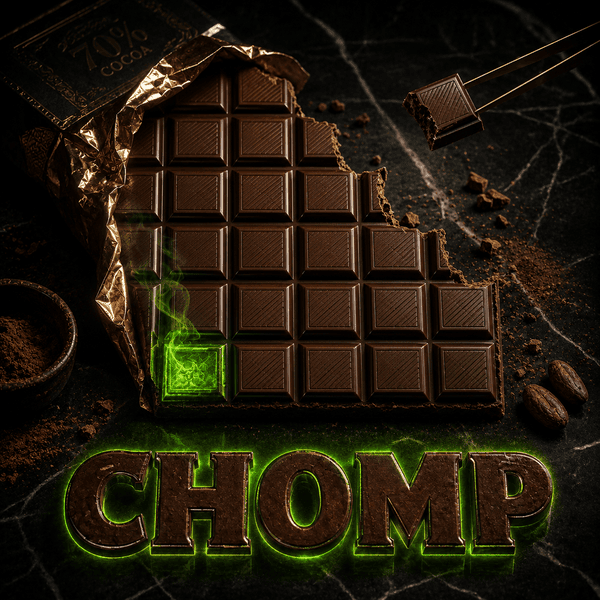
Chomp is a two-player mathematical strategy game played on a chocolate-bar grid with one poisoned corner square. Each turn you bite a square and everything below and to its right; whoever is left holding only the poison loses. Invented by David Gale in 1974, a game takes just a few minutes.
Reviewed & updated
History & Origins
Chomp was invented by mathematician David Gale in 1974 and reached the world through Martin Gardner’s legendary Mathematical Games column in Scientific American. The setup is disarming, a chocolate bar with one poisoned corner, but the game encodes a deep result: by the strategy-stealing argument, the first player always possesses a winning strategy on any bar larger than a single square, yet no general rule for finding it is known.
The game is a dressed-up version of a 1952 number-theory game by Fred Schuh played with divisors, and it remains a staple of combinatorial game theory courses: easy to state, fully solvable by computer on small boards, and stubbornly unsolved in general, with research papers still probing three-dimensional and infinite bars today.
How to Play
Chomp is a two-minute duel of permanent decisions: every bite removes a rectangle of chocolate forever, and the whole game funnels toward one poisoned square.
- Start with a rectangular chocolate bar (Arcadia uses 4x7); the top-left square is poisoned.
- On your turn, choose any remaining square and eat it together with every square below and to its right.
- Alternate bites; there is no passing and no undo.
- Never bite the poison while other chocolate remains.
- The player left with only the poisoned square must eat it and loses.
Strategy Tips
- Read positions as staircases: after any bite the bar’s rows are non-increasing going down, and every staircase is either winning or lost.
- Memorize the lost shapes: the 2x2 block is lost for the mover, and handing it over wins the game.
- Use the 2-row rule: with two rows left, keep the top row exactly one square longer than the bottom.
- Prefer small corrective nibbles over big dramatic bites; tempo control beats material greed.
- Against a perfect opponent, plan the full line before your first bite: one inaccuracy is fatal, but the opening position is always winning for you.
Variations
Chomp scales in every direction: different bar sizes change the solved lines but not the theory, three-dimensional Chomp bites boxes out of chocolate bricks, and infinite ordinal Chomp is a genuine research topic. Its ancestor, Schuh’s divisor game, plays the identical structure with the divisors of a number, where the number 1 is the poison.
Play Chomp on Arcadia
Play Chomp on Arcadia to think in staircases, feed the Glutton his poison, and win a game mathematics says is always yours to win.
Quick Answers
Why is Chomp famous among mathematicians?
Because of its existence proof: the strategy-stealing argument shows the first player can always win, but constructs no strategy. It is the standard example of a non-constructive proof in game theory.
What is the strategy-stealing argument?
Suppose the second player had a winning reply to the smallest possible bite (the bottom-right corner). Then the first player could reach the position after that reply directly with their first bite, stealing the win. So no such second-player strategy can exist.
Is Chomp solved?
Small boards, yes: computers can solve any specific bar (Arcadia’s AI has the 4x7 bar fully solved). A general formula for the winning first bite on arbitrary bars remains unknown.
What happens if I click the poisoned square?
While other chocolate remains the game refuses the bite. When the poison is the last square on your turn, you must eat it, and the game is lost.
Can I play Chomp online for free?
Yes. Arcadia offers free Chomp in your browser with a casual AI and a perfectly solved Glutton mode — no download or account required.
How do you win at Chomp?
You win by always handing your opponent a losing shape. The reliable ones to learn first: the 2×2 block, an L with two equal arms meeting at the poison, and a two-row bar whose top row is exactly one square longer than the bottom. Steer every exchange towards giving one of those away.
What is the best first move in Chomp?
On a square bar it is known: bite the square diagonally adjacent to the poison, leaving an L with two equal arms, then mirror every enemy bite in the other arm. On general rectangles no formula is known — computers can solve any specific bar, but mathematics has no rule that covers them all.
Is Chomp a game of luck or skill?
Entirely skill. There is no chance element, and on any bar larger than a single square the first player provably has a winning strategy. In practice the winner is whoever knows more losing shapes and counts the staircase more carefully — one careless bite is usually fatal.
Why can’t you just leave your opponent the poisoned square on move one?
Because of the bite geometry: every bite removes a rectangle extending down and to the right of the square you choose. From a full 4×7 bar no single bite can strip away everything except the poison — the closest greedy bites leave a thin row or column, which is an easy win for the other side.
Who invented Chomp and why is it called that?
The game was introduced by mathematician David Gale, whose 1974 paper described it as “a curious Nim-type game”. The chocolate-bar framing and the name Chomp were popularised through Martin Gardner’s Mathematical Games column in Scientific American, and the name stuck.
Is Chomp related to Nim?
Closely — both are impartial games covered by the same Sprague-Grundy theory, and Gale explicitly presented Chomp as a Nim-type game. The crucial difference is that Nim has a complete, playable formula (the nim-sum), while Chomp has an existence proof of a first-player win with no general recipe. Chomp is also identical in structure to Fred Schuh’s 1952 game of divisors.
How long does a game of Chomp take?
One to three minutes is typical: Arcadia’s 4×7 bar holds 28 squares, so a game can never exceed 27 bites and most end far sooner. You can play free in your browser, against a casual Sweet Tooth opponent or a Glutton AI that has the whole bar solved.
Can Chomp be played on bigger or infinite boards?
Yes. Any rectangle works, three-dimensional Chomp bites boxes out of a chocolate brick, and mathematicians study transfinite Chomp on infinite ordinal-indexed bars as genuine research. The strategy-stealing argument guarantees a first-player win on every finite bar, but each new size has to be solved from scratch.
Related Games On Arcadia
Related Guides

MAIN MENU
PvP Games
 Battleship
 Crazy Eights
 Dots & Boxes Blitz
 Gomoku
 Ludo
Ludo Quoridor
 Snakes & Ladders
 Yahtzee
Free Games
 Alquerque
 Backgammon
 Bagh-Chal
 Balut
Balut Battle for TokyoBattleship
 Bingo
Bingo Brick Breaker
 Bridge
 Bunco
Bunco Callbreak
 Checkers
 ChessChompCrazy Eights
 Cribbage
 Dara
Dara Derby Dash
 DominoesDots & Boxes Blitz
 Durak
Durak Emberdeep
 Euchre
 Fanorona
 Farkle
 Fox and Geese
 Fox and Hounds
 Generala
 Gin Rummy
 Go / WeiqiGomoku
 Hazard
 Hearts
 Hex
Hex Higher or Lower
 Hnefatafl
 Hounds and Jackals
 Indian Rummy
 Jungle
 Ludus Latrunculorum
 Liar's DiceLudo
 Mahjong Solitaire
 Mancala
 Minesweeper
 Nim
Nim Nine Men's Morris
 Onitama
 Patolli
 Peg Solitaire
 Pentago
 Pente
Pente Pig
Pig PylosQuoridor
 Reversi
 Royal Game of Ur
 Scratch Cards
 Seega
Seega Senet
Senet Shax
Shax Ship, Captain, Crew
 Shut the Box
 Sixteen Soldiers
 SnakeSnakes & Ladders
 Klondike Solitaire
 Space Blaster
 Spades
 Sugar Pop
 Sungka
 Tangram
 Tile Rummy
 Tower
Tower Truco
Truco War
War Word Spy
 XII ScriptaYahtzee
NEED HELP?