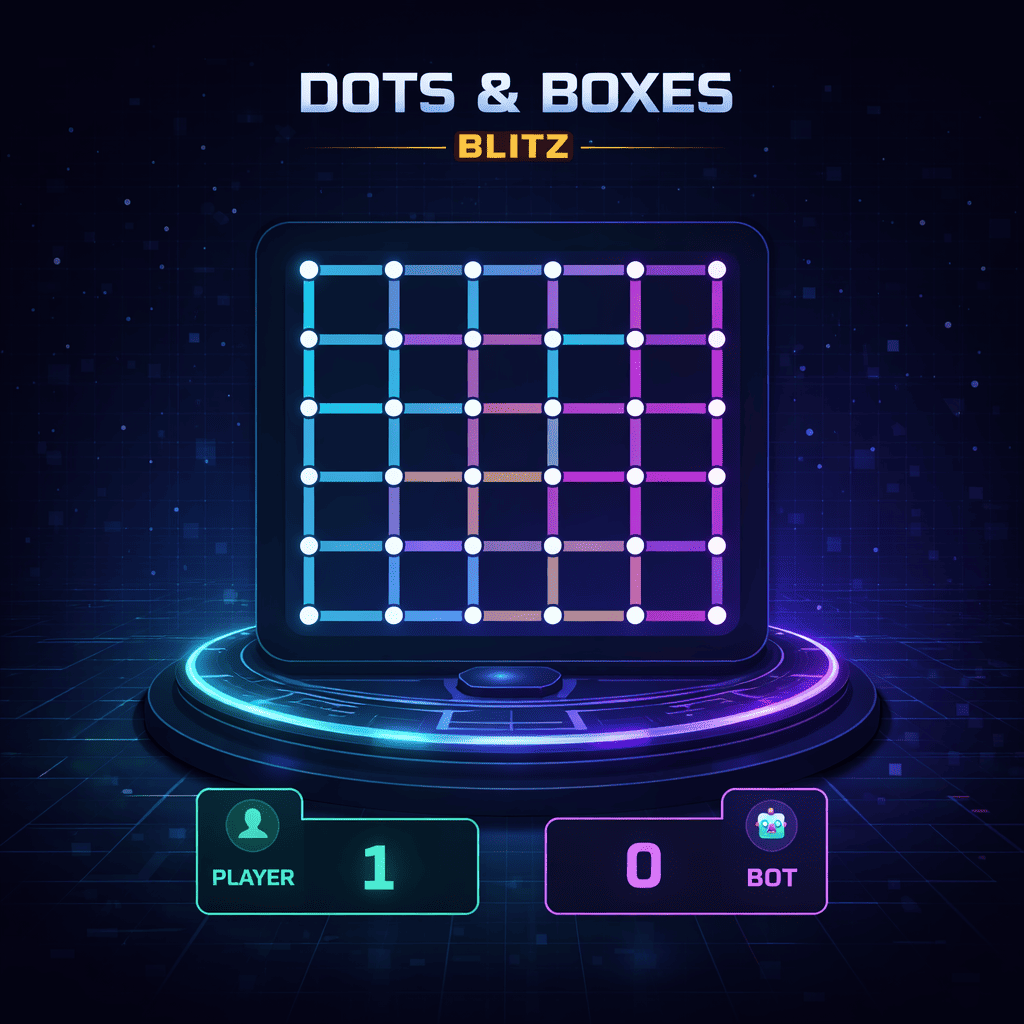
Dots & Boxes Blitz - Rules, History & Strategy Guide
Dots and Boxes Blitz is a fast two-player territory game on a grid of dots. Players take turns drawing one line between adjacent dots; completing the fourth side of a box claims it and grants another move. Most boxes wins, and a blitz game finishes in under five minutes.
Reviewed & updated
History & Origins
Dots and Boxes has been around since the nineteenth century and is famous for being easy enough to doodle on paper yet deep enough to support serious tactical play. The blitz flavor simply compresses the pace and makes pattern recognition even more important.
Players often think the game is about grabbing boxes whenever possible. Stronger play reveals the opposite: the real battle is about who controls chains and who is forced to open them.
How to Play
Players take turns drawing one line between adjacent dots. Completing the fourth side of a box claims it and usually grants another move.
- Draw a single legal line on your turn.
- If the line completes a box, claim it and take another move.
- Continue chaining extra moves while you keep closing boxes.
- When no immediate boxes are available, think about how your line changes future chains.
- The player with the most boxes at the end wins.
Strategy Tips
- Avoid creating the third side of a box too early unless you are setting a bigger trap.
- Count long chains and loops before the late game starts.
- Sometimes the right move is to sacrifice a small box to secure a longer run later.
- In blitz formats, pattern recognition speed matters almost as much as the underlying tactics.
Variations
Paper versions, timed digital versions, and larger boards all shift pacing, but the chain principles stay recognizable. Some variants also experiment with bonus squares or alternate scoring values.
Play Dots & Boxes Blitz on Arcadia
Play Dots & Boxes Blitz on Arcadia to put these rules and ideas into practice right away.
Quick Answers
Why is Dots and Boxes more strategic than it looks?
Because the early and middle game are mostly about controlling future chains rather than scoring immediate boxes.
What is a chain in Dots and Boxes?
A chain is a connected sequence of boxes that one player can often collect in a row once it is opened.
Should you always take a box when it is available?
Not blindly. The right tactical choice depends on what chain structure you hand to the opponent afterward.
Who invented Dots and Boxes?
French mathematician Édouard Lucas published the game in 1889 under the name La Pipopipette. It spread through schools because it needs nothing but paper, a pencil, and two players, yet it has been studied seriously by combinatorial game theorists ever since.
What is the double-cross strategy in Dots and Boxes?
Instead of taking every box in a chain, you deliberately leave the last two and close them off with a single line, forcing your opponent to take those two boxes and then open the next chain for you. Giving up two boxes per chain to keep control is the single biggest idea separating strong players from beginners.
What is the chain rule in Dots and Boxes?
Expert play revolves around the parity of long chains — chains of three or more boxes — because whoever is forced to open the first long chain usually loses control of the endgame. Good players count chains as they form and steer the board so the unfavourable parity lands on the opponent.
Why do you get another turn when you complete a box?
The extra-move rule is what creates chains: each box you close opens the next, letting one player sweep a whole chain in a single turn. It also creates the game’s central trap, because the player who grabs everything greedily must eventually draw the line that hands the next chain away.
Is Dots and Boxes a game of luck?
No — it is a perfect-information strategy game with no dice, cards, or hidden elements. Every loss traces back to a decision, usually opening the wrong chain first. The blitz format adds time pressure, so quick pattern recognition becomes part of the skill.
What size board is best for Dots and Boxes?
Casual paper games often use small grids where a handful of boxes decides everything, while serious play favours larger boards because long chains and loops have room to form. Bigger boards reward planning; smaller ones reward tactics and speed.
What makes the Blitz version different from classic Dots and Boxes?
Blitz compresses the pace: moves come quickly and thinking time is short, so you must recognise chain structures at a glance instead of calculating slowly. The underlying rules — one line per turn, a completed box grants another move — are unchanged.
Can you play Dots and Boxes online for free?
Yes. Arcadia’s Dots and Boxes Blitz is free to play in the browser against an AI opponent, with no download or account needed. It is a fast way to drill chain counting and double-cross timing against a computer that punishes greedy play.

MAIN MENU
PvP Games
 Battleship
 Crazy EightsDots & Boxes Blitz
 Gomoku
 Ludo
Ludo Quoridor
 Snakes & Ladders
 Yahtzee
Free Games
 Alquerque
 Backgammon
 Bagh-Chal
 Balut
Balut Battle for TokyoBattleship
 Bingo
Bingo Brick Breaker
 Bridge
 Bunco
Bunco Callbreak
 Checkers
 Chess
Chess ChompCrazy Eights
 Cribbage
 Dara
Dara Derby Dash
 DominoesDots & Boxes Blitz
 Durak
Durak Emberdeep
 Euchre
 Fanorona
 Farkle
 Fox and Geese
 Fox and Hounds
 Generala
 Gin Rummy
 Go / WeiqiGomoku
 Hazard
 Hearts
 Hex
Hex Higher or Lower
 Hnefatafl
 Hounds and Jackals
 Indian Rummy
 Jungle
 Ludus Latrunculorum
 Liar's DiceLudo
 Mahjong Solitaire
 Mancala
 Minesweeper
 Nim
Nim Nine Men's Morris
 Onitama
 Patolli
 Peg Solitaire
 Pentago
 Pente
Pente Pig
Pig PylosQuoridor
 Reversi
 Royal Game of Ur
 Scratch Cards
 Seega
Seega Senet
Senet Shax
Shax Ship, Captain, Crew
 Shut the Box
 Sixteen Soldiers
 SnakeSnakes & Ladders
 Klondike Solitaire
 Space Blaster
 Spades
 Sugar Pop
 Sungka
 Tangram
 Tile Rummy
 Tower
Tower Truco
Truco War
War Word Spy
 XII ScriptaYahtzee
NEED HELP?