Hex - Rules, History & Strategy Guide
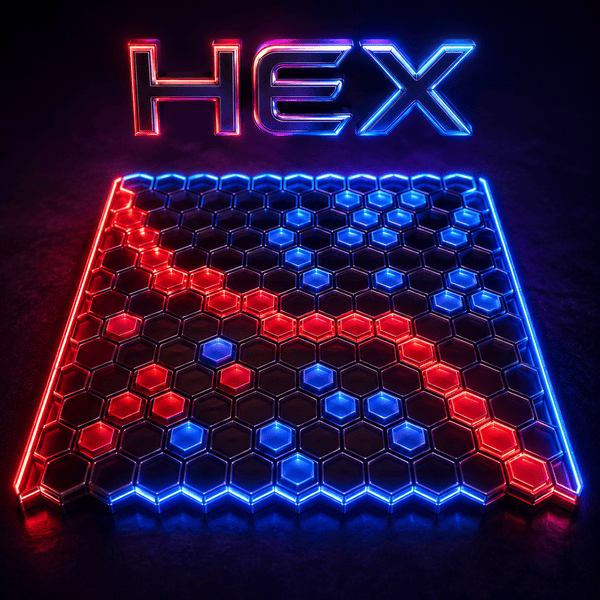
Hex is a two-player connection game played on a rhombus of hexagonal cells, usually 11×11. Players take turns placing stones; one side must link left to right, the other top to bottom. Stones never move or get captured, and a draw is mathematically impossible. A typical game lasts ten to twenty minutes.
Reviewed & updated
History & Origins
Hex was invented twice, independently: first by the Danish poet and scientist Piet Hein in 1942, who introduced it as Polygon in a Copenhagen newspaper, and again by mathematician John Nash at Princeton in 1948. Nash proved that the first player can always win with perfect play, and the game became a fixture of game theory and recreational mathematics.
Part of Hex’s fame is a beautiful theorem: a completely filled board always contains exactly one winning connection, so the game can never end in a draw. Easy to explain and impossible to exhaust, Hex has been used to teach topology and strategy for decades, and it remains a benchmark problem for game-playing AI.
How to Play
You play red on an 11×11 rhombus of hexagons and win by connecting the left and right edges; the AI plays blue and connects top to bottom.
- Take turns placing a single stone on any empty hexagon.
- As red, build an unbroken chain of red hexes joining the left edge to the right edge.
- The AI, as blue, tries to connect the top edge to the bottom edge.
- Stones never move and are never captured once placed.
- The first player to complete their edge-to-edge connection wins — and because a full board always has exactly one connection, there are no draws.
Strategy Tips
- Play toward the centre early; central stones touch more potential paths in both directions.
- Learn the bridge — two stones with two shared empty cells between them are virtually connected because the opponent cannot cut both.
- Remember that every connecting move also blocks your opponent; attack and defence are the same act.
- Build toward your own edges early rather than leaving the final link to a crowded endgame.
- Judge positions by who is closer to connecting, not by counting stones — material is meaningless in Hex.
Variations
Board sizes range from a gentle 7×7 up to 19×19 for experts; 11×11 and 13×13 are tournament standards. The “swap” (pie) rule is often used to offset the first-player advantage: the second player may steal the opening move. Variants like Y, Havannah, and TwixT extend the same connection idea in new shapes.
Play Hex on Arcadia
Play Hex on Arcadia to connect your edges, weave unbreakable bridges, and outrace the AI in the connection game that can never end in a draw.
Quick Answers
Who invented Hex?
Hex was invented independently by Piet Hein in 1942 and by mathematician John Nash in 1948. It became a classic of game theory and recreational mathematics.
Why can Hex never be a draw?
It is a proven theorem that a completely filled Hex board always contains exactly one winning connection for one of the two players, so a draw is mathematically impossible.
What is a bridge in Hex?
A bridge is two of your stones placed with two shared empty cells between them. They are virtually connected: if the opponent plays one of the cells, you simply take the other.
Which two edges do I connect?
You play red and connect the left and right edges. The AI plays blue and tries to connect the top and bottom edges. The first unbroken chain wins.
Can I play Hex online for free?
Yes. Arcadia offers free Hex on a full 11×11 board against an AI opponent — no download or account required.
Does the first player always win in Hex?
In theory, yes: John Nash’s strategy-stealing argument proves the first player has a winning strategy on any board with equal sides. The proof is non-constructive, though — it shows a winning strategy exists without revealing it — and explicit strategies have only been computed for small boards, so full-size games remain genuine contests.
What is the swap rule in Hex?
After the first move, the second player may either reply normally or “swap” — take over the first player’s opening as their own. Because a too-strong opening will simply be stolen, the first player is pushed towards a deliberately balanced first move, which neutralises the first-player advantage.
Why is Hex played on hexagons instead of squares?
Squares create a crossing problem: at a corner where four squares meet, two diagonal chains can cross without touching, which allows draws or forces awkward extra rules. Hexagons never meet four at a point, so one player’s completed chain always blocks the other’s — the geometric fact behind Hex’s no-draw theorem.
Is Hex a game of luck or skill?
Hex is pure skill with perfect information — no dice, no hidden pieces, and no draws to hide behind. Strength comes from pattern knowledge: bridges, ladders, edge play, and the discipline to judge every position by who is closer to connecting.
What is a ladder in Hex?
A ladder is a forced running fight along an edge: the attacker repeatedly plays towards connection, the defender repeatedly blocks, and the pair marches along in a line. Ladders usually favour the defender unless the attacker owns a “ladder escape” — a stone placed ahead of the ladder that turns the running chain into a win.
What does Hex have to do with mathematics?
A great deal. David Gale showed in 1979 that the Hex no-draw theorem is equivalent to the Brouwer fixed-point theorem, a cornerstone of topology, and Nash’s first-player result is a textbook example of a strategy-stealing argument in game theory. Hex has also served for decades as a benchmark for game-playing AI.
When was Hex first published as a board game?
Hex debuted in December 1942 as Polygon, a puzzle feature in the Danish newspaper Politiken, and Parker Brothers published it as a boxed game called Hex in 1952. That later name stuck, and the game has appeared in various editions ever since.
How long does a game of Hex take?
A casual 11×11 game usually takes 10–20 minutes, while small boards such as 7×7 finish in a few minutes. On Arcadia you can play free against the AI in your browser, which makes it easy to replay openings and practise bridge-and-ladder technique.
Related Games On Arcadia
Related Guides

MAIN MENU
PvP Games
 Battleship
 Crazy Eights
 Dots & Boxes Blitz
 Gomoku
 Ludo
Ludo Quoridor
 Snakes & Ladders
 Yahtzee
Free Games
 Alquerque
 Backgammon
 Bagh-Chal
 Balut
Balut Battle for TokyoBattleship
 Bingo
Bingo Brick Breaker
 Bridge
 Bunco
Bunco Callbreak
 Checkers
 Chess
Chess ChompCrazy Eights
 Cribbage
 Dara
Dara Derby Dash
 DominoesDots & Boxes Blitz
 Durak
Durak Emberdeep
 Euchre
 Fanorona
 Farkle
 Fox and Geese
 Fox and Hounds
 Generala
 Gin Rummy
 Go / WeiqiGomoku
 Hazard
 HeartsHex
 Higher or Lower
 Hnefatafl
 Hounds and Jackals
 Indian Rummy
 Jungle
 Ludus Latrunculorum
 Liar's DiceLudo
 Mahjong Solitaire
 Mancala
 Minesweeper
 Nim
Nim Nine Men's Morris
 Onitama
 Patolli
 Peg Solitaire
 Pentago
 Pente
Pente Pig
Pig PylosQuoridor
 Reversi
 Royal Game of Ur
 Scratch Cards
 Seega
Seega Senet
Senet Shax
Shax Ship, Captain, Crew
 Shut the Box
 Sixteen Soldiers
 SnakeSnakes & Ladders
 Klondike Solitaire
 Space Blaster
 Spades
 Sugar Pop
 Sungka
 Tangram
 Tile Rummy
 Tower
Tower Truco
Truco War
War Word Spy
 XII ScriptaYahtzee
NEED HELP?