Tangram vs Peg Solitaire: Which Classic Puzzle to Play
The Verdict
Play Tangram if you think visually: seven pieces, no randomness, and thousands of silhouettes to fill, with each puzzle solved in 2-10 minutes. Play Peg Solitaire if you prefer sequential logic - a fixed 33-hole board, one jump-and-remove rule, and a single hard goal of finishing with one peg in the centre. Tangram has effectively unlimited content; peg solitaire is one deep problem you keep re-attacking.
Side by Side
| Tangram | Peg Solitaire | |
|---|---|---|
| Players | 1 | 1 |
| Average solve time | 2-10 min per figure | 5-20 min per attempt |
| Luck vs skill | 100% skill | 100% skill |
| Core skill | Spatial reasoning | Sequential planning |
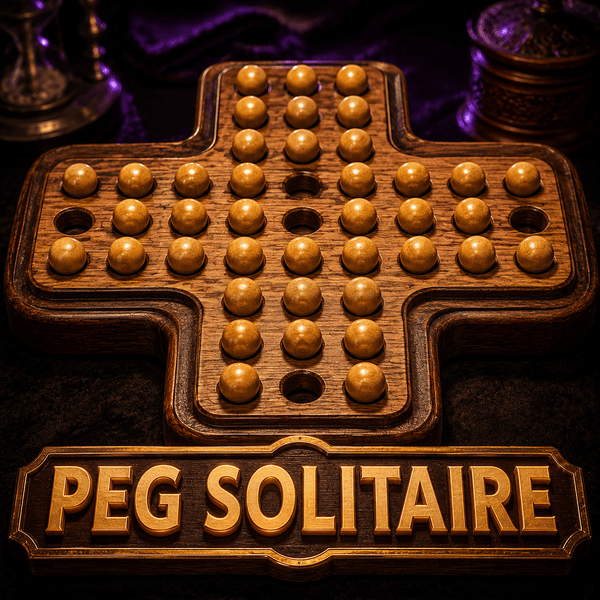
| Components | 7 flat pieces (tans) | 32 pegs, 33 holes |
| Number of puzzles | Thousands of figures | One board, many solution paths |
| Provable facts | Exactly 13 convex figures possible | Solvable to a single centre peg |
| Origin | China, by early 19th c. | France, by 1697 |
Two different kinds of thinking
Tangram is a spatial problem. You are given an outline and must see, inside it, where the two large triangles fit - they cover half the total area, so they constrain everything else. Success feels like recognition: the shape suddenly resolves. Peg solitaire is sequential. Every jump removes a peg and changes what is legal next, so you are planning a chain rather than reading a picture, and a move that looks harmless can strand a peg in a corner twenty moves later.
Which has more replay value?
Tangram, in raw content: any silhouette anyone draws becomes a new puzzle, and published figure collections run into the thousands. Peg solitaire has one board, but it is not thin - reaching the standard goal of a single peg in the centre hole is genuinely hard, and enthusiasts pursue shorter solutions and different finishing holes as separate challenges. Tangram gives you breadth; peg solitaire gives you one problem with depth.
Which is better for children?
Tangram, and it is widely used in primary maths teaching for exactly this reason: it builds spatial reasoning and an intuitive feel for fractions, since every piece is a clean fraction of the whole square. It is also self-checking - a wrong placement simply does not fit. Peg solitaire suits slightly older players, because a bad early jump is not punished until much later, which is a harder lesson in consequences.
Pick Tangram if…
- you think visually and enjoy spatial puzzles
- you want thousands of distinct puzzles
- you want a maths-teaching tool for children
- you prefer short 2-10 minute solves
Pick Peg Solitaire if…
- you prefer step-by-step logical planning
- you like mastering one hard problem deeply
- you enjoy optimising a known solution
- you want a puzzle with a single clear victory condition
FAQ
Which puzzle is harder, tangram or peg solitaire?
Peg solitaire is harder to finish properly. Reaching one peg in the centre requires a long, correct sequence with no way to undo a mistake. Individual tangram figures are usually solved in minutes, though difficulty varies widely between silhouettes.
Do you have to use all the pieces in tangram?
Yes. A valid tangram solution uses all seven tans, laid flat, touching but never overlapping. That constraint is what makes the puzzle hard - and what makes the parallelogram, the only piece you may need to flip, so important.
How many tangram shapes are possible?
Thousands of published figures exist, and Fu Traing Wang and Chuan-Chih Hsiung proved in 1942 that exactly 13 convex shapes can be built from the seven tans. Non-convex figures - animals, people, letters - are effectively unlimited.
Can peg solitaire always be solved?
The standard English 33-hole board with the centre empty can be solved down to a single peg in the centre. Not every starting hole and finishing hole combination works, though - the solvable pairs follow a known parity rule.
Which is older?
Peg solitaire is documented earlier in Europe - a 1697 engraving shows a French noblewoman with the board. Tangram is attested in Chinese sources by the early 19th century and reached Europe around 1817, triggering a genuine puzzle craze.
Are these good games for one player?
Both are true single-player classics with no randomness and no opponent, which is unusual - most traditional games need two. That makes them ideal when you want a quiet mental exercise rather than a contest.

MAIN MENU
PvP Games
 Battleship
 Crazy Eights
 Dots & Boxes Blitz
 Gomoku
 Ludo
Ludo Quoridor
 Snakes & Ladders
 Yahtzee
Free Games
 Alquerque
 Backgammon
 Bagh-Chal
 Balut
Balut Battle for TokyoBattleship
 Bingo
Bingo Brick Breaker
 Bridge
 Bunco
Bunco Checkers
 Chess
Chess ChompCrazy Eights
 Cribbage
 Dara
Dara Derby Dash
 DominoesDots & Boxes Blitz
 Durak
Durak Emberdeep
 Fanorona
 Farkle
 Fox and Geese
 Fox and Hounds
 Generala
 Gin Rummy
 Go / WeiqiGomoku
 Hazard
 Hex
Hex Higher or Lower
 Hnefatafl
 Hounds and Jackals
 Indian Rummy
 Jungle
 Ludus Latrunculorum
 Liar's DiceLudo
 Mahjong Solitaire
 Mancala
 Minesweeper
 Nim
Nim Nine Men's Morris
 Onitama
 Patolli
 Peg Solitaire
 Pentago
 Pente
Pente Pig
Pig PylosQuoridor
 Reversi
 Royal Game of Ur
 Scratch Cards
 Seega
Seega Senet
Senet Shax
Shax Ship, Captain, Crew
 Shut the Box
 Sixteen Soldiers
 SnakeSnakes & Ladders
 Klondike Solitaire
 Space Blaster
 Spades
 Sugar Pop
 Sungka
 Tangram
 Tile Rummy
 Tower
Tower Truco
Truco War
War Word Spy
 XII ScriptaYahtzee
NEED HELP?