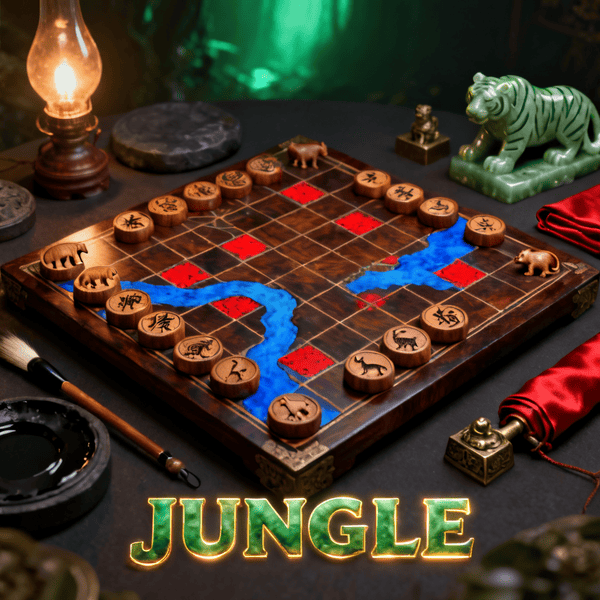
Jungle - Rules, History & Strategy Guide
Jungle, also called Dou Shou Qi or Animal Chess, is a Chinese board game for two players on a 7×9 grid. Each side has eight animals ranked from elephant down to rat, and an animal captures any enemy of equal or lower rank. Two rivers split the board. You win by entering the opponent's den.
Reviewed & updated
History & Origins
Jungle — Dou Shou Qi, the Game of Fighting Animals, sold in English as Animal Chess — is a Chinese two-player board game whose ancestry is genuinely unrecorded. R. C. Bell, sent the game by a Hong Kong correspondent in the 1960s, knew nothing of where it came from, and David Pritchard calls the origins obscure, possibly a development of xiangqi. Treat any site quoting a precise invention date with suspicion.
What is not in doubt is the design. Eight animals ranked elephant down to rat, two rivers only the rat may swim, six trap squares that strip an intruder of all rank, and a den to storm. Parlett notes simply that the game "plays well" — the mark of long refinement, whatever its age.
How to Play
Each side commands eight animals on a 7×9 board. You win by moving any animal into the enemy den, or by capturing every enemy piece.
- Every animal moves one square up, down, left or right — never diagonally, and never into its own den.
- An animal captures an enemy of equal or lower rank: elephant 8, lion 7, tiger 6, leopard 5, wolf 4, dog 3, cat 2, rat 1.
- The rat is the exception that makes the game: it alone kills the elephant, but only with its feet on dry land.
- Only the rat may enter the two rivers. In the water it is untouchable from land — and equally unable to reach land itself.
- The lion and tiger leap a river to the first dry square beyond, capturing what stands there; the lion may also leap sideways. Any rat in the water blocks the jump.
- An animal standing in an enemy trap drops to rank 0 and can be taken by anything. Step off and its rank returns.
Strategy Tips
- Your rat is worth far more than rank 1 suggests: it is your elephant-killer and your river gate. Parked in the water it cancels the enemy lion and tiger leaps on that side.
- Never leave your elephant beside an enemy trap — a cat can take it there.
- Trade down, not across. Every swap that removes a high enemy animal for a low one of yours shortens the road to the den.
- Keep one defender within two squares of your own den; a den is only safe if you can get back faster than they can arrive.
- The lion’s horizontal leap crosses the whole river in one move and is the quickest way to switch flanks.
Variations
Widely played variants shift the balance in small ways: some forbid the elephant from ever taking the rat, some let the leopard leap the river horizontally, some rank the tiger above the lion or make the two equal, and some make all traps universal so an animal is vulnerable even on its own. There is also a stripped-down "animal checkers" with no rivers or traps and only four animals. Arcadia implements the standard ruleset.
Play Jungle on Arcadia
Play Jungle on Arcadia: rank your animals, swim the rat, leap the rivers and storm the den against three levels of AI.
Quick Answers
Why can the rat beat the elephant in Jungle?
It is the deliberate loop in the rank ladder that stops the elephant dominating the board, and many published sets explain it as the rat running into the elephant’s ear. The rat may only do it from a land square, never while swimming, and in the standard rules the elephant can still take the rat in return.
What do the water squares do?
The two rivers are twelve squares in the middle of the board that only the rat may enter or leave. A rat in the water cannot be touched by anything on land, and cannot touch anything on land either. Lions and tigers cross by jumping over the rivers rather than through them.
How do trap squares work?
Three traps surround each den. Either side may walk on any trap, but an animal standing in an enemy trap drops to rank 0, so any enemy piece beside it — even a cat — can capture it. Its normal rank returns the moment it steps off.
How do you win at Jungle?
By moving any one of your animals into the opponent’s den, or by capturing all eight of their pieces. You may never enter your own den, so it cannot be used as a bolt-hole.
Can I play Jungle online for free?
Yes. Arcadia runs Dou Shou Qi free in your browser against three levels of AI, with no download and no account.
What is Dou Shou Qi called in English?
Dou Shou Qi (鬥獸棋) translates roughly as "Game of Fighting Animals", and English-language sets are sold under several names: Jungle, Jungle Chess and Animal Chess. They are all the same game with the same 7×9 board, eight ranked animals per side, two rivers and two dens.
How old is the Jungle board game?
Nobody knows, and the honest answer is that its ancestry is unrecorded. David Parlett notes that R. C. Bell, who catalogued board games worldwide, knew nothing of where it came from, and D. B. Pritchard calls the origins obscure while suggesting it may be a development of xiangqi. Be sceptical of sites that give it a precise invention date.
How many pieces does each player have in Jungle?
Eight, one of each animal: elephant (rank 8), lion (7), tiger (6), leopard (5), wolf (4), dog (3), cat (2) and rat (1). They start in a fixed, point-symmetric array across the three ranks nearest each den, so both sides face an identical position.
Can the elephant capture the rat in Jungle?
In the main ruleset, yes — rank 8 beats rank 1 like any other capture, while the rat can also capture the elephant from a land square. Some published variants remove the elephant's ability to take the rat, making the little piece even stronger, but that is not the standard game and Arcadia does not use it.
What happens when a piece stands in a trap in Jungle?
Three traps guard each den. Either player may move onto any trap freely, but an animal that stands in an opponent's trap has its rank reduced to zero, so any enemy animal — even the cat or the rat — can capture it. The rank is restored the instant the piece steps off the trap.
Can the lion jump sideways over the river in Jungle?
Yes. Both the lion and the tiger leap vertically from one bank to the first dry square beyond the water, but only the lion may also leap horizontally across a river. A rat sitting anywhere in the water being crossed — yours or your opponent's — blocks the jump entirely. Variant rules that let the leopard jump too exist, but are not part of the standard game.
Can a rat be captured while it is in the water?
Not by anything standing on land. A rat in the river is safe from every land piece, and only another rat that is also in the water can capture it. The protection cuts both ways: a swimming rat cannot capture anything on dry land either, elephant included, so it has to climb out first.
Is Jungle a game of luck or skill?
Pure skill. There are no dice and no hidden information — both players see the whole board at all times, exactly as in chess or draughts. Games are decided by rank trades, river control and how quickly you can force a path to the enemy den.
Related Games On Arcadia
Related Guides

MAIN MENU
PvP Games
 Battleship
 Crazy Eights
 Dots & Boxes Blitz
 Gomoku
 Ludo
Ludo Quoridor
 Snakes & Ladders
 Yahtzee
Free Games
 Alquerque
 Backgammon
 Bagh-Chal
 Balut
Balut Battle for TokyoBattleship
 Bingo
Bingo Brick Breaker
 Bridge
 Bunco
Bunco Callbreak
 Checkers
 Chess
Chess ChompCrazy Eights
 Cribbage
 Dara
Dara Derby Dash
 DominoesDots & Boxes Blitz
 Durak
Durak Emberdeep
 Euchre
 Fanorona
 Farkle
 Fox and Geese
 Fox and Hounds
 Generala
 Gin Rummy
 Go / WeiqiGomoku
 Hazard
 Hearts
 Hex
Hex Higher or Lower
 Hnefatafl
 Hounds and Jackals
 Indian RummyJungle
 Ludus Latrunculorum
 Liar's DiceLudo
 Mahjong Solitaire
 Mancala
 Minesweeper
 Nim
Nim Nine Men's Morris
 Onitama
 Patolli
 Peg Solitaire
 Pentago
 Pente
Pente Pig
Pig PylosQuoridor
 Reversi
 Royal Game of Ur
 Scratch Cards
 Seega
Seega Senet
Senet Shax
Shax Ship, Captain, Crew
 Shut the Box
 Sixteen Soldiers
 SnakeSnakes & Ladders
 Klondike Solitaire
 Space Blaster
 Spades
 Sugar Pop
 Sungka
 Tangram
 Tile Rummy
 Tower
Tower Truco
Truco War
War Word Spy
 XII ScriptaYahtzee
NEED HELP?