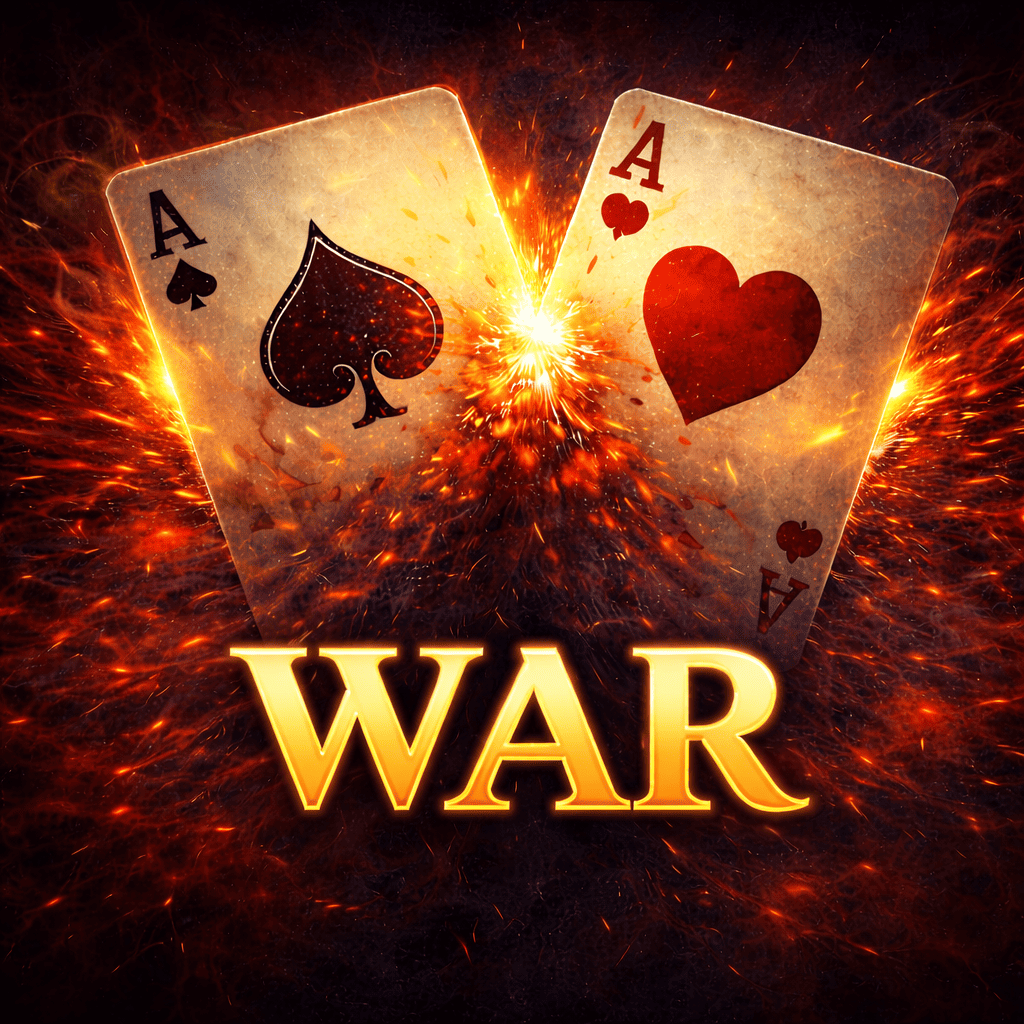
War - Rules, History & Strategy Guide
War is a pure-luck card game for two players. Split a standard 52-card deck evenly, then both players flip their top card at once — the higher rank captures both cards. Tied ranks trigger a “war” with extra cards at stake. Play continues until one player holds the whole deck, usually 10 to 40 minutes.
Reviewed & updated
History & Origins
War has fuzzy historical roots because it belongs to the huge family of simple comparing-card games that have existed in many countries. What made War endure is its extreme accessibility: younger players can join immediately because there is almost no setup burden and almost no hidden information.
That simplicity also made War one of the classic games people learned at home. It became a gateway card game, the kind of ruleset you could explain in thirty seconds and still get a dramatic finish full of swings, ties, and giant pile captures.
How to Play
War is about winning cards by revealing higher ranks than your opponent. Most standard versions use a full deck split evenly between two players.
- Each player flips the top card of their pile at the same time.
- The higher-ranked card wins both cards and places them at the bottom of the winner's pile.
- If the cards tie, a war begins and each player places extra cards down before revealing another deciding card.
- The winner of the war takes the entire contested pile.
- Play continues until one player controls all the cards or the session is ended by agreement.
Strategy Tips
Classic War offers almost no decision-making once the deal is set, so strategy is really about expectations. The fun comes from pacing, volatility, and the emotional swing of big wars.
- Treat War as a fast luck-based game rather than a deep tactical contest.
- Stay aware that long losing streaks can reverse quickly after one large war.
- If you are introducing cards to new players, use War as a stepping stone into more strategic games like Crazy Eights or Spades.
Variations
Popular house rules include three-card war, face-down war, multiplayer war, and timed sessions where the player with more cards after a set period wins. Digital versions often speed up the reveal cycle so the game feels sharper and less repetitive.
Play War on Arcadia
Play War on Arcadia to put these rules and ideas into practice right away.
Quick Answers
Can you use jokers in War?
Most versions do not use jokers, but some house rules treat them as the highest card in the deck.
Is there real strategy in War?
Not in the standard version. Once the cards are dealt, the results come from the order of the deck rather than player choices.
What happens if a player cannot finish a war?
Most house rules say that player loses the war immediately because they do not have enough cards to complete the showdown.
How long does a game of War take?
A typical two-player game runs anywhere from ten minutes to about forty, depending on how the big wars fall. Because captured cards keep cycling back into each player’s pile, the lead can change hands many times before a winner emerges. Many households simply play a timed session and declare whoever holds more cards the winner.
Can a game of War go on forever?
In theory, yes: mathematicians have shown the game can cycle endlessly if players always return captured cards to the bottom of their pile in the same fixed order. Shuffling won cards before reusing them breaks the cycles and makes games finish. That is how almost everyone plays in practice.
How many cards do you put down during a war?
The most common rule places three cards face down before a fourth is flipped face up to decide the war, matching the chant “I de-clare war”. Other tables use one or two face-down cards instead. Whichever count you use, the winner takes every card on the table, which is why wars decide games.
Is the ace the highest card in War?
Yes, aces rank highest in the standard game, followed by king, queen and jack down to the two. Suits are ignored completely, so two cards of equal rank always tie and start a war. On the opening flip of a fresh deal, the chance of a tie is 3 in 51, about 6 per cent.
Can you play War with 3 or 4 players?
Yes. Deal the deck as evenly as possible — 17 cards each with three players, 13 with four — and everyone flips at once, with the highest card taking the lot. If the top cards tie, only the tied players fight the war while the rest sit out. Multiplayer games tend to finish faster because cards concentrate quickly.
What do you do when your draw pile runs out?
Shuffle the cards you have captured and turn them face down as your new draw pile. A player is only out of the game when both their draw pile and their capture pile are empty. This recycling is what allows someone down to a handful of cards to climb all the way back.
Is War a good card game for kids?
It is one of the best first card games because it only asks players to compare numbers — no reading, memory or tactics required. Children around four to six can usually play unassisted, and the drama of a big war keeps them engaged. It also works as a gentle bridge into choice-driven games such as Crazy Eights.
Can you play War online for free?
Yes. Arcadia runs a free browser version of War against a computer opponent, with no download or account needed. The digital deal automates flipping, capturing and reshuffling, so a full game finishes noticeably faster than with physical cards.
Related Games On Arcadia
Related Guides

MAIN MENU
PvP Games
 Battleship
 Crazy Eights
 Dots & Boxes Blitz
 Gomoku
 Ludo
Ludo Quoridor
 Snakes & Ladders
 Yahtzee
Free Games
 Alquerque
 Backgammon
 Bagh-Chal
 Balut
Balut Battle for TokyoBattleship
 Bingo
Bingo Brick Breaker
 Bridge
 Bunco
Bunco Callbreak
 Checkers
 Chess
Chess ChompCrazy Eights
 Cribbage
 Dara
Dara Derby Dash
 DominoesDots & Boxes Blitz
 Durak
Durak Emberdeep
 Euchre
 Fanorona
 Farkle
 Fox and Geese
 Fox and Hounds
 Generala
 Gin Rummy
 Go / WeiqiGomoku
 Hazard
 Hearts
 Hex
Hex Higher or Lower
 Hnefatafl
 Hounds and Jackals
 Indian Rummy
 Jungle
 Ludus Latrunculorum
 Liar's DiceLudo
 Mahjong Solitaire
 Mancala
 Minesweeper
 Nim
Nim Nine Men's Morris
 Onitama
 Patolli
 Peg Solitaire
 Pentago
 Pente
Pente Pig
Pig PylosQuoridor
 Reversi
 Royal Game of Ur
 Scratch Cards
 Seega
Seega Senet
Senet Shax
Shax Ship, Captain, Crew
 Shut the Box
 Sixteen Soldiers
 SnakeSnakes & Ladders
 Klondike Solitaire
 Space Blaster
 Spades
 Sugar Pop
 Sungka
 Tangram
 Tile Rummy
 Tower
Tower TrucoWar
 Word Spy
 XII ScriptaYahtzee
NEED HELP?