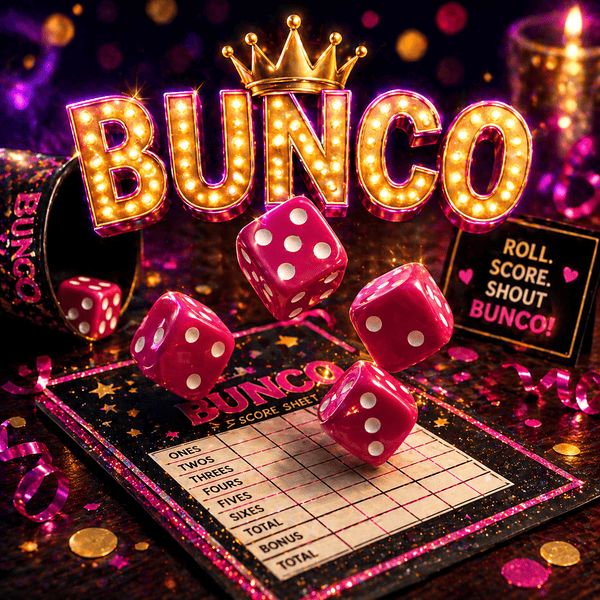
Bunco - Rules, History & Strategy Guide
Bunco is a pure-luck social dice game played over six rounds, traditionally by twelve players at tables of four. Each round has a target number from 1 to 6; you roll three dice, score a point per match, and keep rolling until you blank. A full six-round game takes about ten minutes.
Reviewed & updated
History & Origins
Bunco arrived in America in the mid-19th century, with the modern three-dice version traceable to roughly 1855. It quickly spread through saloons, parlors, and travelling card-and-dice hustles — early gambling crews used the name "bunco" so liberally that "bunco squad" became a real police-department term in San Francisco and other cities for officers tasked with cracking down on confidence games.
The respectable parlor version survived prohibition and shifted from saloon to suburb in the mid-20th century. By the 1980s it had become a staple of women's social clubs across the United States — the iconic "Bunco night" features twelve players spread across four tables of four, rotating partners each round and keeping the conversation flowing while the dice clatter. The World Bunco Association, founded in 1996, today claims that Bunco is played monthly by tens of millions of Americans.
How to Play
Bunco is a fast-paced game of three dice played across six rounds. Each round has a target number (round 1 = 1s, round 2 = 2s, up through round 6 = 6s), and players take turns rolling all three dice — scoring 1 point for each die that matches the target. You keep rolling as long as you score; your turn ends only when you roll three dice and none match.
- Each round starts with a target number, beginning with 1s in round 1 and rotating up to 6s in round 6.
- On your turn, roll all three dice. Each die showing the target number scores 1 point.
- If you scored at least one point, keep rolling — your turn continues until you roll a complete blank (no matches at all).
- Roll all three dice as the target number for a Bunco — instantly worth 21 points and the round. Three of any other matching number is a Mini Bunco worth 5 points.
- First player to reach 21 points wins the round. Most rounds won across the six target numbers wins the game.
Strategy Tips
- There is essentially no strategy — Bunco is pure dice luck. Every roll is independent of the last, you cannot hold dice between rolls, and the rules force you to keep rolling whenever you score. That's the design — it frees players to focus on conversation.
- The probability of rolling a Bunco on any single throw is 1/216 (about 0.46%). The probability of any three-of-a-kind (Bunco or Mini) is 6/216 = 2.78%. Most turns end without a three-of-a-kind, so don't expect them.
- The probability of scoring zero matches on a single roll is (5/6)³ ≈ 57.9%, meaning you have about a 42% chance of scoring at least one point each roll. That's why turns can run surprisingly long when you get hot.
- Track your opponent's progress against the round target — sudden Buncos can flip a round you thought was locked. Don't mentally bank a round-win until it's on the board.
- Embrace the randomness. The reason Bunco has lasted 170 years isn't depth — it's the social cadence of "your turn, my turn" punctuated by the rare-but-electric Bunco shout.
Variations
The traditional party variant is played with twelve players across three tables of four (sometimes four tables of four). Tables play simultaneously, partners rotate after each round based on wins/losses, and the entire group plays through all six target rounds twice or three times depending on the night. Rule variations exist around scoring "Wizards" (when you roll the previous round's number unintentionally), bonus prizes for "Most Buncos" or "Last Bunco of the Night", and travelling-trophy formats. Arcadia's single-player version simulates the social game by pitting you head-to-head against an AI through all six target rounds — same dice, same scoring, faster pace.
Play Bunco on Arcadia
Play Bunco on Arcadia to roll into 170 years of American parlor history — three dice, six target rounds, and the chance to shout BUNCO! when the pips line up.
Quick Answers
How do I score points in Bunco?
Each die showing the round's target number scores 1 point. Three of the target = Bunco (21 points and the round). Three of a kind that isn't the target = Mini Bunco (5 points). Roll all three dice with no matches and your turn ends.
Where does the name "Bunco" come from?
The word "bunco" was 19th-century slang for a confidence trick or swindle, and the original three-dice game in 1855 America was associated with travelling gambling crews. The respectable parlor version inherited the colourful name. Police "bunco squads" cracking down on confidence men in San Francisco and elsewhere kept the term in circulation.
How is Bunco different from Yahtzee or Farkle?
Bunco uses three dice with no holding or rerolling — every throw is fresh. Yahtzee uses five dice with three rolls per turn and a complex scorecard. Farkle uses six dice and a hot/cold push-your-luck banking mechanic. Bunco is the simplest of the three by design, built for socialising rather than tactical depth.
How long does a game of Bunco take?
A full six-round game takes about 5–10 minutes in Arcadia's single-player version. Traditional party Bunco with 12 players plus snacks and conversation typically runs about two hours per night.
Can I play Bunco online for free?
Yes. Arcadia offers free Bunco against an AI opponent — three dice, six rotating-target rounds, instant-win Buncos and Mini Buncos. No download or account required.
How many players do you need for Bunco?
Traditional party Bunco seats twelve players across three tables of four, rotating partners between rounds, though smaller groups simply use fewer tables. You can also play head-to-head: Arcadia’s free browser version pits you against an AI opponent through all six rounds, with no download or account required.
What are the odds of rolling a Bunco?
On any single throw of three dice, the chance that all three show the round’s target number is 1 in 216, about 0.46%. Any three of a kind — Bunco or Mini Bunco — comes up with probability 6 in 216, or 2.78%, so most turns end without one. Expect a genuine Bunco only a handful of times in a long night.
What is the travelling prize in Bunco?
The travelling prize — often a fuzzy die or a small trophy — passes to whichever player rolled the most recent Bunco, and whoever holds it when the night ends keeps that prize. It is one of several traditional side awards, alongside prizes for most Buncos or most round wins, that keep every table invested even when scores are lopsided.
What is a Wizard in Bunco?
A Wizard is a house-rule bonus some groups award for rolling the previous round’s target number. It sits outside the core rules, so groups agree on whether Wizards score, and for how much, before the night begins.
Do you have to score exactly 21 points to win a round of Bunco?
No — the first player to reach 21 or more points takes the round. A rolled Bunco is worth 21 on its own, which is why it wins a round instantly regardless of the scores beforehand.
Is Bunco a gambling game?
Modern Bunco is a social game, not a casino one — there is no betting mechanic in the rules. Many groups run a small prize pot for categories like most wins or most Buncos, but the stakes are token by convention, a world away from the 19th-century swindles that gave the game its name.
How many rounds are in a game of Bunco?
A game is six rounds, one for each target number from 1s up to 6s. Party groups usually play the full set two or three times in a night, rotating seats and partners between rounds, while a single six-round set is a complete game on its own.
Is there any strategy in Bunco?
No meaningful strategy exists — you cannot hold dice, pick targets, or stop while you are scoring, so every turn plays itself. That is deliberate: the format keeps hands busy and minds free, and the rare Bunco shout supplies the drama.
Related Games On Arcadia
Related Guides

MAIN MENU
PvP Games
 Battleship
 Crazy Eights
 Dots & Boxes Blitz
 Gomoku
 Ludo
Ludo Quoridor
 Snakes & Ladders
 Yahtzee
Free Games
 Alquerque
 Backgammon
 Bagh-Chal
 Balut
Balut Battle for TokyoBattleship
 Bingo
Bingo Brick Breaker
 BridgeBunco
 Callbreak
 Checkers
 Chess
Chess ChompCrazy Eights
 Cribbage
 Dara
Dara Derby Dash
 DominoesDots & Boxes Blitz
 Durak
Durak Emberdeep
 Euchre
 Fanorona
 Farkle
 Fox and Geese
 Fox and Hounds
 Generala
 Gin Rummy
 Go / WeiqiGomoku
 Hazard
 Hearts
 Hex
Hex Higher or Lower
 Hnefatafl
 Hounds and Jackals
 Indian Rummy
 Jungle
 Ludus Latrunculorum
 Liar's DiceLudo
 Mahjong Solitaire
 Mancala
 Minesweeper
 Nim
Nim Nine Men's Morris
 Onitama
 Patolli
 Peg Solitaire
 Pentago
 Pente
Pente Pig
Pig PylosQuoridor
 Reversi
 Royal Game of Ur
 Scratch Cards
 Seega
Seega Senet
Senet Shax
Shax Ship, Captain, Crew
 Shut the Box
 Sixteen Soldiers
 SnakeSnakes & Ladders
 Klondike Solitaire
 Space Blaster
 Spades
 Sugar Pop
 Sungka
 Tangram
 Tile Rummy
 Tower
Tower Truco
Truco War
War Word Spy
 XII ScriptaYahtzee
NEED HELP?