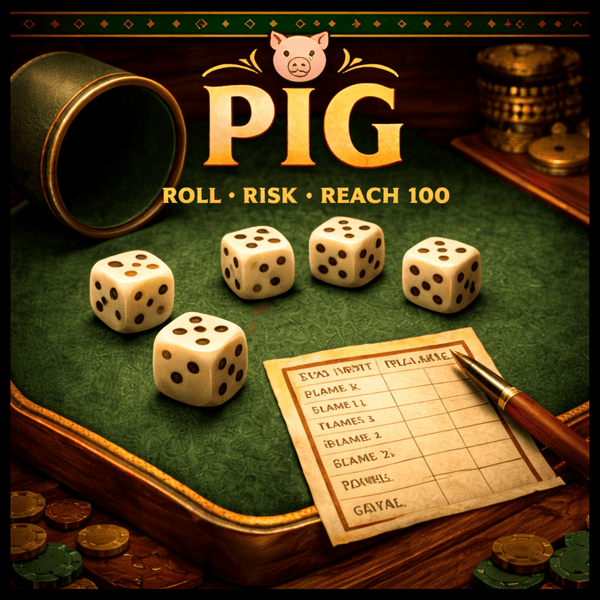
Pig - Rules, History & Strategy Guide
Pig is a push-your-luck dice game for two or more players using a single die. On each turn you roll repeatedly, adding to a turn total you can bank at any time — but rolling a 1 loses it all. First to 100 points wins, usually within 10 minutes.
Reviewed & updated
History & Origins
Pig's exact origin is unclear, but variants have been played for over a century — it's often the first dice game taught to children because the rules fit on a postcard yet the optimal strategy is mathematically rich.
The game has been the subject of academic analysis since the 1970s, with optimal "hold at N" strategies derived for two-player play. Pig is now a staple example in game theory and probability classes.
How to Play
You roll one die repeatedly on your turn, accumulating points — but if you roll a 1, you bust and score zero for that turn.
- On your turn, roll the die and add the value to your turn total.
- After each roll, choose to ROLL again or HOLD.
- If you roll a 1 at any point, your turn ends with zero points added (your saved score is safe).
- If you HOLD, your turn total is added to your saved score and play passes to your opponent.
- First player to reach 100 saved points wins.
Strategy Tips
Pig's optimal strategy is well-studied. The simple "hold at 20" rule is close to mathematically optimal for most positions and is what beginners should learn first.
- Default to holding at a turn total of 20. Each additional roll has a 1/6 chance of wiping it out — at 20 the expected value of rolling drops below the expected value of holding.
- When you're trailing badly, push past 20 — the cost of a bust is small compared to the cost of losing.
- When you're close to 100 (within reach in one turn), keep rolling until you can win on the spot.
- When your opponent is close to winning, take more risk on your turn — a conservative hold won't catch up.
Variations
Two-Dice Pig (also called Big Pig) busts on any 1 from either die, with double-1s being especially punishing. Pass-the-Pigs uses miniature pig figurines instead of dice. The "hold at 25" variant exists but is mathematically inferior to "hold at 20" for typical play.
Play Pig on Arcadia
Play Pig on Arcadia to feel out where greedy meets reckless and test your timing against an AI that knows when to push past 20.
Quick Answers
What is the optimal strategy in Pig?
For two-player play, the simple "hold at 20" rule is near-optimal. You should push past 20 only when you're trailing badly or within reach of 100 in a single turn.
Why does rolling a 1 wipe out the turn?
It's the core risk-reward mechanic that makes Pig interesting. Without bust risk, you'd just roll forever. The 1/6 wipeout chance creates a real tension between greed and safety.
Can I play Pig online for free?
Yes. Arcadia offers free Pig against an AI that uses a near-optimal hold-at-20 strategy with situational adjustments.
Who invented the dice game Pig?
Pig is a folk game with no known inventor; it was first described in print by the magician and gambling expert John Scarne in 1945. Because it spread by word of mouth long before that, countless households play slightly different versions — the single-die, bust-on-1, race-to-100 form is the standard.
How many players can play Pig?
Any number from two upwards — turns simply rotate, which is why Pig works for classrooms and big family tables. It also plays perfectly well heads-up: on Arcadia you can play free in the browser against an AI opponent that pushes its luck with near-optimal judgement.
What are the odds of busting in Pig?
Each roll has a 1-in-6 chance (about 16.7%) of showing a 1 and wiping your turn total. Survival compounds against you: the chance of four safe rolls in a row is (5/6)⁴, or roughly 48%. Meanwhile each safe roll adds 4 points on average — the mean of 2, 3, 4, 5 and 6.
Why is 20 the break-even point in Pig?
Because the maths balances exactly there. One more roll gains an average of 4 points five times out of six — an expected gain of about 3.33 — while risking one sixth of your turn total. At a total of 20 the expected loss is also 20 ÷ 6 ≈ 3.33, so beyond 20 rolling again costs more than it earns.
How long does a game of Pig take?
A two-player race to 100 usually takes 5 to 10 minutes. A hold-at-20 player banks about 8 points per turn once busts are averaged in, so the race settles in roughly a dozen turns each — short enough that best-of-five series are common.
Does going first matter in Pig?
Yes — with both sides playing optimally, computer analysis puts the first player’s winning chances at about 53%. Fair matches usually correct for this by alternating who starts across an even number of games.
Has Pig been solved mathematically?
Yes — in 2004 Todd Neller and Clifton Presser computed the exact optimal policy for two-player Pig using value iteration. The optimal strategy is famously not a flat rule: how far to push depends on both scores, producing a jagged three-dimensional decision surface that only approximates hold-at-20 in the mid-game.
How do you play Pig with two dice?
In Two-Dice Pig you roll both dice each time: if a single 1 appears, the turn total is lost, and in the most common rules a double 1 wipes out your entire banked score. Rolling two dice raises the bust chance per roll to 11 in 36 (about 31%), which makes long pushes far more dangerous.
Related Games On Arcadia
Related Guides

MAIN MENU
PvP Games
 Battleship
 Crazy Eights
 Dots & Boxes Blitz
 Gomoku
 Ludo
Ludo Quoridor
 Snakes & Ladders
 Yahtzee
Free Games
 Alquerque
 Backgammon
 Bagh-Chal
 Balut
Balut Battle for TokyoBattleship
 Bingo
Bingo Brick Breaker
 Bridge
 Bunco
Bunco Checkers
 Chess
Chess ChompCrazy Eights
 Cribbage
 Dara
Dara Derby Dash
 DominoesDots & Boxes Blitz
 Durak
Durak Emberdeep
 Fanorona
 Farkle
 Fox and Geese
 Fox and Hounds
 Generala
 Gin Rummy
 Go / WeiqiGomoku
 Hazard
 Hex
Hex Higher or Lower
 Hnefatafl
 Hounds and Jackals
 Indian Rummy
 Jungle
 Ludus Latrunculorum
 Liar's DiceLudo
 Mahjong Solitaire
 Mancala
 Minesweeper
 Nim
Nim Nine Men's Morris
 Onitama
 Patolli
 Peg Solitaire
 Pentago
 PentePig
 PylosQuoridor
 Reversi
 Royal Game of Ur
 Scratch Cards
 Seega
Seega Senet
Senet Shax
Shax Ship, Captain, Crew
 Shut the Box
 Sixteen Soldiers
 SnakeSnakes & Ladders
 Klondike Solitaire
 Space Blaster
 Spades
 Sugar Pop
 Sungka
 Tangram
 Tile Rummy
 Tower
Tower Truco
Truco War
War Word Spy
 XII ScriptaYahtzee
NEED HELP?