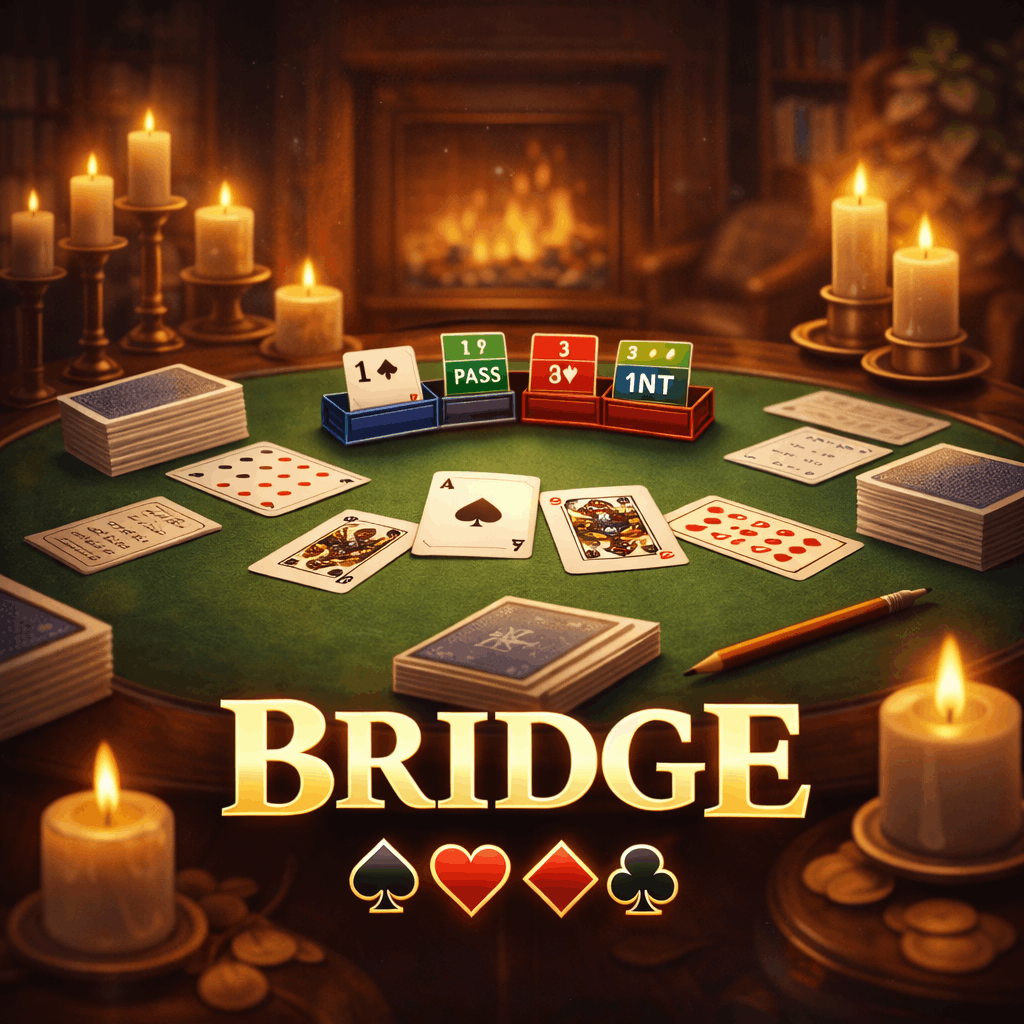
Bridge - Rules, History & Strategy Guide
Bridge is a trick-taking card game for four players in two fixed partnerships, using a standard 52-card deck dealt thirteen to each. An auction sets a contract, then declarer tries to win the promised tricks while the defenders resist. A single deal takes under ten minutes; club sessions run several hours.
Reviewed & updated
History & Origins
Contract Bridge emerged from older trick-taking games such as whist and auction bridge before becoming the global standard in clubs and tournaments. Its mix of bidding language, partnership inference, and technical card play gave it a reputation as the thinking player's card game.
Even though competitive bridge can become highly technical, the core appeal is approachable: you and a partner try to describe your hands in the auction and then convert that information into efficient trick play.
How to Play
Bridge is played by four people in fixed partnerships. The hand begins with a bidding phase that sets the contract and the trump suit, if any.
- Deal thirteen cards to each player.
- Players bid in turn to describe hand strength and suit preference until the contract is set.
- The side that wins the auction becomes declarer and dummy.
- During play, players follow suit if possible while declarer tries to make the contracted number of tricks.
- Defenders work together to beat the contract by forcing losers and controlling tempo.
Strategy Tips
New bridge players improve fastest when they focus on counting. Count winners, count losers, and count distribution before worrying about advanced conventions.
- As declarer, form a plan before touching dummy.
- As defense, lead actively from strength and pay attention to partner's signals.
- Do not overload the auction with conventions before you understand the plain-language meaning of bids.
- Partnership trust matters as much as card technique in long sessions.
Variations
Rubber bridge, duplicate bridge, and online matchpoint formats all reshape incentives. Casual circles may simplify bidding agreements, while tournament groups add system notes and highly structured conventions.
Play Bridge on Arcadia
Play Bridge on Arcadia to put these rules and ideas into practice right away.
Quick Answers
Is Bridge hard to learn?
Bridge has a higher learning curve than most casual card games, but the trick-taking core is manageable if you learn the auction one layer at a time.
What is dummy in Bridge?
Dummy is the declarer's partner. After the opening lead, dummy's hand is placed face up on the table and played by declarer.
Do beginners need conventions right away?
No. Beginners can improve quickly with simple natural bidding before adding more elaborate partnership agreements.
How many players do you need for bridge?
Exactly four, seated as two fixed partnerships with partners facing each other. The full 52-card deck is dealt out, thirteen cards to each player, and every deal is a contest between the two sides rather than four individuals.
How does scoring work in bridge?
Tricks bid and made score 20 points each in clubs and diamonds, 30 in spades and hearts, and 40 for the first no-trump trick then 30 thereafter. Reaching 100 contract points makes "game", which brings large bonuses, while failing a contract hands penalty points to the defenders. Doubling, vulnerability, and slam bonuses layer on top of that skeleton.
Is bridge a game of luck or skill?
A single deal has plenty of card luck, but the duplicate format removes most of it: the same deals are played at every table, and you are scored against the other pairs who held exactly your cards. Over a session, bidding judgement, declarer technique, and defensive signalling dominate the results.
How long does a game of bridge take?
One deal takes roughly seven to eight minutes, which is the pace duplicate events allot per board. A social rubber can be over in half an hour, while a typical club duplicate session of 24 to 27 boards runs around three hours.
What are high card points in bridge?
High card points are the standard way to weigh a hand: ace 4, king 3, queen 2, jack 1, giving 40 points in the whole deck. An average hand holds 10, and most partnerships open the bidding with about 12 or more. Point count is only a first estimate — distribution and fit routinely outrank a point or two either way.
What is a slam in bridge?
A small slam is a contract to win twelve of the thirteen tricks, and a grand slam is a contract to win all thirteen. Both carry large bonuses and correspondingly large risks, which is why partnerships develop special bidding tools just to investigate them.
How many possible bridge hands are there?
There are 635,013,559,600 possible thirteen-card hands — over 635 billion. Full deals are vastly more numerous again, which is why no two sessions ever feel alike and why counting and inference beat memorisation.
Can you play bridge online for free?
Yes. Bridge is free to play on Arcadia in your browser against AI opponents, with no download or account required. Online play is a forgiving way to practise the auction and basic declarer play before sitting down at a club table.

MAIN MENU
PvP Games
 Battleship
 Crazy Eights
 Dots & Boxes Blitz
 Gomoku
 Ludo
Ludo Quoridor
 Snakes & Ladders
 Yahtzee
Free Games
 Alquerque
 Backgammon
 Bagh-Chal
 Balut
Balut Battle for TokyoBattleship
 Bingo
Bingo Brick BreakerBridge
 Bunco
Bunco Callbreak
 Checkers
 Chess
Chess ChompCrazy Eights
 Cribbage
 Dara
Dara Derby Dash
 DominoesDots & Boxes Blitz
 Durak
Durak Emberdeep
 Euchre
 Fanorona
 Farkle
 Fox and Geese
 Fox and Hounds
 Generala
 Gin Rummy
 Go / WeiqiGomoku
 Hazard
 Hearts
 Hex
Hex Higher or Lower
 Hnefatafl
 Hounds and Jackals
 Indian Rummy
 Jungle
 Ludus Latrunculorum
 Liar's DiceLudo
 Mahjong Solitaire
 Mancala
 Minesweeper
 Nim
Nim Nine Men's Morris
 Onitama
 Patolli
 Peg Solitaire
 Pentago
 Pente
Pente Pig
Pig PylosQuoridor
 Reversi
 Royal Game of Ur
 Scratch Cards
 Seega
Seega Senet
Senet Shax
Shax Ship, Captain, Crew
 Shut the Box
 Sixteen Soldiers
 SnakeSnakes & Ladders
 Klondike Solitaire
 Space Blaster
 Spades
 Sugar Pop
 Sungka
 Tangram
 Tile Rummy
 Tower
Tower Truco
Truco War
War Word Spy
 XII ScriptaYahtzee
NEED HELP?