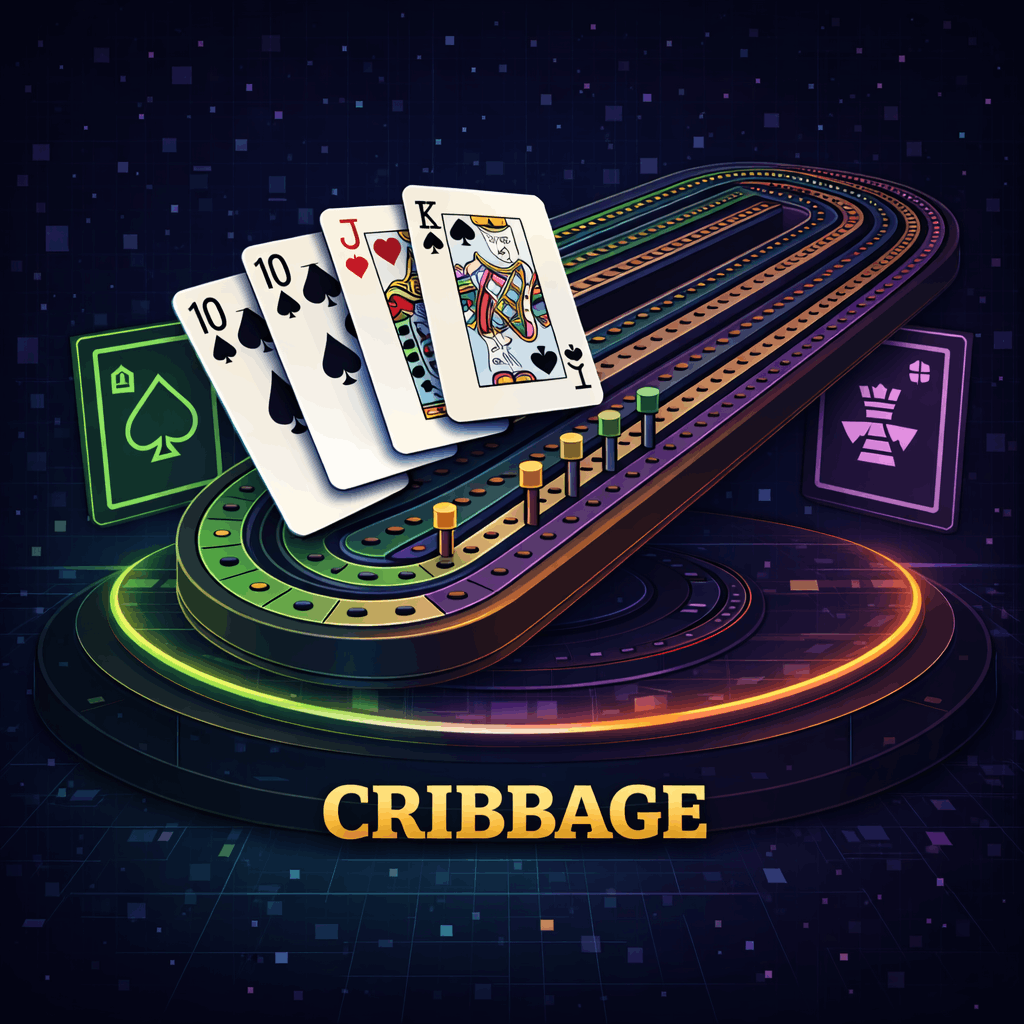
Cribbage - Rules, History & Strategy Guide
Cribbage is a two-player card game of counting and combinations, scored by pegging along a 121-point board. Each hand you discard two cards to the crib, score points during play for fifteens, pairs, and runs, then count your hand. A full game takes roughly 15 to 30 minutes.
Reviewed & updated
History & Origins
Cribbage dates back to seventeenth-century England and is usually credited to Sir John Suckling, who adapted older card games into the pegging-and-hand format people still recognize today. The pegging board became part of the game's identity because it turns every single point into visible progress.
That scoring texture is why cribbage remains beloved. Runs, pairs, fifteens, flushes, and the crib itself all create a dense but elegant point economy.
How to Play
Two-player cribbage is the most common form. Players receive hands, discard to the crib, then score both during play and after the reveal.
- Deal six cards to each player and have both discard two to the dealer's crib.
- Cut the starter card after the discards are set.
- During pegging, players alternate laying cards while scoring for fifteens, pairs, runs, and exact totals.
- After pegging, each hand is scored with the starter card included.
- The dealer also scores the crib, then the next hand begins.
Strategy Tips
Cribbage rewards players who understand not only what their hand scores, but what their discards create for the crib and what totals are likely during pegging.
- Keep flexible combinations that can score in multiple ways instead of chasing one fancy line.
- Respect whose crib it is before discarding connected cards or fives.
- During pegging, think ahead to totals like 15, 21, and 31.
- A small edge every hand matters because cribbage is built from many tiny point swings.
Variations
Three-player, four-player partnership, and short-game cribbage all exist, but the counting principles stay familiar. House rules most often affect board length and a few pegging interpretations.
Play Cribbage on Arcadia
Play Cribbage on Arcadia to put these rules and ideas into practice right away.
Quick Answers
What is the crib in Cribbage?
The crib is a side hand built from the players' discards and scored by the dealer after the regular hands.
Why are fives so important in Cribbage?
Fives combine well with ten-value cards to make fifteens, so they are central to both hand scoring and discard decisions.
Is pegging as important as hand scoring?
Yes. Over many games, strong pegging adds up and often separates experienced cribbage players from casual ones.
What is the highest possible hand in Cribbage?
The best cribbage hand scores 29 points: three fives and the jack of the fourth suit, with the starter card being the five of the same suit as the jack. It is genuinely rare — the odds are about 1 in 216,580 hands.
What does it mean to get skunked in Cribbage?
You are skunked if your opponent pegs out at 121 before you have reached 91 points, which counts as a double loss in match play. Failing even to reach 61 is a double skunk, worth more still under some scoring systems.
What are nobs and heels in Cribbage?
Nobs is holding the jack of the same suit as the starter card, worth one point when you count your hand. Heels — also called nibs — is when the dealer cuts a jack as the starter itself, scoring two points immediately. Both come up often enough that experienced players never forget to claim them.
Why is 19 a famous score in Cribbage?
No combination of four cards plus the starter can score exactly 19, so calling a hand “a nineteen” is the traditional joke for scoring zero. The other impossible hand scores are 25, 26, and 27.
What is muggins in Cribbage?
Muggins is an optional cut-throat rule: if you undercount your own hand, your opponent may call muggins and peg the points you missed. It is standard in many clubs and tournaments, so counting accurately matters as much as playing well.
How many points do you play to in Cribbage?
The standard game is 121 points — twice around a traditional 60-hole board plus one final peg. Shorter games to 61 are common for quick matches. The first player to peg out wins instantly, even in the middle of a count.
Can three or four people play Cribbage?
Yes. Three players each receive five cards and discard one to the crib, while four usually play as two fixed partnerships, also with five cards each. The two-player game remains the classic form and the one used in tournaments.
Can you play Cribbage online for free?
Yes. Arcadia offers free browser Cribbage against an AI opponent, with automatic counting so you can focus on discards and pegging — no download or account required. It is a good way to learn the scoring rhythm before playing on a physical board.
Related Games On Arcadia
Related Guides

MAIN MENU
PvP Games
 Battleship
 Crazy Eights
 Dots & Boxes Blitz
 Gomoku
 Ludo
Ludo Quoridor
 Snakes & Ladders
 Yahtzee
Free Games
 Alquerque
 Backgammon
 Bagh-Chal
 Balut
Balut Battle for TokyoBattleship
 Bingo
Bingo Brick Breaker
 Bridge
 Bunco
Bunco Callbreak
 Checkers
 Chess
Chess ChompCrazy EightsCribbage
 Dara
Dara Derby Dash
 DominoesDots & Boxes Blitz
 Durak
Durak Emberdeep
 Euchre
 Fanorona
 Farkle
 Fox and Geese
 Fox and Hounds
 Generala
 Gin Rummy
 Go / WeiqiGomoku
 Hazard
 Hearts
 Hex
Hex Higher or Lower
 Hnefatafl
 Hounds and Jackals
 Indian Rummy
 Jungle
 Ludus Latrunculorum
 Liar's DiceLudo
 Mahjong Solitaire
 Mancala
 Minesweeper
 Nim
Nim Nine Men's Morris
 Onitama
 Patolli
 Peg Solitaire
 Pentago
 Pente
Pente Pig
Pig PylosQuoridor
 Reversi
 Royal Game of Ur
 Scratch Cards
 Seega
Seega Senet
Senet Shax
Shax Ship, Captain, Crew
 Shut the Box
 Sixteen Soldiers
 SnakeSnakes & Ladders
 Klondike Solitaire
 Space Blaster
 Spades
 Sugar Pop
 Sungka
 Tangram
 Tile Rummy
 Tower
Tower Truco
Truco War
War Word Spy
 XII ScriptaYahtzee
NEED HELP?