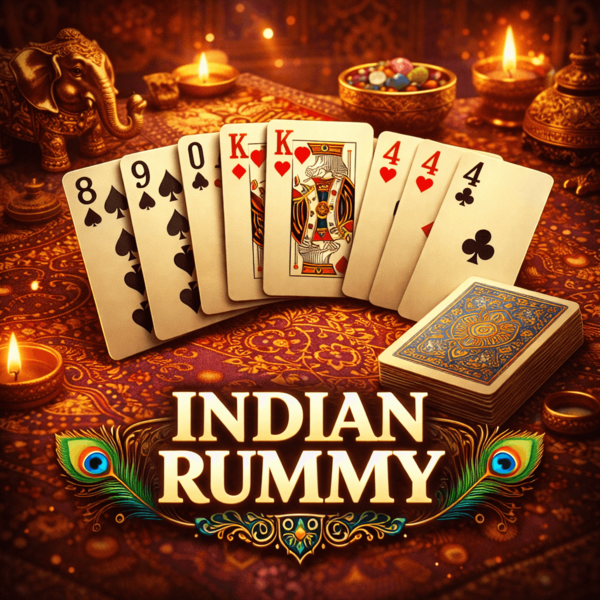
Indian Rummy - Rules, History & Strategy Guide
Indian Rummy is a draw-and-discard card game for two to six players, usually played with 13 cards each from two decks plus jokers. Each turn you draw one card and discard one, racing to arrange your hand into sequences and sets, including one pure sequence. A hand typically takes five to fifteen minutes.
Reviewed & updated
History & Origins
Indian Rummy grew out of broader rummy traditions and became a major favorite across South Asia because it combines familiar card handling with layered tactical decisions. It feels social and analytical at the same time.
Its appeal comes from the hand-building race. Every draw and discard changes not just your own plan, but the information you leak to the table.
How to Play
Players draw and discard while trying to arrange their hand into valid sequences and sets under Indian Rummy rules.
- Receive your opening hand and identify potential pure sequence lines immediately.
- Draw one card each turn from the stock or discard pile.
- Discard one card after re-evaluating your meld structure.
- Complete the required sequence conditions before declaring.
- Show the hand only when the arrangement is legally complete under the table rules.
Strategy Tips
- Build the pure sequence first because it unlocks the whole hand.
- Watch opponents' pickups closely; they reveal suit and rank interest.
- Do not cling to pretty but unrealistic combinations if the table is moving fast.
- High deadwood becomes dangerous late, so cut exposure early when needed.
Variations
Points rummy, pool rummy, and deals rummy change scoring incentives and pacing. Joker use, deck count, and declaration penalties may also vary by platform or table.
Play Indian Rummy on Arcadia
Play Indian Rummy on Arcadia to put these rules and ideas into practice right away.
Quick Answers
What is a pure sequence in Indian Rummy?
A pure sequence is a run made without using a joker. It is usually required for a legal declaration.
Should you always pick from the discard pile in Rummy?
Only when the card materially improves your structure, because visible pickups give useful information to opponents.
Why are discards so important in Indian Rummy?
Every discard changes your hand and broadcasts information, so clean discard discipline is one of the biggest skill edges in the game.
How many cards are dealt in Indian Rummy?
Each player receives 13 cards, which is why the game is often called 13-card rummy. Games with three or more players normally use two standard 52-card decks shuffled together with printed jokers, so the stock does not run dry.
What is the difference between Indian Rummy and Gin Rummy?
Indian Rummy deals 13 cards and requires at least two sequences, one of them pure, before you can declare. Gin Rummy deals 10 cards, uses no jokers, and lets a player knock while still holding a little unmelded deadwood. The two share the draw-and-discard core but reward quite different hand plans.
How do jokers work in Indian Rummy?
Two kinds of joker are in play: the printed jokers from the decks, plus a wild joker chosen at random at the start of each deal — every card of that rank becomes wild. Jokers substitute for any card in a set or an impure sequence, but they cannot form the pure sequence your declaration requires.
What do you need for a valid declaration in Indian Rummy?
All 13 cards must be arranged into sequences and sets, including at least two sequences, one of which must be pure — built without jokers. An invalid show draws the maximum penalty on most tables, so double-check the arrangement before declaring.
Is Indian Rummy a game of skill or luck?
Indian courts have treated rummy as a game of skill since 1968, when the Supreme Court of India ruled that it is “mainly and preponderantly” skill-based. The deal is random, but hand reading, discard discipline, and knowing when to fold a bad hand dominate results over any run of games.
How are points counted in Indian Rummy?
Number cards count their face value, while aces, kings, queens, and jacks count 10 points each. A losing player scores the total of their unmelded cards, commonly capped at 80 points, and in points rummy that total converts directly into the winner’s gain.
How long does a game of Indian Rummy take?
A single points-rummy hand usually takes five to fifteen minutes. Pool and deals formats run longer because they play many hands towards a target: pool games continue until players cross 101 or 201 points, while deals rummy plays a fixed number of deals.
Can you play Indian Rummy online for free?
Yes. Arcadia offers free Indian Rummy in your browser against AI opponents, with no download or account required. Free play is the sensible way to drill pure-sequence priorities and discard discipline before joining competitive tables.
Related Games On Arcadia
Related Guides

MAIN MENU
PvP Games
 Battleship
 Crazy Eights
 Dots & Boxes Blitz
 Gomoku
 Ludo
Ludo Quoridor
 Snakes & Ladders
 Yahtzee
Free Games
 Alquerque
 Backgammon
 Bagh-Chal
 Balut
Balut Battle for TokyoBattleship
 Bingo
Bingo Brick Breaker
 Bridge
 Bunco
Bunco Callbreak
 Checkers
 Chess
Chess ChompCrazy Eights
 Cribbage
 Dara
Dara Derby Dash
 DominoesDots & Boxes Blitz
 Durak
Durak Emberdeep
 Euchre
 Fanorona
 Farkle
 Fox and Geese
 Fox and Hounds
 Generala
 Gin Rummy
 Go / WeiqiGomoku
 Hazard
 Hearts
 Hex
Hex Higher or Lower
 Hnefatafl
 Hounds and JackalsIndian Rummy
 Jungle
 Ludus Latrunculorum
 Liar's DiceLudo
 Mahjong Solitaire
 Mancala
 Minesweeper
 Nim
Nim Nine Men's Morris
 Onitama
 Patolli
 Peg Solitaire
 Pentago
 Pente
Pente Pig
Pig PylosQuoridor
 Reversi
 Royal Game of Ur
 Scratch Cards
 Seega
Seega Senet
Senet Shax
Shax Ship, Captain, Crew
 Shut the Box
 Sixteen Soldiers
 SnakeSnakes & Ladders
 Klondike Solitaire
 Space Blaster
 Spades
 Sugar Pop
 Sungka
 Tangram
 Tile Rummy
 Tower
Tower Truco
Truco War
War Word Spy
 XII ScriptaYahtzee
NEED HELP?